
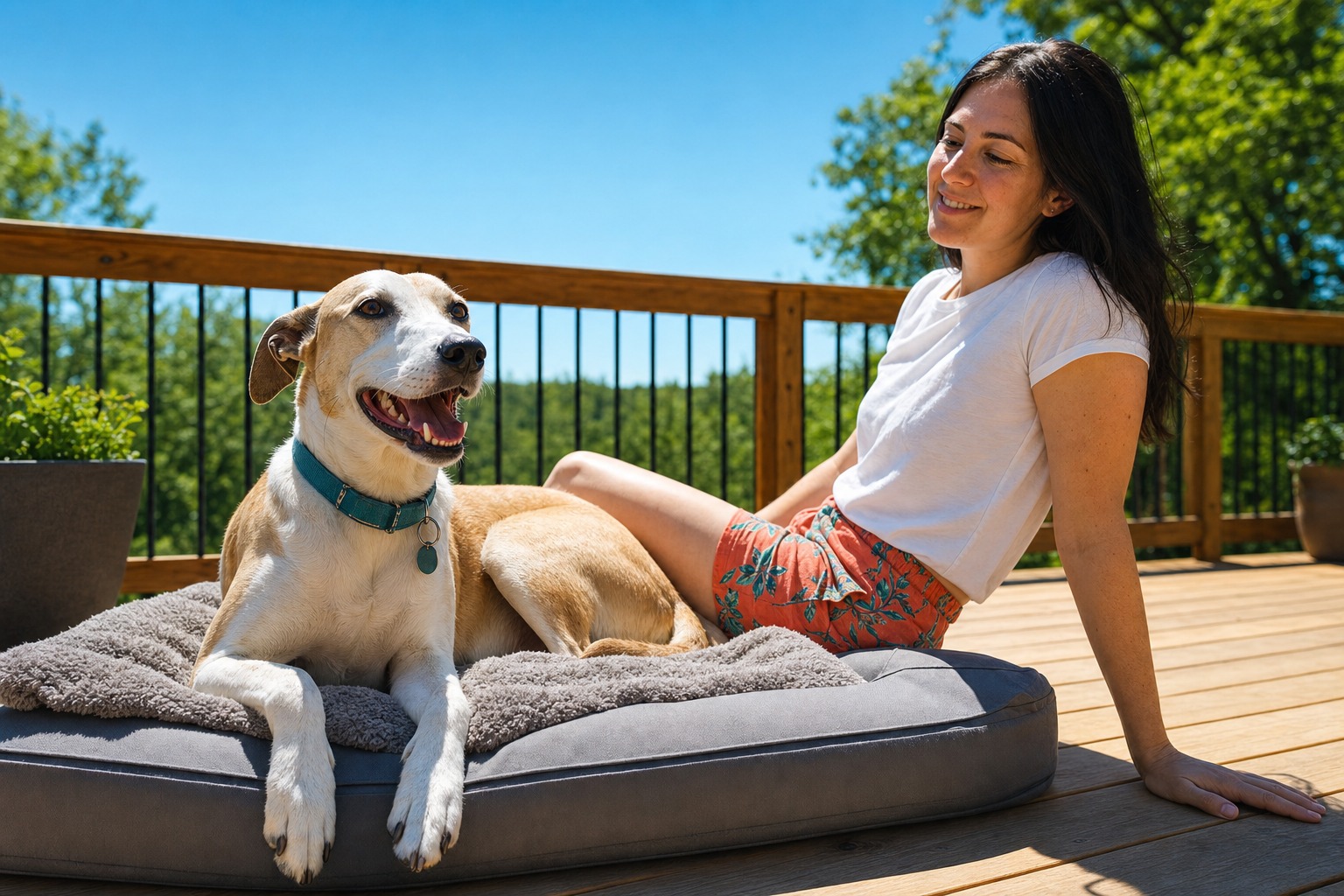
Your dog spends at least half of every day in bed, and far from being laziness, that downtime is when real physical and mental recovery happens. That single fact reframes the whole purchase: a dog bed is not décor, it is the surface your dog’s joints, spine, and nervous system rest on for twelve-plus hours a day. Get it right and you are doing quiet, daily good for their health. Get it wrong and you are buying the thing your dog ignores in favor of the cold kitchen floor.
The problem with most “best dog beds” lists is that they hand you twenty products and leave the hard part, deciding which one is actually right for your dog, entirely to you. So this is built differently. It is a decision sequence: answer five questions in order, size, type, materials, health needs, and your home and habits, and the field narrows itself. At each fork, there is a standout bed worth knowing about. Work top to bottom and you will end up with the right bed, not just a popular one.
One foundational point before the decisions, because it changes how much a bed is worth: a bed is also a training tool. As certified trainer Leila Torres puts it:
“A bed your dog genuinely loves becomes a ‘place’ cue you can use everywhere, when guests arrive, when you’re on a call, during dinner. Reinforce it as a safe, rewarding spot and you’ve turned a cushion into one of the most useful management tools you own.”
That is why fit and comfort matter beyond the nap: a bed your dog actively chooses is worth far more than a cheaper one they tolerate.
Decision 1: Size (get this wrong and nothing else matters)
Start here because if the bed doesn’t fit, no feature saves it. Counterintuitively, too big is also a mistake; a cavernous bed can feel less secure than one that is just roomy enough. Measure your dog nose-to-tail and add six to twelve inches, then factor in how they sleep: stretched-out flat-sleepers need more length than tight curlers. Manufacturer breed and weight charts are a fine starting point, but trust your tape measure over the label.
Best for large and giant dogs: An orthopedic bolster bed offered in a true extra-large size. The bolster cradles the head, the lowered front entry is gentle on stiff knees, and a waterproof, washable inner liner handles the realities of a big dog. The right pick for Danes, Leonbergers, and other genuine giants who need both support and square footage.
Best for puppies and tiny dogs: A scratch-proof, waterproof marine-grade bed stuffed with plush pillows, fitting dogs under about 30 pounds. Durable enough for puppy chaos, soft enough to actually sleep in, and stylish enough that you won’t mind it in the living room.
Decision 2: Bed type (matched to how and where your dog sleeps)
Next, the form. Orthopedic beds relieve joint pressure and are the default for seniors and dogs with conditions like hip dysplasia. Elevated beds also offload joints and sleep cooler. Where the bed lives matters too: an adventure dog may need a travel or outdoor design more than a plush floor cushion.
Best orthopedic bed: Big Barker, a brand whose founder started it after his seven-year-old dog was told it might need hip surgery; he tried a supportive bed first. The memory-foam top and bottom pads mold to the dog while a high-density core keeps joints from ever bottoming out on the floor, backed by a 10-year guarantee against sagging. (That founder backstory is the brand’s real origin, not marketing gloss.)
Best elevated bed: Kuranda, essentially chew-proof, with vinyl-coated fabric stretched taut in a metal frame. The raised design relieves joint pressure, and because there’s no stuffing to trap dirt or allergens, it stays odor-free and wipes clean, a strong allergy pick.
Best travel bed: The Sleepypod, a crash-tested car seat, carrier, and bed in one. As trainer Jordan Ellis notes:
“For car travel it’s my default, because it’s actually passed independent crash testing through the Center for Pet Safety, not just marketed as safe. That third-party verification is the part most travel products can’t claim.”
Removable plush bedding, padded adjustable straps, non-abrasive mesh, and a water-repellent lining round it out.
Best outdoor bed: A waterproof, UV-resistant bed with grommets to anchor it for windy days or boat rides, built from camping-grade performance fabric and filled with PlanetFill, made from 100 percent post-consumer recycled bottles. Through P.L.A.Y.’s Warm Bellies Initiative with the Petfinder Foundation, each purchase donates a bed to a shelter dog.
Decision 3: Materials (comfort, cleanability, and footprint)
Now the build. Memory foam molds to your dog and eases stiffness much like a dedicated orthopedic bed. Recycled and sustainable fills shrink the carbon paw print, and a removable, washable, replaceable cover both extends a bed’s life and makes it more sustainable than a sealed one.
Best memory foam: The Casper Dog Bed, soft-yet-supportive foam in three neutral, interior-friendly colors with a machine-washable, dryer-safe removable cover, the rare bed that disappears into a styled room.
Best washable: UnHide’s “faux chinchilla,” a densely packed, genuinely plush 100 percent recycled polyester with raised head-rest sides to burrow into. The cover is removable, machine washable, and dryer safe; three sizes, three colors.
Best sustainable: The Foggy Dog’s beds, made from 100 percent recycled-bottle fiber with a removable Sustainafill insert (so you can swap in your dog’s favorite cushions), an anti-rip cotton cover, and a food donation to rescue shelters with every purchase.
Decision 4: Health needs (where the bed earns its keep)
If your dog has a specific condition, let it drive the choice. Anxious dogs do better in calming beds with high, enveloping edges. Hot-running dogs, including flat-faced breeds, overweight dogs, seniors, and puppies, benefit from cooling beds. Allergy-prone dogs (and people) benefit from hypoallergenic materials.
Best cooling bed: The Coldest dog bed, with an anti-heat-dispersion layer, a cooling-gel-embedded removable cover, and breathable memory foam.
Best calming bed for anxiety: A plush donut bed with a self-warming insulation layer designed to soothe anxious and newly adopted dogs, and yes, machine washable. For a step up, Modernbeast’s MD Pod is among the softest surfaces a dog can lie on, with a form-fitting core that doubles as a safe space to ease separation anxiety; its inner fabric is 100 percent recycled high-loft fiber.
Best joint-relief bed: A human-grade memory-foam core under a faux-fur cover, with a water-resistant inner lining, an anti-slip rubber base so your dog doesn’t slide mid dream-sprint, and a giant size option.
Best hypoallergenic bed: A velvety bolster bed with hypoallergenic memory-spring fill in six sizes for small and senior floppers. For corner-curlers, Jax & Bones’s sofa-shaped Bumble Terra Lounge uses eco-friendly, hypoallergenic fill. Founder Tina Nguyen started the brand in 2004 because she couldn’t find products for her dog Jax that were both safe and stylish, a brand fact worth keeping in view when you weigh the price.
Decision 5: Your dog’s habits and your home
Last, the practical realities. Chewers and diggers need genuine durability for the sake of their comfort and your wallet; design devotees may want swappable covers.
Best for chewers: Orvis’s “guaranteed” indestructible bed, with no visible zippers or seams to trigger chewing, two nylon layers plus a bonded rip-resistant micro-velvet top, and a non-flattening ComfortFill-Eco cushion underneath.
Best for diggers: A rip-stop ballistic-cover bed built to shrug off scratching and digging, also fur-, dirt-, stain-, and odor-resistant, with a free replacement if your dog damages it within 120 days.
Best with removable covers: Molly Mutt, 100 percent cotton canvas, free of toxic chemicals, easy to wash, with 35 interchangeable covers from quiet neutrals to bold florals.
Best non-slip: A Saatva bed with a flatten-resistant coil design, dander-reducing cooling fibers, a stain-repellent removable cover, and a non-slip base, safer for seniors and dogs with mobility issues.
Best budget: A soft, snug, machine-washable bed with an understated look that blends into any room, proof that comfort doesn’t require a splurge.
The short version
Answer the five questions in order, fit, form, fill, health, habits, and the right bed reveals itself. Because your dog will log thousands of hours on whatever you choose, spend the most on the decision that affects their body the most (support and size for a big or aging dog), and let aesthetics be the final tiebreaker, never the starting point.
References
- Adams, G.J., & Johnson, K.G. “Sleep, work, and the effects of sleep deprivation in dogs.” Applied Animal Behaviour Science. https://www.sciencedirect.com/science/article/abs/pii/0168159194900566
- “Canine Hip Dysplasia.” American College of Veterinary Surgeons. https://www.acvs.org/small-animal/canine-hip-dysplasia
- Center for Pet Safety. Crash-test certification program. https://www.centerforpetsafety.org/
- Patel, S.I., et al. “The Effect of Dogs on Human Sleep in the Home Sleep Environment.” Mayo Clinic Proceedings, 2017. https://www.mayoclinicproceedings.org/article/S0025-6196(17)30519-0/fulltext