


Your Dog Isn't Bad at Kids. The Bus Stop Is Just Built to Scare Them
Back-to-school season floods the sidewalk with the most unpredictable creatures a nervous dog will meet all year. A trainer and a veterinary behaviorist explain how to manage the season, not just the dog.

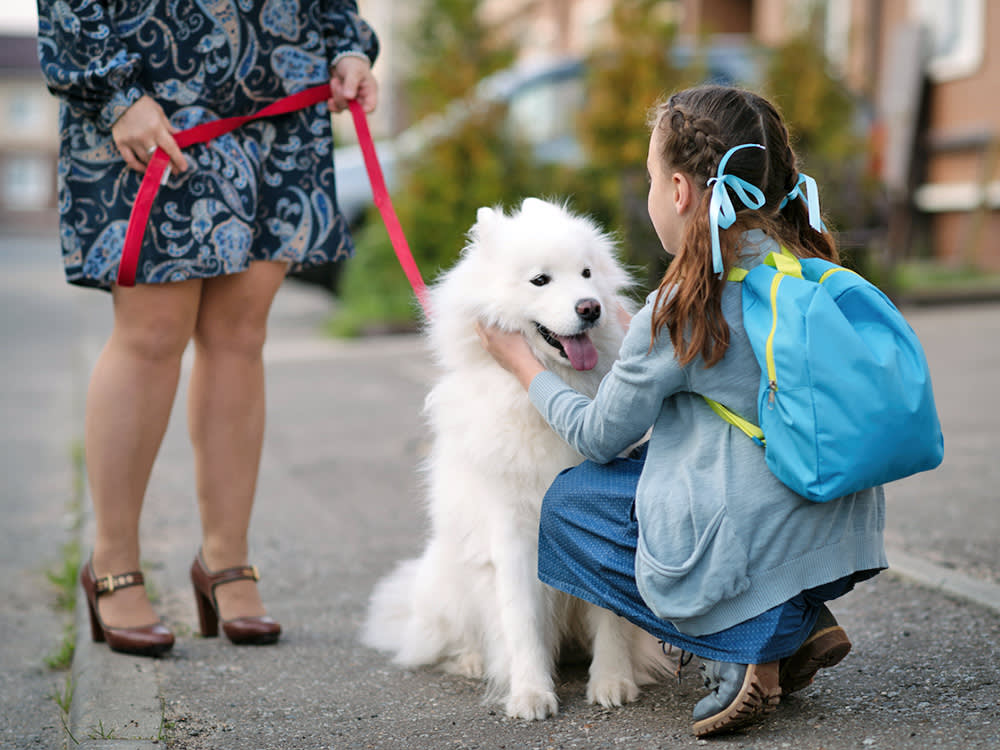
Your dog is probably not afraid of children in the abstract. Bring a calm kid into your living room and many anxious dogs are fine. What undoes them is the specific scene that arrives every fall: a sidewalk suddenly full of small, fast, loud, unpredictable humans, several of them at once, none of them reading your dog’s signals. Back-to-school season does not test your dog’s character. It tests the one situation dogs are least equipped to handle.
That reframing matters because it points to the fix. Most advice treats this as a training problem, as if the right drill will make your dog love the bus stop. The more honest approach, the one professionals reach for first, is to manage the season as much as you train the dog: change what your dog is exposed to, coach the children who approach, and only then do the slow confidence work. We talked with trainers and a veterinary behaviorist and built this guide around that order, starting with the cheapest, fastest wins and ending with the long game.
People come to me wanting to ‘fix’ the dog by October, and I gently flip it around. Most of what helps a scared dog through back-to-school season isn’t a command you teach. It’s a route you change and a kid you coach. Treat your dog as a feeling animal with a hard week ahead, not a machine that should obey through fear.
First, manage the season (the part you can do today)
Before any training, change the math of how often your dog has to be scared. Every frightening encounter rehearses the fear and makes the next one worse, so reducing exposure is not avoidance, it is treatment.
Walk the schedule, not just the route. Drop-off and pickup windows, roughly the half hour around the first and last bell, are the danger zones. Shift your walks earlier, later, or to a different block entirely. If your usual loop passes a school, bus stop, or playground, find a quieter one for the season.
Carry an exit plan. When you spot a cluster of kids ahead, cross the street or turn before your dog locks on. The goal is to put distance between your dog and the trigger before the stress response fires, not after.
These two moves alone resolve most of the daily friction. They cost nothing and work immediately, which is why they come first.
Learn the signals your dog is already sending
We have all heard that a tucked tail means an unhappy dog, but canine body language is layered, and some dogs wag while terrified. The skill is reading the whole body, and catching the quiet signals before they escalate.
The earliest tells are easy to miss: lip-licking, yawning out of context, turning the head away, a hard stare with the whites of the eyes showing (often called “whale eye”), and suddenly refusing a treat they would normally inhale. On leash near children, where the dog cannot create its own distance, the signals climb: the tail drops and tucks, the ears pin back, the lips go tight and closed, the dog pants when it is not hot, the body stiffens, and they crouch or scan.
“Watch your dog when they’re genuinely relaxed at home, the loose mouth, the soft eyes, the easy tail,” says Sasha Ford, a certified trainer. “That’s your baseline. Stress shows up as everything that baseline isn’t, and it shows up early. Sweaty paw prints on the sidewalk, flexed toes, a stiff tail held oddly, those are your dog asking for help before they ever growl.”
The obvious warnings, straining to get away, whimpering, barking, a growl, a snap, arrive last of all. A dog that growls is not “bad”; it is using its loudest word after the quiet ones went unanswered. Punishing it teaches the dog to skip the warning next time, which is exactly the opposite of what you want.
Coach the kids, not just the dog
Here is the lever most owners never pull: the children are half of every interaction, and they are the half you can actually instruct in the moment. A scared dog plus a child who knows how to approach is a manageable situation. The same dog plus a child who lunges to hug is a bite report.
When a child wants to greet your dog and your dog is willing, run the interaction yourself. Have the child stop five to ten feet away and let your dog choose to walk over, rather than the child advancing. Teach the over-the-head hover to disappear: hands stay low, an open palm offered below chin level, never a pat coming down from above, which dogs read as threatening. And give yourself permission to say no. “He’s working on being brave, you can wave instead of petting” is a complete sentence, and most kids accept it cheerfully.
Set puppies up before fear ever forms
If you are raising a puppy, the single best investment is positive, well-managed exposure to children and crowds during the developmental window, so the bus stop never becomes scary in the first place.
The prime socialization period runs from about three to 14 weeks, and may extend to 16 weeks, per the American Veterinary Medical Association. The catch is that puppies are not fully vaccinated until around 20 weeks, so you expose carefully and at a distance.
“Carry your puppy to the bus stop,” says Sasha Ford. “Let them sit in your arms and just watch the chaos from a safe bubble while you feed great treats. They bank the sight and sound of kids, backpacks, buses, skateboards, all of it, without ever touching the ground or another dog.”
Start tiny: five to ten minutes at a comfortable distance from a busy playground, with high-value treats and maybe a chew, rewarding the puppy simply for watching calmly. Let the puppy move away if it wants to; that choice is part of feeling safe. Over several sessions you can move closer, or let the puppy greet one calm child, keeping every session short and positive.
The thing to avoid is “flooding,” dropping a dog into the scary scene to force it to cope. Being fine with one familiar kid at home does not mean being fine with five strangers sprinting up at a bus stop. Flooding usually deepens fear instead of curing it.
Rule out pain before you assume it’s behavioral
If your dog’s fear of children appears suddenly, or an existing fear sharply worsens, see your vet for a full workup before you commit to a training plan. A dog in pain has a shorter fuse, and kids, with their grabbing and noise, are exactly the trigger that exposes it.
I’ve seen dogs labeled ‘suddenly aggressive with kids’ who turned out to have a sore hip or dental pain. Treat the body and the behavior often softens on its own. It is unfair to start desensitization on a dog who is hurting.
The long game: desensitization, at the dog’s pace
Should you and a trainer conclude that training is worth pursuing, keep it slow and reward-based. Be honest about the ceiling first, though.
When someone asks, ‘Can you train my dog to handle crowds of kids?’ my real answer is ‘Maybe, but should you?’ Some dogs are wired to find that overwhelming for life. Forcing it isn’t kindness.
When training does fit, systematic desensitization pairs gradual exposure with rewards so the dog slowly grows comfortable around the trigger, whether that means walking a little closer to a crowd or tolerating louder, rowdier, or more numerous children. A pro reads your dog’s body language and builds the positive associations.
A typical progression: begin near a single calm child who is absorbed in something else, kept at a safe distance, then gradually increase the activity, the number of kids, or the closeness as your dog stays relaxed. Keep sessions short, often 15 to 20 minutes of high-stress work a day at most, sometimes less, and build in decompression time. Some dogs need a day or two off between sessions to reset.
Let your dog’s feelings set the tempo. Standing beside a barking dog on leash feels awkward, but resist shutting the dog down; the barking is information, and forcing the dog through fear can seed real aggression later.
A toolkit for the unavoidable run-in
Even with good management, you will occasionally turn a corner into a knot of kids. For those moments, give your dog a job that beats staring at the threat.
Nose-targeting teaches the dog to boop your open palm with their nose on cue, a quick way to swing their focus to you. Pattern games work the same way; the One-Two-Three game, where your dog learns that every time you say “three” a treat appears, gives an anxious dog a predictable rhythm to lean on when the world gets loud. Small treats, delivered fast, are the difference between a redirect and a meltdown.
If you worry your dog might bite, train them to wear a well-fitted basket muzzle comfortably and positively. Beyond preventing injury, a muzzle is a visible signal to kids and parents that this dog would rather not be touched. The Muzzle Up! Project has good fitting and training resources.
If the worst happens
No one wants to picture their dog biting a child. Good management prevents the vast majority of incidents, but accidents happen, so prepare before the season: look up your local dog-bite laws now and keep vaccinations current.
If a bite occurs, do not get angry; the damage is done and anger only escalates things. Get your dog out of the situation as fast as is safe, with one critical caveat: never pull your dog away while they still have an active grip, which can tear the wound far worse. Wait for the jaw to release, then create distance. Scatter treats on the ground a safe way off to calm and redirect your dog, and if that fails, break the line of sight by stepping behind a car, a bin, or into a driveway.
If no other adult is present, stay near the child at a safe distance until a caregiver arrives; if you are alone, you may need to tether your dog away from the injured person first. Hand over your contact information.
Don’t hide, and don’t argue. Be open with the family, take responsibility, and offer to cover the bills. Nothing good has ever come from a dog owner trying to dodge that conversation.
Above all, remember that every household teaches kids about dogs differently, and some teach nothing at all. You cannot count on a child knowing better, which makes the boundaries, and the work that keeps everyone safe, your job.
References
Common questions
What body language shows a dog is scared of children?
Read the whole body, not just the tail, since some dogs wag when frightened. Early, easy-to-miss signs include lip-licking, yawning, turning the head away, a hard or 'whale eye' stare showing the whites, and refusing treats they normally love. Escalating signs include a tucked tail, pinned ears, tight closed lips, panting when it isn't warm, a stiff body, crouching low, and scanning. Overt warnings are pulling to flee, whining, barking, growling, or snapping. The subtle cues come first, so learn what your dog looks like relaxed at home.
When should you socialize a puppy with kids and crowds?
The prime socialization window runs from about three to 14 weeks, possibly stretching to 16. Because puppies aren't fully vaccinated until around 20 weeks, do this carefully and at a distance, even carrying the puppy so it can watch a bus stop from your arms without contacting pathogens. Every exposure should stay positive and end before the puppy is overwhelmed.
Can you train an adult dog to be comfortable around children?
Sometimes, but the better question is whether you should. Some dogs will never be at ease in a crowd of kids, and for them, staying home is the kinder choice. When training fits, use systematic desensitization and reward-based work with a professional, at the dog's pace. Management, such as changing routes and avoiding pickup hours, often does more for daily life than training alone.
What should you do if your dog bites a child?
Stay calm; anger makes it worse. Remove your dog as soon as it is safe, but never pull while the dog still has an active grip, which can deepen the wound. Wait for the jaw to release, create distance, and stay with the child until a caregiver arrives. Share your contact information, take responsibility, and offer to cover medical bills. Know your local dog-bite laws and keep vaccinations current before the season starts.
Dr. Kohl is a board-certified veterinary dentist with a particular interest in preventive oral care. She reviews all dental health content at The Pet Times and contributes practical guides on home dental routines, professional cleaning, and oral disease prevention.
Meet our experts ↗Keep reading
 TrainingYour Shy Dog Isn't Antisocial. You're Fighting Two Hidden Deadlines.Dr. Mara Chen · 9 min
 TrainingYou Can't 'Cry It Out' a Dog. The Baby Advice Falls Apart Here.Dr. Lena Park · 5 min
 TrainingSome Dogs Hate Walks. Dragging Them Only Makes It Worse.Dr. Ravi Mehta · 8 min
 TrainingYour Dog Doesn't Miss You. He Can't Predict You.Dr. Ravi Mehta · 7 min
 TrainingYou Didn't Train Your Dog Wrong. They're Just Wired This Way.Jordan Ellis · 6 min
 TrainingYour Dog Isn't Aggressive at the Door. He's Scared, and the Door Makes It Worse.Dr. Mara Chen · 4 min