


Buy the Crate for the Dog You Have: 8 Picks by Behavior, Not Looks
An escape artist, a chewer, an anxious traveler, and a chill homebody need four different crates. Here is how to size a crate correctly and which of eight tested picks matches your actual dog.

Affiliate disclosure. This article contains affiliate links. We may earn a small commission if you buy through a link, at no extra cost to you. How we handle recommendations.

A crate is not furniture, and choosing one by which model looks best in your living room is how dogs get hurt or learn to hate the thing entirely. The crate that calms an anxious rescue is the wrong crate for a Houdini who picks latches, and the one that survives a determined chewer is overkill for a small dog who just wants a quiet den. So before any product names, answer one question: what kind of dog are you actually crating?
This guide sorts eight tested crates by the behavior they solve, with a sizing method first, because the most common crate mistake has nothing to do with brand.
Get the size right before anything else
Most crate problems are sizing problems in disguise. Too small and the dog cannot stand or turn, so it resists going in. Too large and, counterintuitively, housetraining stalls, because a dog will happily soil one end of a roomy crate and sleep at the other.
The measurements are simple. For length, measure from your dog’s nose to the base of the tail and add about 4 inches. For height, measure from the floor to the top of the head while the dog is sitting and add 2 to 4 inches. The dog should be able to walk in, turn around, and lie down fully stretched, and nothing more.
For a puppy, do not buy small and re-buy later. Buy the projected adult size and use a divider panel to shrink the usable space to just-big-enough, then move the divider out as the puppy grows. That keeps the crate housetraining-friendly the whole way up.
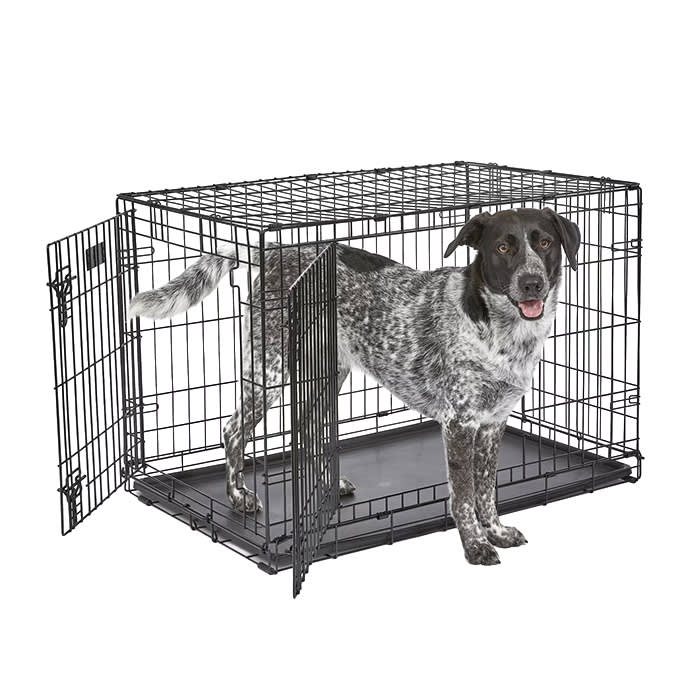
the everyday den
For a dog who settles easily and just needs a cozy, well-ventilated spot, a classic wire crate is all you need, and it is the option vets, shelters, and trainers reach for most. The MidWest iCrate folds flat, wipes clean, and costs a fraction of the designer crates. Add a fitted cover if your dog prefers a darker, den-like feel; the enclosed darkness genuinely helps many dogs settle. The honest caveat: a few owners report rough wire edges, so inspect a new unit and file down any burrs.
For households that rearrange often, the dual-door version, the MidWest Fold & Carry Double Door iCrate, adds a side entrance so you can place it against more wall configurations.
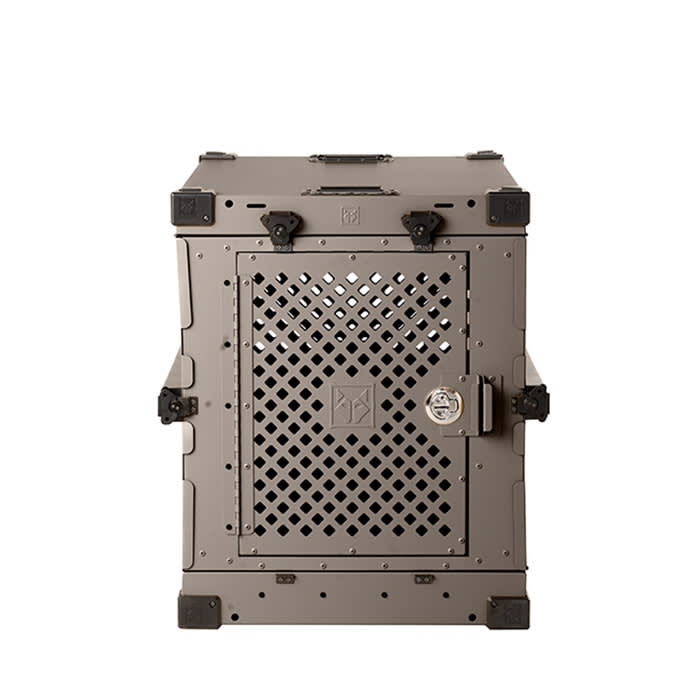
build for chewing
A determined chewer will go through fabric and can bend light wire, so the material has to fight back. Aircraft-grade aluminum is the answer. The Impact Collapsible Dog Crate comes in six sizes from Beagle to Great Dane, sets up in under a minute, and gives an anxious chewer nothing to grab. Owners of panic-chewers report the same pattern: the smooth aluminum walls offer no seam or edge for teeth to start on, so the shredding simply stops. The trade-offs are real, though: it is heavy, expensive, and the aluminum can dent.
lock it down
Some dogs treat slide-bolt latches as a puzzle to solve. For them, prioritize tamper-resistant or key-lock hardware over everything else. A heavy wire crate with reinforced double-latch doors handles most escape artists, but for the genuinely clever, a key-lock travel crate (see the crash-tested pick below) removes the puzzle entirely. Avoid soft-sided crates here on principle: the zippers are the first thing an escape artist learns to defeat.
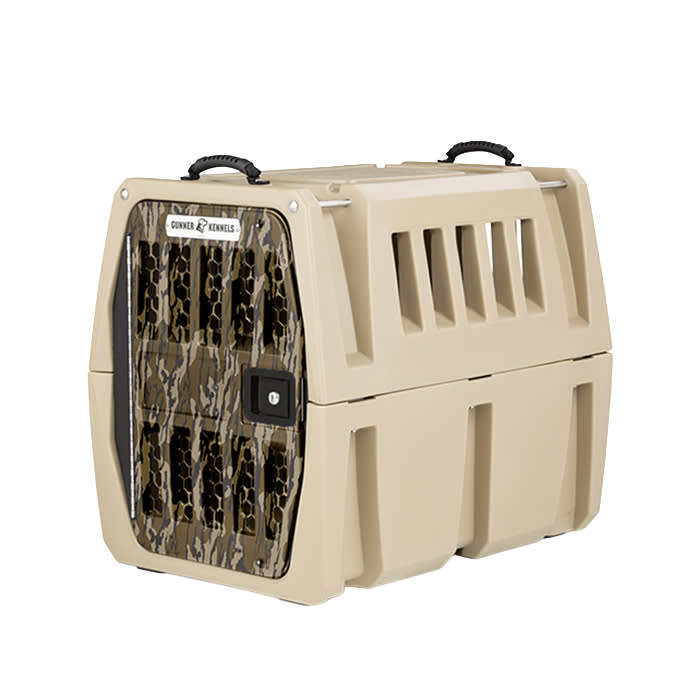
only crash-tested counts
Here is the distinction that matters and that most roundups blur: sturdy is not the same as crash-tested. Aluminum crates like the Impact are tough, but toughness in your living room says nothing about how a crate behaves in a 30-mph collision. The Gunner G1 Kennel is built with double-walled plastic and a lockable powder-coated aluminum door, and it carries a five-star crash-test rating from the Center for Pet Safety, the only independent body that crash-tests pet travel gear. Tie-down pins anchor it to the vehicle, and a recessed floor keeps the dog out of any mess. It is heavy and pricey, and for a dog who rides often, it is the one category where spending more buys something measurable: tested protection.
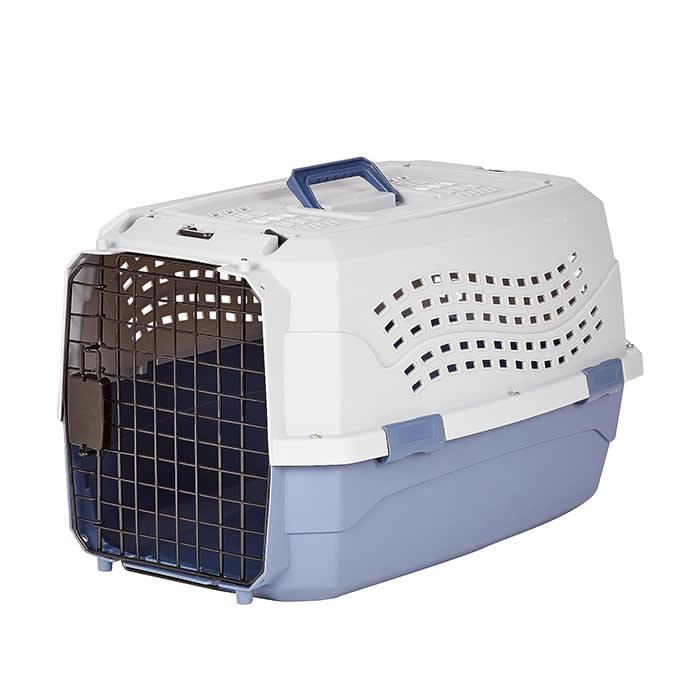
If your dog flies or you want a den-style carrier
For small dogs and vet trips, a hard-sided top-load carrier makes life easier. The Amazon Basics 2-Door Top-Load Hard-Sided Travel Carrier lets you lower a nervous dog in from the top rather than wrestling it through a front door, and the enclosed shell feels secure. It fits dogs up to about 20 pounds and does not fold flat, so it is a small-dog and travel pick, not an everyday crate for a big dog. If you want the lightest, most packable option for a trip and your dog is not a chewer, the soft-sided Amazon Basics 2-Door Folding Travel Crate collapses to almost nothing, with the firm caveat that fabric and zippers are no match for a chewer or escape artist.
If you want it to disappear into the room
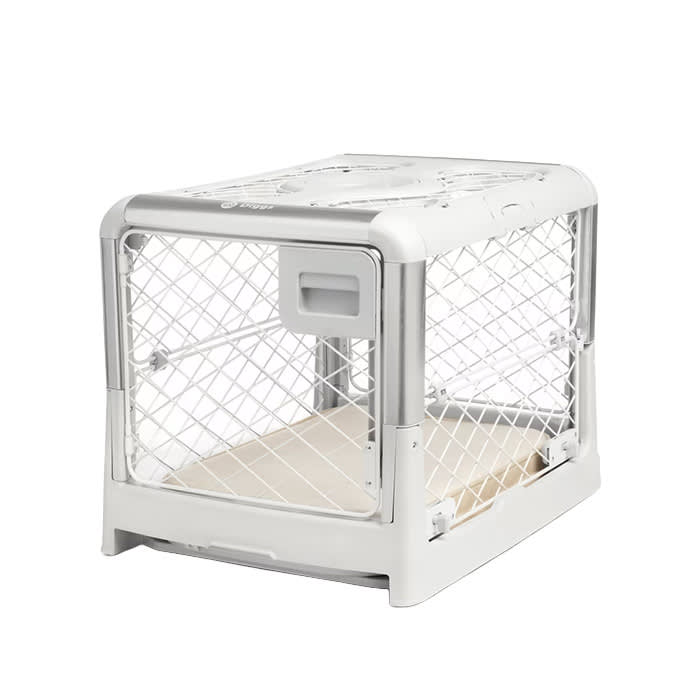
A crate you actually leave out gets used more, and two designs solve the eyesore problem without sacrificing safety. The Diggs Revol is the modern standout: rounded corners, a garage-style side door, a treat-dispensing top hatch, built-in wheels, and a collapsible frame, all built in the same factories as high-end baby gear. It is expensive, and it is the rare designer crate that earns it on engineering rather than looks alone. For a crate that hides in plain sight, the Frisco Double Door Furniture-Style Crate is built like a side table, supports up to 150 pounds on top, and comes in brown or black. Two cautions: it requires assembly (some panels arrive chipped), and if you leave your dog crated near it, keep lamp cords out of paw’s reach.
The quick-match summary
Calm homebody: a covered wire crate (MidWest iCrate). Heavy chewer: aircraft-grade aluminum (Impact). Escape artist: reinforced double-latch or key-lock hardware. Car traveler: crash-tested only (Gunner G1). Small dog or flyer: a hard top-load carrier; packable trips, a soft-sided crate for non-chewers. Style-conscious home: the Diggs Revol or the furniture-style Frisco.
Match the crate to the dog in front of you, size it with the tape measure rather than the photo, and the crate becomes what it should be: the one place your dog chooses to go when it wants to rest.
References
- Center for Pet Safety. “Crate Studies and Crash Test Ratings.”
- American Veterinary Society of Animal Behavior. “Crate Training and Confinement Guidelines.”
- American Kennel Club. “How to Pick the Right Size Dog Crate.”
- ASPCA. “Weekend Crate Training Your Puppy.”
Common questions
How do I size a dog crate correctly?
Measure your dog from nose to base of tail and add 4 inches for length, then measure from the floor to the top of the head while sitting and add 2 to 4 inches for height. The dog should be able to stand, turn around, and lie flat. For a growing puppy, buy the adult size and use a divider so the space stays just big enough to discourage soiling.
Is a bigger crate always better?
No. A crate that is much larger than your dog can actually slow housetraining, because the dog can soil one end and sleep at the other. The goal is enough room to stand, turn, and stretch out, not a roomful of space.
Are dog crates safe for car travel in a crash?
Only crash-tested crates have evidence behind that claim. Most everyday wire and aluminum crates are sturdy but not crash-tested. If car safety is your priority, look specifically for a crate that carries Center for Pet Safety certification.
What kind of crate is best for an escape artist or heavy chewer?
Heavy-gauge metal or aircraft-grade aluminum with tamper-resistant or key locks. Soft-sided and standard light wire crates are the easiest for determined dogs to chew through or unlatch, so they are the wrong choice for escape artists.
Tom Hadley writes about training and behavior, helping owners understand what their pets are trying to tell them. His work covers everyday manners, decoding common behaviors, and the small changes at home that make dogs and cats easier to live with.
Meet our experts ↗Keep reading
 Product PicksThe $599 Dog Crate Isn't for Your Dog. It's for the Four Things Wire Crates Get Wrong.Marcus Webb · 5 min
 Product PicksBuild Your Dog's Pool-Day Kit in the Right Order: Safety First, Toys LastDr. Mara Chen · 7 min
 Product PicksOnly One Piece of Dog Car Gear Actually Saves Their LifeMarcus Webb · 8 min
 Product PicksA Vogue Alum Looked at Dog Carriers and Saw a Design ProblemLeila Torres · 3 min
 Product PicksWinter Dog Gear, Ranked by the Danger It Prevents: 20 Picks for the ColdTom Hadley · 11 min
 Product PicksThe Right Travel Crate Depends on the Trip: 8 Picks, Sorted by How You TravelNina Vasquez · 12 min