


6 Automatic Ball Launchers for High-Energy Dogs, Sorted by What Matters
The real question isn't 'which launcher is best,' it's how big your space is and whether your dog respects the danger zone. We tested six and sorted them by the choices that decide which one belongs in your home.

Affiliate disclosure. This article contains affiliate links. We may earn a small commission if you buy through a link, at no extra cost to you. How we handle recommendations.
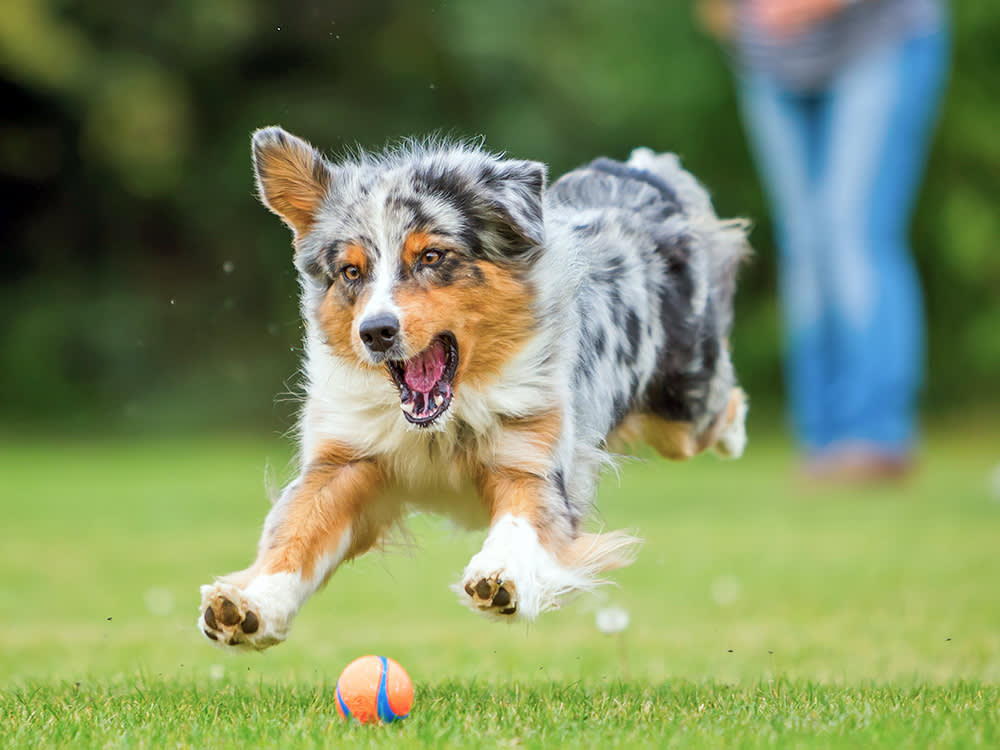
If you live with a high-energy dog, you already know the cost of an under-exercised afternoon: the zoomies, the redecorated couch cushions, the dog staring at you like you personally owe it a marathon. An automatic ball launcher won’t replace a walk, but it can take the edge off on a hectic week, and it can save your shoulder from the fortieth overhand throw.
The trouble with most “best launcher” lists, including the older version of this one, is that they hand you a winner without asking the two questions that actually decide which machine belongs in your house: how much space do you have, and does your dog respect the launch zone? Get those two right and the pick almost makes itself. So instead of crowning a single champion, we’ve sorted six machines we tested by the decisions that matter. Several can be on your doorstep within a few days.
the two questions that pick the machine for you
Space. A launcher that hurls a ball 50 feet is glorious in a fenced yard and a hazard in a one-bedroom apartment. Before anything else, decide whether you’re shopping for backyard distance or indoor restraint. Indoor shoppers should ignore the top-line distance number and look for a model that locks down to roughly 8 to 10 feet.
Safety awareness. Here’s the thing nobody markets loudly: almost none of these machines know your dog is standing in front of the barrel. An excited dog parked over the launch hole can take a tennis ball to the face. Exactly one pick below solves that in hardware with a motion sensor. With the rest, you are the safety system, training the dog to stand back and watching every session.
Hold those two questions in mind as you read. The picks are grouped by the job they’re best at.
Hyper Pet GoDogGo Fetch Machine
If you have the space and a dog that never quits, this is the workhorse. The remote-controlled Hyper Pet GoDogGo has won over more than 10,000 Amazon reviewers on the strength of its capacity and reach. It handles both mini and standard tennis balls, runs on rechargeable batteries or an AC adapter, throws anywhere from 12 to 35 feet (and the balls can travel up to 50), and offers four-, seven-, and 15-second intervals so you can pace a session.
- Why it earns the spot: It holds up to 25 balls, by far the most hands-free option here. For a dog that out-fetches every other machine, the reload-free runtime is the whole point.
- The tradeoff: Some owners report the spring mechanism softening over time, so durability is the open question. It’s also genuinely big.
- Right for / wrong for: Right for dogs up to about 60 pounds with a large fenced yard. Wrong for apartments, where 50 feet of travel is a problem, not a feature.
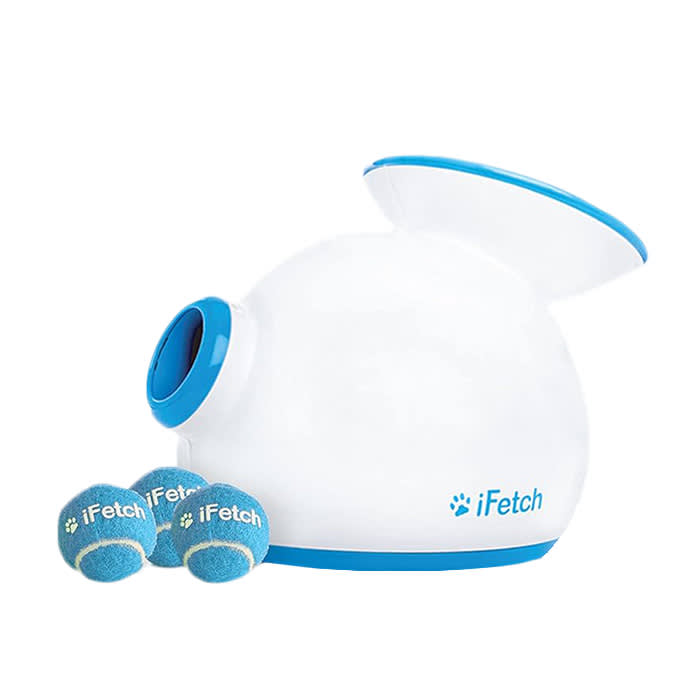
iFetch Automatic Dog Ball Launcher
The iFetch is the pick for in-house fetch, mostly because of one feature: a safety setting that locks it at 10 feet so you’re not launching a ball down the hallway and into a lamp. The small/medium model throws 10, 20, or 30 feet; the medium/large does 10, 25, or 40. It runs on a rechargeable battery with an included charging plug.
- Why it earns the spot: That 10-foot lock makes it genuinely living-room-safe, and the adjustable range covers a yard too if you size up.
- The tradeoff: It only holds three balls, so a relentless retriever will have you reloading.
- Right for / wrong for: Right for indoor dogs of any size, as long as you buy the right machine (it comes in small/medium and medium/large). Wrong for the dog that needs a 20-ball buffer.
PetSafe Automatic Ball Launcher
This is the new addition, and it earns its place by being the only machine here that addresses the safety gap directly. The PetSafe Automatic Ball Launcher uses electronic motion sensors that detect when your dog is within about 7 feet of the launch hole and refuse to fire until the dog moves clear. It also sounds an audible tone before each throw, offers nine distance settings from 8 to 30 feet plus six angle settings, holds three standard balls, and shifts into a rest mode after 30 minutes to force a break.
- Why it earns the spot: For an over-eager dog that crowds the barrel, or for anyone who can’t hover over every session, hardware that won’t fire into a dog’s face is worth a lot. It’s water-resistant for indoor or outdoor use.
- The tradeoff: It tops out at 30 feet, so it’s not the distance king, and it’s standard-ball only.
- Right for / wrong for: Right for the impatient dog that won’t learn to stand back, and for multi-tasking owners. Wrong for someone who wants maximum throw in a big field.
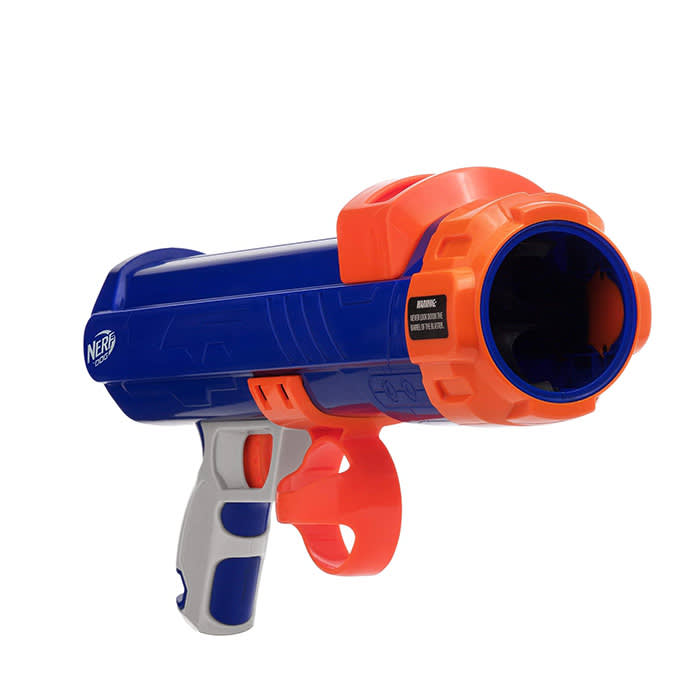
Nerf Dog Tennis Ball Blaster
If charging cables and outlets annoy you, go manual. The Nerf Dog Tennis Ball Blaster uses a finger-pull mechanism to fling standard tennis balls up to 50 feet, with zero power required.
As someone who uses this one regularly, I can vouch that dogs lose their minds the second it appears, well before it’s even loaded. My only gripe is the bulk, so I keep it in the backyard rather than hauling it to the park. (Want something that travels? We swear by the Chuckit! Fetch & Fold, which clips onto a fanny-pack strap.)
- Why it earns the spot: Cheap, effective, and immune to dead batteries.
- The tradeoff: It’s a bit clunky to lug around, and it’s not hands-free; you’re still doing the pulling.
- Right for / wrong for: Right for dogs of any size and people who’d rather not throw out a shoulder. Wrong for anyone wanting fully automatic, walk-away play.
All for Paws Automatic Dog Ball Launcher
The All for Paws is the design-conscious pick. The white-and-neon machine comes in mini and max sizes, both holding six balls, which makes it a fine choice for entertaining a couple of dogs in one session. Adjustable to 10, 20, 25, 30, or 40 feet depending on model.
- Why it earns the spot: Six-ball capacity plus a silhouette that blends into a living room better than the others.
- The tradeoff: It carries a specific warning against wet or dirty balls, which can jam it, so it’s best kept to indoor or dry-day use. It’s also designed around its own proprietary balls (though many owners report same-size off-brand balls work).
- Right for / wrong for: Right for dogs that tire after about six tosses and parents who care how the thing looks. Wrong for muddy-yard, all-weather fetch.
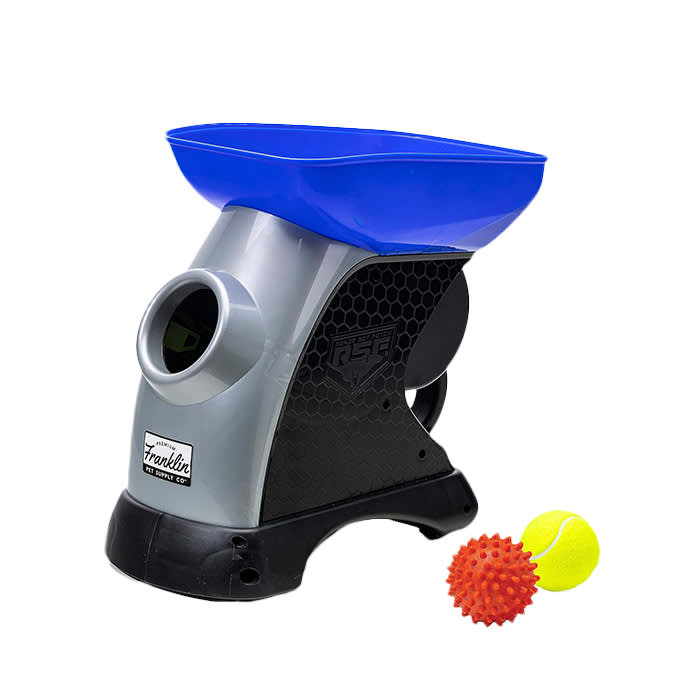
Franklin Pet Supply Ready Set Fetch
Most powered launchers run north of $100, so if you’re not sure your dog will even take to one, the Franklin Ready Set Fetch is the low-risk way in. It earns praise for a long throw, big capacity, and an adjustable toss angle, and it works indoors or out with an adapter or batteries.
Worth noting: it’s one of the very few here with any built-in warning system. It sounds an alarm to tell dogs a ball is coming, and owners report dogs catch on quickly, a small but real safety plus at this price.
- Why it earns the spot: Cheap entry point, works with any brand of tennis ball, and catapults up to 50 feet.
- The tradeoff: Running it outdoors means buying eight D batteries.
- Right for / wrong for: Right for medium-to-large dogs who love to run and owners testing the concept. Wrong for anyone wanting a premium build out of the gate.
How to shop, in plain terms
Ball size is a safety issue, not a preference. Small dogs do best with mini balls (1.5 to 2 inches); medium and large dogs need standard balls (2.5 to 3 inches) to avoid a choking hazard. Some machines only handle one size, so check before you buy. Most standard machines can fire smaller balls too; they may just throw a little shorter or farther.
Distance: match the room. Aim for 30 to 50 feet of range outdoors, and a model that locks down to 8 to 10 feet if you’ll use it inside.
Capacity: how patient are you? Most launchers hold six balls or fewer; the GoDogGo holds 25. The fewer it holds, the more you’ll be reloading for a tireless dog.
Power: pick your annoyance. Four of these six need an outlet or batteries; some use rechargeables, others eat C or D cells sold separately. The Nerf needs nothing but a finger.
The safety rules that apply to every machine
A launcher is a tool, not a babysitter. Use these every time:
- Train the stand-back. A dog staring down the barrel can get whacked. Only the PetSafe here detects and prevents that; with the rest, teach your dog to wait off to the side.
- Watch the leaps. Many launchers throw high as well as far, which tempts excited dogs to jump and risk a pulled muscle. Build in breaks if your dog is winding up.
- Don’t run them ragged. A forward-hanging tongue means tired; a side-flopping tongue means overheated. Rest your dog between rounds to head off heat stress and strain.
- Supervise, full stop. The convenience is real, but it’s not an excuse to tune out. The worst-case outcomes here, a strained muscle or a choking hazard, only happen when nobody’s watching.
The best launcher is the one that fits your square footage and your dog’s self-control. Answer those two questions first, and any of these six will do its actual job: a tired, satisfied dog and a shoulder that still works.
Marcus Webb writes about the gear, gadgets, and everyday choices that make life with a pet easier. His coverage runs from product picks to training and the causes worth paying attention to, always with an eye on what actually earns a place in your home.
Meet our experts ↗Keep reading
 Product PicksA Fashion Founder's Dog Shelf, Audited: 2 Are Real Buys, 1 Is a PropSara Lim · 7 min
 Product PicksA Pool Float Is a Safety Decision, Not a Photo Op: 10 Picks by Swimming TypeJordan Ellis · 6 min
 Product PicksYour Dog Doesn't Need Another Puzzle. They Might Need the Opposite.Sasha Ford · 7 min
 TrainingStop Handing Your Dog a Boring Kong. Stuff It Like This.Dr. Amara Solis · 7 min
 Product PicksEco Dog Toys Are the Last Holdout. These $16 Handmade Ones Show Why.Nina Vasquez · 4 min
 TrainingOne in Three Toy-Obsessed Dogs Couldn't Calm Down. That's the Number That Matters.Dr. Ravi Mehta · 8 min