
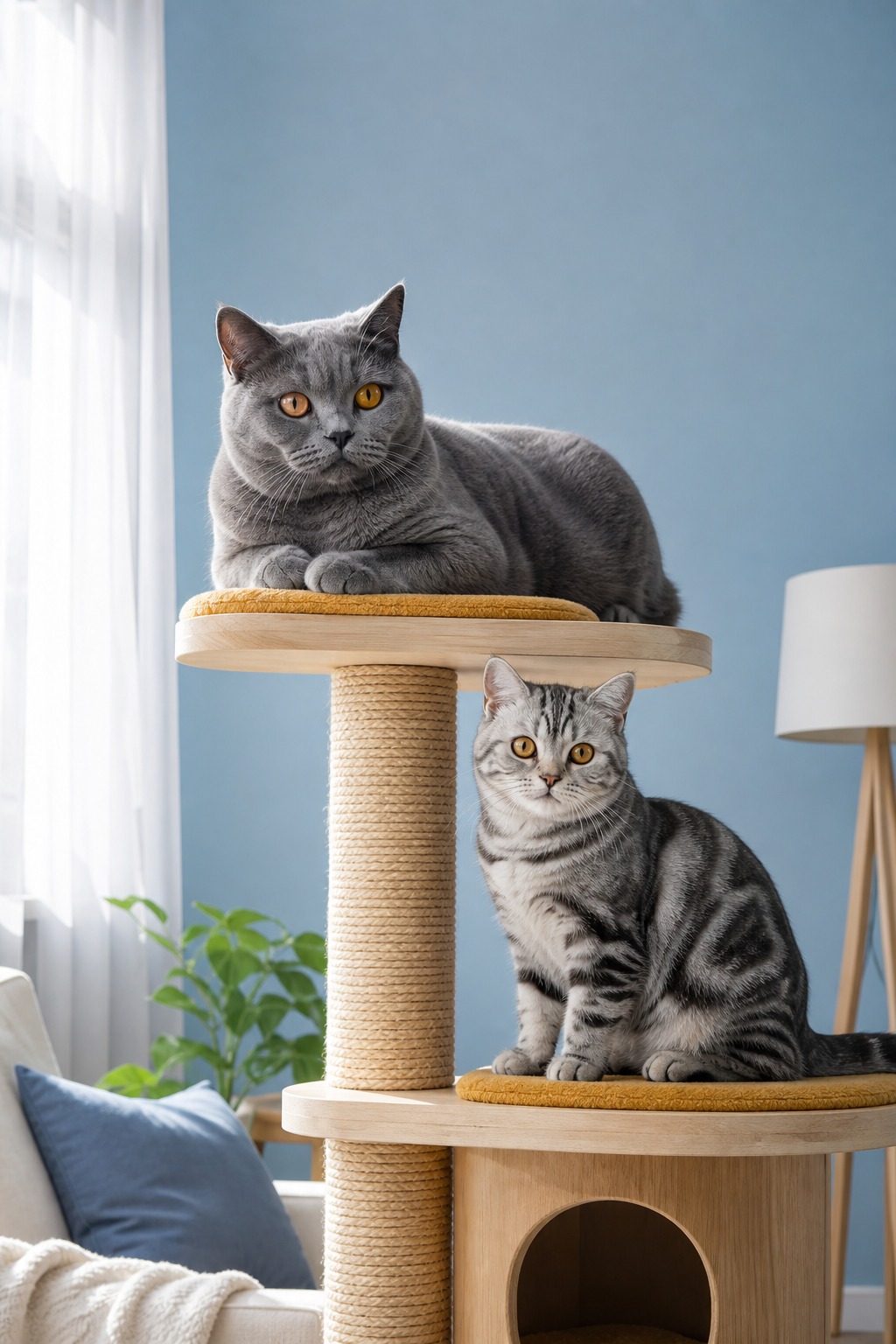
Most cat tree guides hand you a list of towers and let you sort it out. We want to start somewhere more useful: a cat tree is not furniture you happen to buy for your cat. It is vertical territory, and the right one is a tool for fixing a specific behavior. A cat who shreds the couch arm needs a different tree than a cat who body-checks you off the counter at 6 a.m., who needs a different tree than the anxious cat hiding under the bed. Buy for the problem, not the photo, and the tree earns its footprint. Buy for the photo, and it becomes a $200 coat rack.
That reframe drives everything below. We tested and cross-referenced towers against the jobs cats actually assign them, and we lead with how to diagnose your cat before we name a single product.
A quick note: our editors (and their pets) chose these products. Everything was in stock when we published, but cat trees do sell out. If you buy through our links, we may earn a commission.
Why cats want height in the first place
The instinct traces straight back to a cat’s predator-and-prey heritage. A high perch gives a cat a defensible vantage point, somewhere to watch the room without being snuck up on. In a multi-cat home, vertical space also defuses tension: cats time-share territory by elevation, so adding height literally adds usable square footage to a room without moving a wall. That is why a tree often calms a household that a second litter box could not. The perch is not a luxury. It is conflict resolution.
Diagnose your cat first
Before you compare heights and finishes, name the behavior you want to redirect. The tree should answer it.
- The scratcher. If your cat targets the couch, you need posts they will actually choose over upholstery, which means tall, rigid, vertically oriented sisal they can stretch up to full length. A wobbly post teaches a cat to go back to the couch, which never wobbles.
- The counter surfer. If your cat colonizes counters and tables, height is the lever. The tree has to out-rank the counter, so aim for a top perch at or above your counter height (roughly 36 inches) plus the cat’s standing reach.
- The hider. An anxious or newly adopted cat needs an enclosed condo or cave at a mid-level, not a bare platform. A place to watch from cover lowers stress faster than an open lookout.
- The athlete. A young, bored cat that zooms and climbs the curtains needs staggered levels close enough to leap between, plus dangly toys to burn the energy a flat post cannot.
- The senior. An older or arthritic cat wants a low, stable tower with closely spaced steps and a heated-friendly cushion, never a six-foot tower they will refuse to climb.
Match the cat to the category, then read only the picks that fit. The rest is noise.
The stability rule nobody tells you
Here is the single most important spec, and most listicles skip it: the tree must weigh more than the heaviest cat who will use it, and ideally more than all of them combined if they pile on. A ten-pound cat launching onto a top perch delivers a sideways force a static weight chart never shows. A tippy tree does not just annoy a cat, it scares them off the tree for good and can injure them on the way down. Prioritize, in order, a wide base, a low center of gravity, a solid-wood or heavy-MDF frame over particle board, and wall-anchor hardware for anything over five feet. Treat the listed weight as a floor, not a target.
Our nine picks at a glance
Because heights, features, materials, and prices vary so much, we cast a wide net so there is something here for every cat and every space. Prices below are the figures we recorded at publish time and will drift; confirm before you buy.
| Pick | Best for | Height | Approx. price | Frame |
|---|---|---|---|---|
| Refined Feline Lotus Tower | Big cats & looks | 69 in | $300+ | Oak, 75 lb |
| New Cat Condos Solid Wood House | Maximum stability | 67 in | ~$280 | Solid wood |
| Petmaker 6-ft Cat Tower | Kittens & athletes | 72.25 in | Under $100 | Plush/wood |
| Majestic Pet 76-in Cat Tree | Multi-cat homes | 76 in | ~$200 | Wood/faux fur |
| Merry Products Folding Cat Tree | Scratchers | ~60 in | ~$190 | Wood |
| Amazon Basics Cat Tree | Carpet lovers | 45.88 in | Under $100 | Particle board |
| Feandrea 33.1-in Cat Tower | Small spaces | 33.1 in | Under $75 | Particle board |
| Frisco 47.5-in Modern Cat Tree & Condo | All-rounder | 47.5 in | Under $100 | Wood |
| Mau Uni Faux Fur Basket Tree | Design-first homes | 41 in | ~$260 | Real branch |
Best for big cats (and looks): Refined Feline Lotus Tower
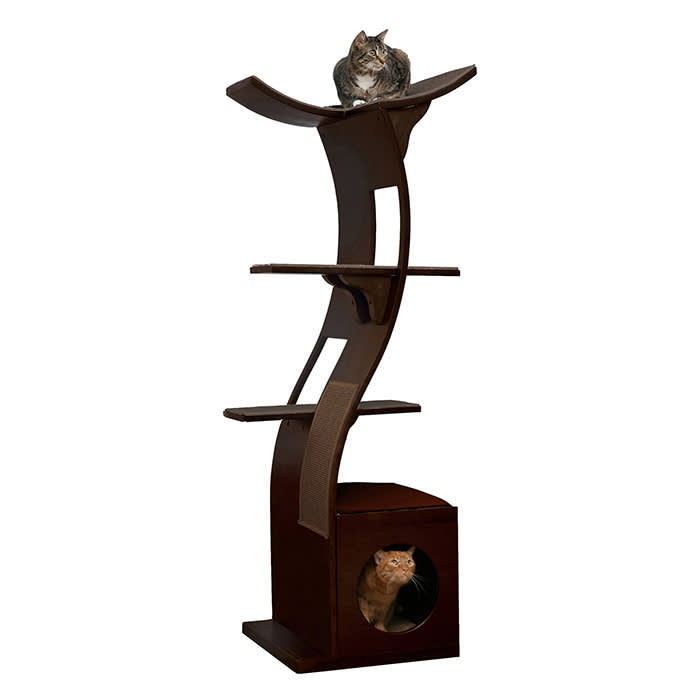
Large cats need a frame that does not flinch, and the Refined Feline Lotus is built for it: a 75-pound oak tower (20”L x 20”W x 69”H) whose weight alone clears our stability rule for almost any cat. Wide platforms suit big bodies, all lined with washable berber carpet attached by velcro for cleaning, with a vertical sisal mat above a cushioned den for the cat who wants to hide.
The price is steep at over $300 and the footprint is large, so it is a commitment. But for a Maine Coon, a Ragdoll, or any household that wants the tower to read as furniture, it is the pick that pairs genuine stability with a finish you will not want to hide. Amazon rating: 4/5.
Best for maximum stability: New Cat Condos Solid Wood House
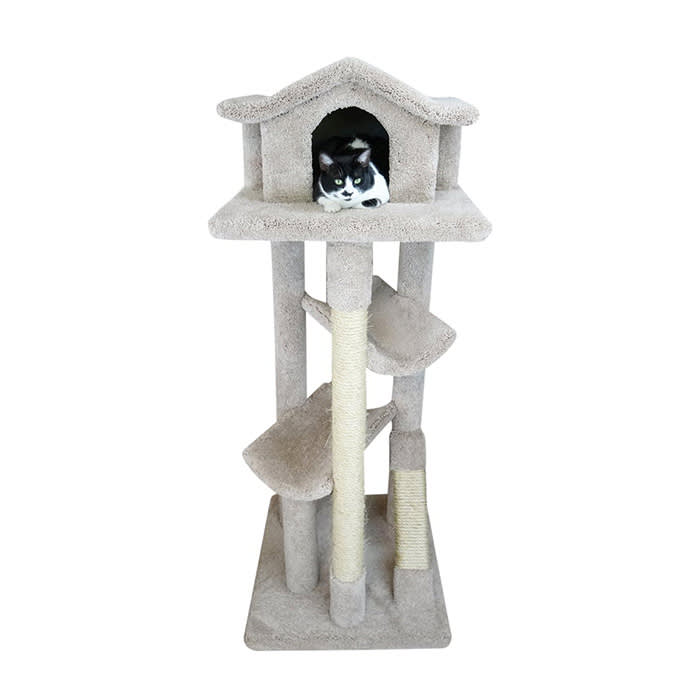
If you have a launcher, a tipper, or a cat that has already been spooked off a wobbly tree, buy stability outright. This fully carpeted New Cat Condos tower stands 67 inches (24”W x 24”D x 67”H) on a solid-wood frame and, crucially, arrives preassembled, so it is put together correctly out of the box. Three staggered levels top out in a roomy pagoda, with two sisal posts below.
At about $280 it is not cheap, and carpet is not universal. But the one thing every reviewer agrees on is that it does not move, which is the entire point for an anxious or heavy cat. Amazon rating: 4.5/5.
Best for kittens and athletes: Petmaker 6-ft Cat Tower
A young cat that climbs the curtains needs somewhere legal to burn it off. This affordable Petmaker six-footer (23.5”L x 19.25”W x 72.25”H) staggers four levels, including two bed perches, a cave, and a platform with a center hole a rope descends through, plus two dangly mice and nine sisal posts. All that climbing builds strength and coordination as a kitten grows, and the toys soak up the energy a flat post never will.
Plush carpet is not for every cat and the footprint is large, so confirm your space and anchor it given the height. Under $100 for this much vertical playground is hard to beat for a household with a tornado in it. Amazon rating: 4/5.
Best for multi-cat homes: Majestic Pet 76-in Cat Tree
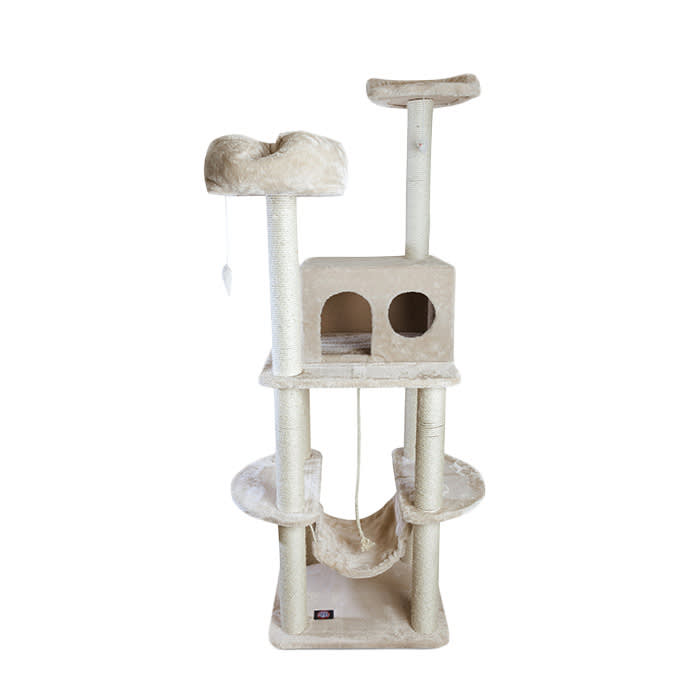
Vertical space is how cats share a room, so a multi-cat household wants levels at several heights. This six-foot-plus Majestic Pet tower (76”H x 32”W x 35”D) delivers four levels, a hammock, a kitty cave, two sisal posts, and a rope with two dangly mice, all wrapped in water-resistant faux fur. The variety of lounging styles means two cats are far less likely to fight over the single best spot.
It eats floor space and the faux fur is not every cat’s texture, and at close to $200 it is an investment. Leave clearance around it, because it becomes the busiest corner in the house. PetSmart rating: 4.5/5.
Best for dedicated scratchers: Merry Products Folding Cat Tree
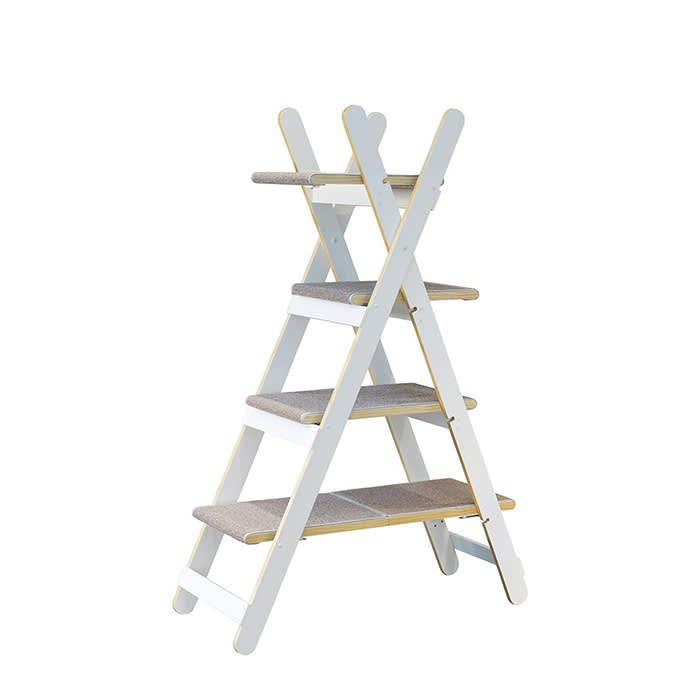
If your cat’s whole crime is the couch, prioritize scratching real estate over gadgets. This roughly five-foot Merry Products ladder tree (40.13”L x 17”W x 60.25”H) gives four carpeted shelves that double as scratch surfaces, plus the height a frustrated scratcher wants for a full vertical stretch. It folds flat for storage.
The carpet shelves will wear faster than the wood frame and may need replacing eventually, and at about $190 it is mid-range rather than cheap. But for a cat who scratches to mark and stretch, the abundance of rigid, climbable surface is exactly the lure that pulls them off the furniture. Amazon rating: 4/5.
Best for carpet lovers: Amazon Basics Cat Tree
Some cats simply prefer carpet underfoot and as a scratch surface, and the Amazon Basics tree leans all the way in. Under four feet (17.72”L x 17.72”W x 45.88”H), it packs four carpeted levels, a round top platform with raised sides that doubles as a bed, and seven jute rope-wrapped posts.
The base is particle board and carpet is not universal, so it suits one or two carpet-loving cats more than a heavy multi-cat crowd. Under $100 with that many scratch surfaces is the value play for a confirmed carpet cat. Amazon rating: 4/5.
Best for small spaces: Feandrea 33.1-in Cat Tower
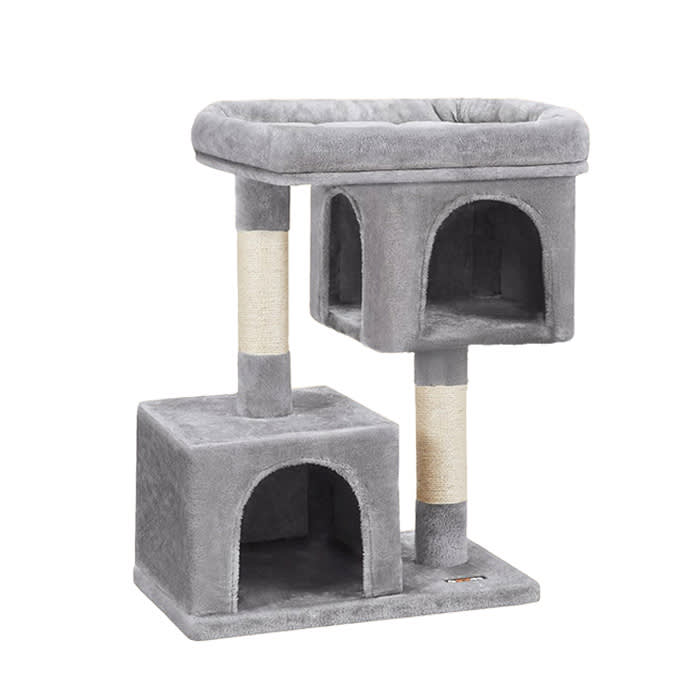
For a studio, a rental, or a corner, the Feandrea 33.1-in tower does a surprising amount in under three feet (23.6”L x 5.7”W x 33.1”H): three levels, two enclosed caves for the hider, two sisal posts, and a plush surface cats like to knead. Reviewers with Maine Coons report their big cats still claim the top.
Be honest about the cons before you buy: the base is particle board, which is less durable and less heavy than wood, so it is best for one to three lighter cats rather than a pile of large ones. Under $75 makes it the easiest tree to justify as a first try. Amazon rating: 4/5.
Best all-rounder: Frisco 47.5-in Modern Cat Tree & Condo
If one brand keeps surfacing as a reviewer favorite, it is Frisco, and the 47.5-in Modern Cat Tree & Condo is the rare tower that does not force you to pick a single job. At just under four feet (47.5”H x 18.8”W x 23.2”L), it clears most counters while fitting most rooms. Five sisal-wrapped posts and two flat sisal mats cover both scratching styles, three levels give the climber room, and a private condo answers the hider. It comes in modern gray and natural wood, and the cushion is washable.
The tradeoff: the platforms are not steeply staggered, so a less agile cat may hesitate to jump between them, and the bare-wood finish disappoints cats who specifically want carpet. But because it is wood-framed and serves the scratcher, the surfer, and the hider at once, it is the safest first tree for a household that has not yet figured out what its cat is. Our rating: 5/5.
Best for design-first homes: Mau Uni Faux Fur Basket Tree
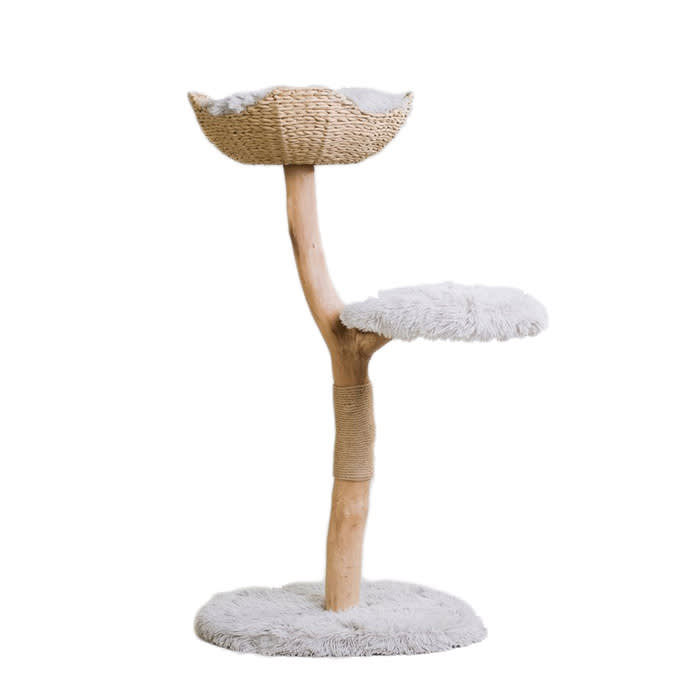
When the tower has to look like it belongs, Mau makes the case. The Uni tree (29”L x 20”W x 41”H) is handcrafted around real tree branches, with a shaggy carpet perch, a handwoven basket holding a machine-washable cushion, a dangly toy, and a sisal post. It is genuinely two-job furniture: a perch and a hideaway in a single sculptural piece.
It runs about $260 and is sized for single-cat homes or smaller cats, not a multi-cat scrum. For a design-led space where a chrome-pole tower is a dealbreaker, it is the rare tree you will not want to relocate when guests come over. Chewy rating: 4.5/5.
How to get a cat to actually use the tree
Buying the right tree is half the job. Placement is the other half. Put it where your cat already wants to be, near a sunny window or in the room the family uses most, not banished to a spare bedroom. Rub a little of your cat’s scent or a pinch of catnip on the lower posts, reward the first climb, and never pick a cat up and plant them on a perch, which most cats resent. If the tree is meant to end counter surfing, place it beside the counter so the legal high spot is more appealing than the illegal one.
FAQs
What is the safest cat tree I can buy?
Safety comes down to materials, weight, and construction. Avoid trees with toxic finishes; safe surfaces include sisal, cut-pile carpet, and faux fur. Choose a wood or heavy-MDF frame over thin particle board, confirm the tree weighs more than the cat or cats using it, and anchor anything over five feet to the wall.
How do I know which material my cat will prefer?
Watch what your cat already targets at home. A couch-scratcher usually wants rigid sisal posts and a carpet they can dig into; a cat that burrows into soft blankets will gravitate to plush or faux fur. When in doubt, a tree that offers both posts and a carpeted platform hedges the bet.
My cat ignores the tree. What now?
Nine times out of ten it is placement or stability. Move it next to a favorite window or busy room, add catnip to the base, and make sure it does not wobble, since a single scary tip can sour a cat on a tree permanently.
References
- The Humane Society of the United States. “Preventing Inappropriate Scratching.” humanesociety.org.
- American Association of Feline Practitioners and International Society of Feline Medicine. “Environmental Needs Guidelines,” Journal of Feline Medicine and Surgery.
- Cornell Feline Health Center. “Environmental Enrichment for Cats.” Cornell University College of Veterinary Medicine.