


One Tourist, 6,000 Spayed Strays, and an Island That Changed
A Canadian vacationer fell for one wire-haired street dog in Puerto Rico. He died six months later, but he started something: a free spay-neuter clinic that ran out of a living room and reshaped an entire island's stray population.
Almost every big animal-rescue story starts with one animal. This one starts with a wire-haired street dog on a Caribbean island, a Canadian tourist who couldn’t leave him behind, and a heartbreak that turned into a plan.
Laurie Mosher first vacationed on Vieques, a small island off the coast of Puerto Rico, and had the reaction a lot of visitors have: she didn’t want to go home. That feeling didn’t fade back in Ontario, so in 2015, she and her husband bought a second home on the island. While the house was going up, a roaming street dog wandered into her life and refused to leave her heart. She brought him back to Canada.
She named him J. Edgar, a nod to the FBI’s founding director. He was, by her description, a tiny, wire-haired force of nature and cute as a button. Six months later, he died of complications from heartworm. But like his namesake, he left a legacy, a far less complicated one, and it reshaped the island he came from.
A death that started something
Getting J. Edgar to Canada in the first place had introduced Mosher to Laura Cohen, who fostered the pup while the logistics of the move got sorted. Neither of them knew it at the time, but J. Edgar turned out to be the very first animal the two women would rescue under the banner they went on to build: Our Big Fat Caribbean Rescue.
What Mosher had also seen, up close, was the scale of the stray problem on Vieques, a large population of dogs and cats surviving on the streets. She and Cohen shared the same instinct: this is awful, so let’s fix it. In the beginning, “fixing it” was modest and run out of Mosher’s newly built house. They’d foster five or six street dogs at a time, then line up partner organizations across Canada and the States to fly the dogs toward better odds of adoption.
Then Hurricane Maria hit.
Maria, and the decision to fix the problem at its root
The Category 5 storm devastated Vieques in September 2017, and it fell hardest on populations that were already struggling. Dogs wandered the streets, some abandoned, and the infrastructure that might have helped them was gone. For a while, even getting dog food onto the island was hard.
The storm became a turning point. Flying a handful of dogs off the island at a time was never going to outrun a stray population that kept reproducing. Mosher and Cohen decided the real fix had to happen at the source, on Vieques itself. So they started their first free spay-and-neuter clinic the only place they had: Mosher’s living room.
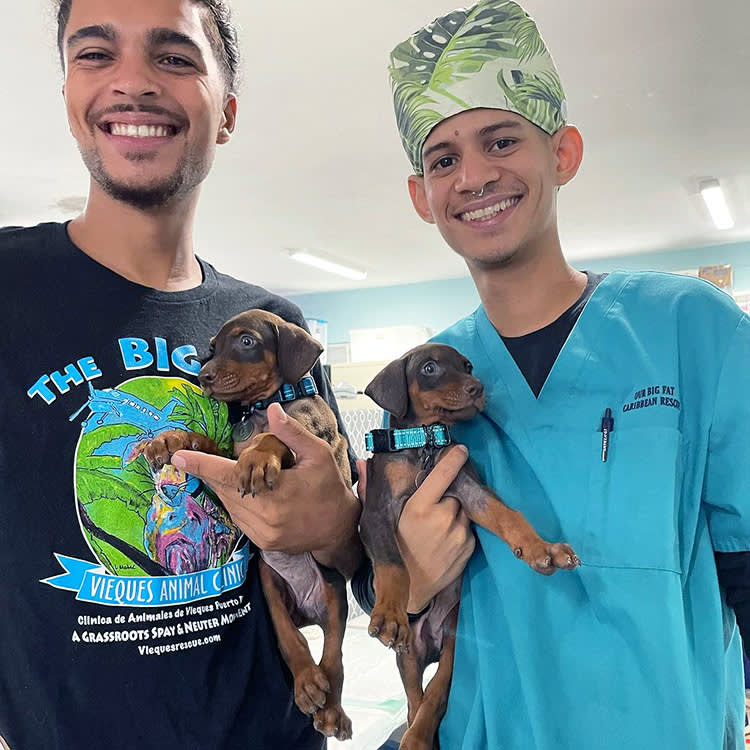
To make space, they hauled the furniture out into the garden. They found a veterinarian who believed in the cause, and he brought a team to sterilize local dogs. In that first clinic, they altered 60 dogs, putting a real dent in the overpopulation cycle for the first time.
That became the heart of the whole operation. For the next two years, they ran clinics out of that living room before a larger facility was finally donated to them. Mosher now estimates the rescue has spayed or neutered at least 6,000 animals, and the effect is visible in daily life. As she describes it, Vieques has become one of the rare Caribbean islands where you no longer see starving strays wandering the streets. That’s not a small claim, and it’s not an accident.
Why “free” was the whole strategy
The reason the model worked comes down to one deliberate choice: the services were free. Vieques is an island where most residents live in poverty, with some estimates putting the rate north of 70 percent. Charging for spay-neuter would have quietly excluded the exact families the program needed to reach. The nonprofit offers other vet services at flexible or no cost for the same reason.
In the early days, seeing six or eight dogs living at one house wasn’t unusual. The pattern was rarely neglect, Mosher is clear that the people of Vieques love their animals. It was resources. Families would take in a pet or two, never had a realistic way to spay or neuter them, and the animals multiplied. The information about why sterilization matters simply wasn’t circulating.
So the rescue circulated it, in person. Mosher and her team went door to door handing out pet food, leashes, collars, and flea-and-tick meds. She believes that groundwork is why families turned out for those earliest clinics at all. It made the work personal, and it built trust, the currency any community-based program actually runs on.
What’s in a name
For the first stretch, the rescue didn’t even have a name. Once the free clinics made it clear this was becoming serious, Mosher and Cohen went looking for the right one. During a brainstorm with her family, Mosher latched onto the phrase “big fat,” ran the candidate through a name-rating website, and got back a perfect score. Our Big Fat Caribbean Rescue it was. (For the rom-com fans: no, the wedding movie wasn’t the inspiration.) The name has helped the group stand out at conferences and fundraisers, though it’s the relentless work behind it that does the real lifting.
The model, and why it matters beyond one island
Alongside the clinics and outreach, Mosher and Cohen still transport adoptable pets to North American shelters, where they have a better shot at a home. What OBFCR really demonstrates is a template a lot of island and rural rescues have converged on: you cannot adopt your way out of a stray crisis, but you can spay and neuter your way toward the end of one. Free, high-volume, community-trusted sterilization is the lever that actually bends the curve, because it stops the next generation of strays before it exists.
Like most nonprofits, the group’s hardest constraint is money. Free and low-cost care only works on donations, and funds run thin fast when you’re regularly booking air travel for animals. Mosher points to the steady trickle of small recurring gifts, the $5 and $10 donations that arrive through social media, as what keeps the lights on day to day. It adds up, she says, and it really does.
The instinct after a disaster is to fly animals out, and that saves the ones in front of you. But the rescues that actually change a place are the ones that make spay and neuter free and easy and local. You’re not just saving this dog, you’re preventing the next hundred. That’s the math that ends a stray crisis instead of just managing it.
If you want to support the work, OBFCR takes donations through its website, which is also available in Spanish. Skipping one coffee run and sending that cash instead is, genuinely, the kind of small gift that adds up.
Leila Torres leads our Living coverage, from home life and travel to the products and rescue stories that come with sharing a life with animals. She edits and writes across the section, with a soft spot for pieces about the bond between people and their pets.
Meet our experts ↗Keep reading
 LivingStarting an Animal Rescue Is Mostly Paperwork, Not Puppies. Read This Before You LeapLeila Torres · 8 min
 LivingShelters Stopped Guessing: How Science Rebuilt the Modern ShelterClaire Sutton · 10 min
 LivingYou Can Write Off Your Foster Pet's Food. Most Fosters Never Do.James Okafor · 5 min
 LivingBefore Beryl Made Landfall, 94 Shelter Pets Were Already on the Road OutNina Vasquez · 6 min
 LivingThe Most Meaningful Hour of Your Vacation Might Be Spent Walking Shelter DogsLeila Torres · 5 min
 LivingYou Don't Have to Adopt a Dog to Get the BenefitClaire Sutton · 6 min