


This Brand Tests Cat Furniture in Cat Cafés. One Week There Equals a Year in Your Home.
Most cat furniture is designed to be cheap and hidden. Tuft + Paw designs backwards, starting with a behaviorist and ending in a room full of cats trying to destroy it.

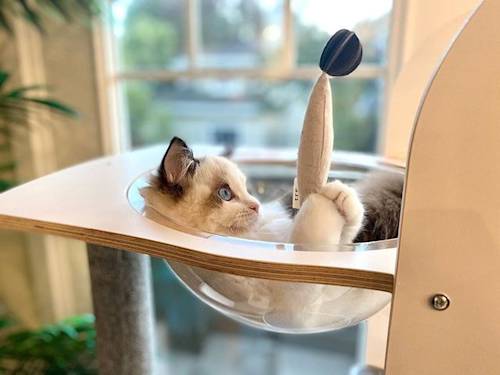
Here is the industry standard for cat furniture, and it has been for decades: build it as cheaply as possible, cover it in carpet, and accept that the customer will hide it behind a couch.
The result is a category where nobody was designing for either species. The cat gets a wobbly tower with a scratching surface that shreds in a month. The human gets an eyesore. Everybody agrees to look away from it.
Tuft + Paw was built on the observation that this is stupid, and on one genuinely unusual piece of process: their prototypes go to cat cafés, because one week in a cat café is roughly equivalent to a year of wear in a one-cat home.
That is the thing worth stealing from this brand, whether or not you ever buy anything from it.
The origin, which is the same for every good pet product
Jackson Cunningham adopted a cat named Jiggity from a local rescue in 2016, went shopping, and found nothing.
Not “nothing he liked.” Nothing that met either standard. Every company seemed to be optimizing for the lowest possible cost, which meant minimal design and the cheapest available materials, producing objects that were somehow not designed for cats or humans: the cat’s needs went unmet and the thing was ugly enough that you would want to hide it.
His conclusion, which is the correct one: it is strange that cat products are held to such a low standard given how much people love their cats.
So the brand’s whole aesthetic proposition is furniture that does not read as pet furniture. Cave-like orbs on powder-coated steel bases. Floating modernist shelves lined with faux fur. Slatted ash towers that work as airy perches. A litter box concealed inside what looks like a retro record console.
But the aesthetics are the marketing. The process is the interesting part.
Three gates a product has to pass
Gate one: the behaviorist briefs the designers. Every designer starts with an internal document, the Guide to Cats, built with the company’s cat behaviorist, on cat behavior and how it should shape product design. The point of writing it down is consistency: every designer works from the same principles, and what one product learns, the next one inherits.
Gate two: the behaviorist reviews the concept. Late in iteration, the design goes back to the behaviorist to be checked for red flags before anything gets built at scale.
Gate three: the cat café. Early material prototypes go into a working cat café to test durability, on the ratio above: a week there is about a year of household wear. Then the final prototype goes back and stays for weeks, so the team can watch whether cats actually use the thing, and catch the surprises that no amount of design review will predict.
They also send early samples out to a group of customers, and the team lives with prototypes at home, Jiggity included.
Why the cat café test is the one that matters
Design review catches the theoretical problems. The café catches the real ones.
A behaviorist can tell you a cat needs a stable perch, a full-body-length scratching surface, and an escape route. What a behaviorist cannot tell you is that thirty cats will find the one corner of a joint that pulls apart, or that the fabric you chose looks perfect until it has been shed on, vomited on, and scratched by a rotating cast of strangers for a month.
Anything a company can’t put in front of thirty cats for a week hasn’t been tested. It has been reviewed.
That is a useful lens for the entire category, and it is the lens to bring to whatever you are actually about to buy. Ask what the wear looks like at month twelve, not week one.
The products, and what the design choices tell you
The Cove litter box. The company spent 18 months on it, and it is the clearest window into the process. The scoop and brush store within the box itself, so the tools live with the mess instead of in another room. The body is shaped to act as a lever, so a human can lift and empty it without a liner, and there is a hidden handle underneath. And critically, they took early customer feedback and increased the size by 30 percent, then added an optional wall extender for cats who dig enthusiastically.
That last change is the tell. Almost every litter box on the market is too small, because a smaller box is cheaper to make and ship and looks less intrusive in a bathroom. Cats need a box roughly one and a half times their body length, and the industry has been quietly ignoring that for decades. Making the box bigger, on purpose, at cost, is the entire thesis of the company in one decision.
The Frond. Their take on the cat tree: three adjustable tiers of oval perches, so you can reconfigure the climb rather than living with one fixed shape, with the central pillar wrapped entirely in tightly-secured sisal, meaning there is a scratching surface at every level rather than one sad post at the bottom.
The Zip. A stripped-down scratching post, tall enough that a confident cat can sit on top of it. This is the underrated category: most posts are too short for a cat to get a full stretch, which is half of what scratching is for.
The Puff bed. Cunningham’s own cat’s favorite, though the founder cheerfully admits the cat ignored it for a stretch before adopting it, which is the most honest sentence in any brand interview I have read this year. Cats do not accept new objects on your schedule.
The reality check
This is expensive furniture. That is the trade, and it is worth being blunt about it: you are paying design-object prices for cat gear, and a $40 tower from a big-box store will hold a cat.
What you are actually buying is durability, a scratching surface that survives, a litter box a cat will fully use, and an object you do not resent having in your living room. Whether that is worth several times the price is a real question, not a rhetorical one.
The more useful takeaway is the standard, which costs nothing. Buy the bigger litter box. Buy the taller post. Check whether the scratching surface runs the height of the thing or just the bottom eighteen inches. Ask what it looks like after a year. Those questions do not require a designer brand. They just require you to stop accepting the thing that was built to be cheap and hidden.
What’s new since this was written
The brand has kept going, and the Cove is now sold as a full system in the $200 range, with the Shelter add-on for cats who need more height, which is roughly where the market for a “designed” litter box has settled.
The bigger shift is that the premium cat-furniture category the brand helped invent is now crowded, which is good for buyers. Wall-mounted shelving, sculptural trees, and concealed litter cabinets are widely available, and the design standard across the whole market has risen.
Which means the question is no longer whether you can find a cat tree that does not embarrass you. It is whether the one you are looking at has ever been put in a room with thirty cats. Almost none of them have.
References
- Tuft + Paw. “Cove Modern Litter Box.” https://www.tuftandpaw.com/products/cove-litter-box-full
- American Association of Feline Practitioners. “Feline Environmental Needs Guidelines.” https://catvets.com/guidelines/practice-guidelines/environmental-needs-guidelines
- Ohio State University Indoor Pet Initiative. “Litter Box Basics.” https://indoorpet.osu.edu/cats/basic-cat-needs/litterbox
Sasha Ford is a certified cat behaviour consultant who has worked with shelters, catteries, and private clients across the country. They review all feline behaviour content at The Pet Times, with expertise in multi-cat households, indoor enrichment, and stress-related disorders.
Meet our experts ↗Keep reading
 Product PicksThe 8 Best Cat Trees for Maine Coons, Sorted by Size and Your CeilingSasha Ford · 11 min
 Product PicksThe 9 Best Outdoor Cat Trees of 2026, Reviewed for CatiosSasha Ford · 15 min
 Product Picks8 Litter Box Enclosures That Hide the Box Without a Cat BoycottSara Lim · 8 min
 Product PicksYour Cat Shreds the Couch Because Every Scratching Post Is an EyesoreSasha Ford · 4 min
 Product Picks13 Pieces of Cat Furniture That Pass the Vet Test and the Decor TestSasha Ford · 7 min
 Product PicksNo Box Fixes a Litter Box Problem. Here's What Actually Does.Dr. Lena Park · 10 min