


Thanksgiving Is Rigged Against Your Dog. 7 Ways to Beat It
You cannot train a dog out of a house that smells like roasting turkey. So do not try. Engineer the day instead, working outward from the places the damage actually happens: the table, the trash, the door, and the dog.
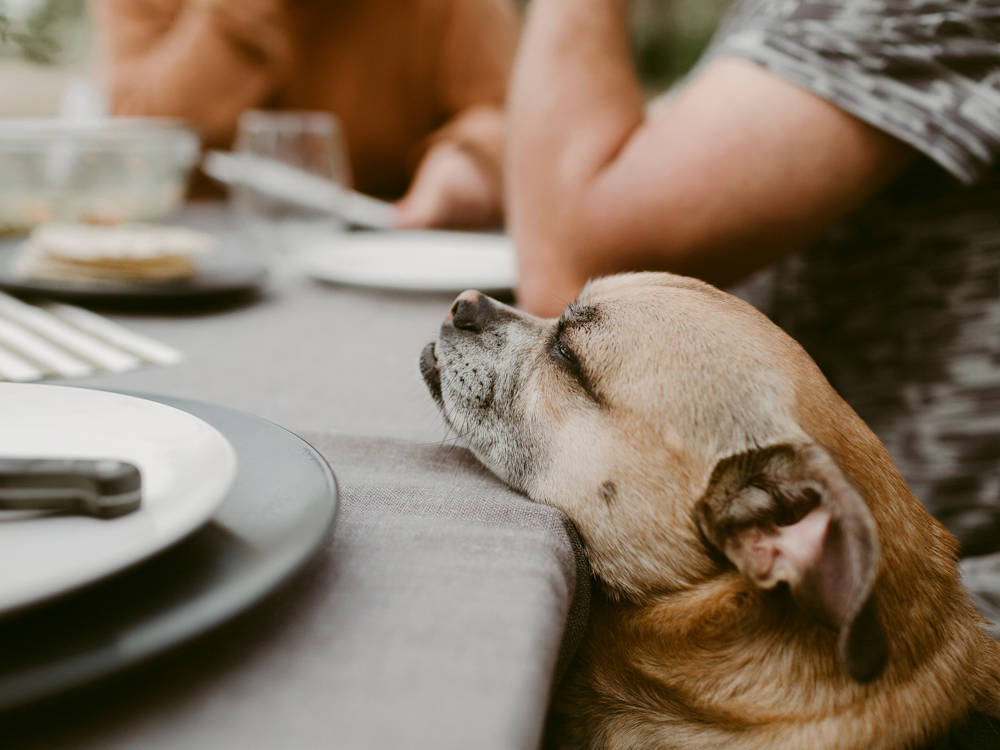
Every year, some percentage of Thanksgiving dogs disgrace themselves, and every year their people take it personally. The dog stole a roll. The dog counter surfed the bird. The dog would not stop begging at the table, in front of your sister-in-law, who has opinions.
Here is the reframe that makes the day survivable: none of that is a training failure. It is an environment failure. You have filled a house with the most interesting smells your dog will encounter all year, added a crowd of humans who have never once said no to him, left food at nose height, and then asked him to demonstrate impulse control he was never taught and could not use anyway.
Impulse control under that much distraction takes months of work, sometimes years. If Thanksgiving is in two days, you do not have months. What you have is the ability to change the environment, and that turns out to be enough. Do not train the dog. Rig the day.
So we are going to work through this the way the damage actually arrives, worst first: the table, the trash, the door, and then the dog himself.
1. Set the food rules before your guests set them for you
Your guests are going to feed your dog. Some of them will do it after you have asked them not to, because they think a little bit will not hurt and because your dog is very good at his job. So instead of relying on a rule nobody will follow, decide what is allowed and put it where people can see it.
The stuff that lands dogs in the ER:
- Fatty scraps, turkey skin, gravy, and drippings. This is the big one, and it is the reason emergency clinics dread this week. A sudden hit of rich, fatty food can trigger pancreatitis, an inflamed pancreas that is painful, expensive, and occasionally fatal. Small dogs need shockingly little of it.
- Cooked bones. Cooked poultry bone splinters. It can perforate a gut. The carcass on the counter and the carcass in the trash are both loaded weapons.
- Onions, garlic, leeks, chives, and shallots. In stuffing, in gravy, in green bean casserole, in almost everything on the table. They damage red blood cells, and the damage is dose-dependent and cumulative.
- Grapes and raisins. In the stuffing, in the salad, in the pie. Kidney failure, at unpredictable doses.
- Xylitol. In sugar-free desserts, in some peanut butters. Causes a crash in blood sugar and liver damage, fast.
- Chocolate, alcohol, and rising bread dough. All three do exactly what you fear they do.
The stuff that is genuinely fine, in small amounts: plain unseasoned turkey meat with no skin, plain sweet potato with nothing on it, plain green beans, plain pumpkin (not pie filling), a slice of apple.
If you want the guests to comply, put a small bowl of approved dog treats by the door and tell people that is the bribe. People want to give your dog something. Give them something to give.
The Thanksgiving cases we see are almost never one dramatic mistake. They are eleven people each slipping the dog one harmless little thing. By eight o’clock that dog has eaten a meal’s worth of fat, and pancreatitis does not care that every individual piece was small.
Signs that mean call now, not tomorrow: repeated vomiting, a hunched back or a belly that hurts to touch, refusing to move, restlessness that will not settle, drooling and pacing with a swollen abdomen, pale gums, or any collapse. Do not wait it out overnight. Know where your nearest emergency clinic is before you need it, because looking that up at 11 p.m. on a holiday is its own small catastrophe.
2. Clear the field the second the meal ends
The window between the last bite and the fridge is the most dangerous hour of the day, and almost nobody guards it, because the humans are full, slow, and pleased with themselves, while the food is now completely unattended.
Wrap it and put it away immediately. Cover the counter. Get the carcass off the stove. And take the trash out of the house, not into the kitchen bin. A dog who gets into a Thanksgiving garbage bag has just eaten fat, bones, string, foil, and onion skins in one sitting, which is a nearly perfect recipe for the exact ER visit described above.
Do this before you sit down with coffee. The coffee will still be there.
3. Run a door protocol
This is the one the tip lists forget, and it is the one that ends worst.
Thanksgiving means a door that opens over and over, people carrying dishes with both hands, kids running in and out, and a dog who is overstimulated. Dogs bolt on holidays, and a bolted dog on a day when half the neighborhood is traveling is genuinely hard to get back.
Before guests arrive: confirm his collar is on and the tag is legible, confirm the microchip registration is actually current (most are not), and put him behind a gate or a closed door during the arrival window, which is the highest-risk twenty minutes of the day. Tell one specific person that the dog is their responsibility at the door. Diffuse responsibility is how dogs get out.
4. Decide in advance where he is not
Now build a barrier, and stop feeling guilty about it.
The kitchen while you cook and the dining room while you eat are the two rooms where nearly every Thanksgiving disaster begins. If your dog can settle comfortably in a crate or a closed room, that is not a punishment, it is a plan. Plenty of dogs find a house full of strangers genuinely stressful, and the quiet back bedroom is the kindest thing in the building.
The important word is comfortably. A dog who has never been crated does not learn to love a crate on the day of the party. If that is your situation, use a baby gate and give him a spot with a view, where he can see the action without being able to reach the table.
5. Give him something better to do than beg
An unoccupied dog in a room full of food has exactly one job available to him, and he will take it.
Stock up beforehand: a stuffed rubber toy, a food puzzle, a long-lasting chew, something that requires work. Freeze a couple of them, because frozen doubles or triples how long they last. Plan on at least two: one while you are cooking, one when you sit down to eat, and make the second one the best thing he has had all week. A dog working on a frozen puzzle is a dog who is not tracking the turkey, and this works whether he is crated in the back or lying under the table with the guests.
6. Exhaust him before anyone arrives
Everything above is architecture. This one is chemistry, and it is the reason the architecture holds.
A dog who has had a long walk, a run, a hike, or forty-five minutes of hard play arrives at the afternoon in a different physiological state than a dog who has been in the house since dawn watching you cook. Physical exercise blunts the frantic edge. Mental work does too, and it is easier to fit in: ten minutes of nose work, hiding treats around a room, or a training session for the sake of the thinking rather than the obedience.
Boredom is what turns a dog into a problem. A dog whose day has already been interesting has less need to invent excitement out of your charcuterie board.
7. Walk it off together
Then go outside.
A walk after the meal is good for the humans, obviously, but it is close to essential for the dog. He has spent hours in a loud, strange, food-scented house full of people who kept touching him. He is over threshold even if he looks fine. Twenty minutes of sniffing in the cold evening air resets the whole nervous system, and it is the part of the day where the two of you get to be a team again after a day of you telling him no.
That is the entire program. No obedience required, nothing you needed to start in September. Just a house arranged so that the dog cannot fail, which is, when you think about it, the kindest way to ask anything of anyone.
References
- ASPCA Animal Poison Control Center, People Foods to Avoid Feeding Your Pets
- VCA Animal Hospitals, Pancreatitis in Dogs
- American Veterinary Medical Association, Household Hazards
- Merck Veterinary Manual, Onion, Garlic, Chive, and Leek Toxicosis in Animals
Not a substitute for your vet. Our guidance is educational. For urgent symptoms, contact a vet or emergency clinic right away. Editorial standards
Dr. Park is a board-certified emergency and critical care specialist. She reviews our health and safety content for clinical accuracy and contributes guides on recognising urgent conditions. Her focus is helping owners act quickly and correctly when it matters most.
Meet our experts ↗Keep reading
 FoodThe Christmas Food That Sends Dogs to the ER Isn't Chocolate. It's the Gravy.Dr. Priya Nair · 8 min
 LivingA Wolfdog Is Not a Fluffier Husky. Nobody Can Tell You What You Actually Own.Dr. Ravi Mehta · 8 min
 Health & WellnessYou Dog-Proofed the Yard and Forgot the SkyDr. Mara Chen · 6 min
 Health & WellnessDon't Skip Your Dog's Summer Workout. Move It. Here Are 7 Ways.Dr. Lena Park · 7 min
 LivingDon't Teach Your Dog to Swim. Teach Them to Get Out.Dr. Priya Nair · 8 min
 LivingYour Dog Doesn't Hate Fall. It Hates Your Calendar.Dr. Mara Chen · 8 min