


Stop Dog-Proofing Your Home. One Designer Did the Opposite.
For a New York show house, Sheila Bridges built a room that treated dogs as the point instead of the problem. It quietly rewrote what a dog-friendly home can look like.

Most advice about living with a dog is defensive. Cover the sofa. Choose a rug you will not mourn. Pick a paint color roughly the shade of a shedding Lab. The unspoken assumption is that the dog is a threat to the room, and the room is something to be protected from the dog.
Then there is the room Sheila Bridges built.
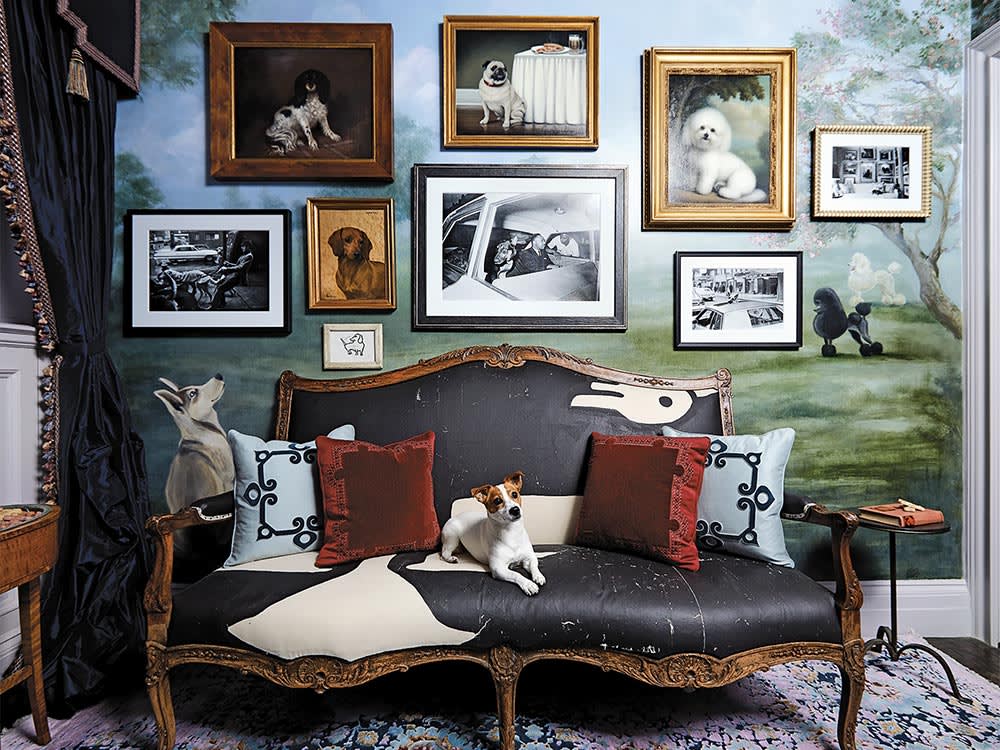
For the 2019 Kips Bay Decorator Show House in Manhattan, Bridges was handed a small ground-floor reception space and thirty days. She turned it into Le Salon des Chiens, a room organized entirely around dogs, and the thing visitors remember about it is not the drapery. It is that she rigged the powder room to bark at them.
The worst room in the house
Show house assignments are handed out more or less at random, and Bridges drew a difficult one: a cramped reception room facing the street, on the ground floor, with the added indignity that anyone who needed the public bathroom had to walk straight through it. Foot traffic, no privacy, not much square footage. It is the kind of assignment that produces a beige holding pen.
Central Park was a block and a half away, and the parade past the window was dog walkers. Bridges, who walked her own two Australian Shepherds, Jax and Wheeler, in the park most mornings, took the constraint and made it the concept. Rather than hide the room’s function as a corridor, she leaned into what was already moving through it.
The result was a salon for dogs and the people who move them around a city: a place to come in from a walk, clean off, and sit down. The backdrop was a hand-painted mural of the Great Hill, the stretch of Central Park where she actually walked.
A gallery wall that was an argument
The walls are where the room stopped being decoration and started being a thesis.
Bridges layered them salon-style with dog imagery pulled from wildly different registers: formal oil portraiture of the sort that used to signal aristocratic leisure, needlepoint, drawings, and archival black-and-white press photography, including images from the Civil Rights era.
That last category is what made the room land. Hung in the middle of the wall was a photograph of Martin Luther King Jr. in a car’s back seat, beside a German Shepherd. Many visitors read it as a charming candid of a great man and his dog. It is a police car. Andrew Young is standing at the window. Whether the dog was placed in the back to intimidate King or to protect him is not settled, and Bridges kept it up precisely because the answer depends on who is looking.
Nearby hung a 1964 press photograph of a man described as New York City’s first professional dog walker, standing outside Central Park in a sports coat, trousers, leather shoes, and a hat, dressed considerably better than any dog walker currently working the same block.
Put those two images on one wall and the room is no longer asking whether you like dogs. It is asking what your relationship with dogs was handed to you by history, geography, and race, and whether you have ever examined it.
What actually happened in there
Here is the finding buried in the middle of a decorating story. Design show houses exist so that people can talk about carpet. Visitors came into Le Salon des Chiens and talked about their own dogs instead.
Not the mural. Not the upholstery. Their dogs. The room built for canine subject matter turned every stranger in it into someone with a story about a terrier.
And then they walked toward the powder room, where Bridges had hung a “beware of dog” sign and wired a motion detector to a recording of a barking dog, the sort sold as a burglar deterrent. Step over the threshold and the barking started, and it did not stop until you left. Roughly nine in ten visitors thought it was very funny. A few did not.
It was also, she has been clear, a practical decision. Nobody waiting in a line six feet away wanted to hear what was happening in that bathroom, and nobody in the bathroom wanted to be heard. The barking covered the sound, and it moved the line along. A design solution disguised as a joke, which is usually the best kind.
Design toward the dog, not around it
The reason the room still matters is that it inverted the default. Bridges did not ask what a dog might ruin. She asked what a dog is, and built for that.
You can do a version of this without a mural budget. The trick is to stop treating durability as a defensive concession and start treating the dog’s actual behavior as a design input.
Start with where the dog already goes. Dogs choose resting spots for reasons: a sightline to the door, a patch of sun, proximity to where you sit. Fighting that choice is how you end up with an expensive unused dog bed and a dog on the good chair.
“People buy a bed and then get frustrated the dog ignores it, when the dog has already told them where it wants to lie,” says Dr. Nina Kohl. “Watch for a week before you buy anything. Put the comfortable thing in the place your dog picked, not the place that suits your floor plan.”
Buy the fabric on the spec, not the vibe. Upholstery abrasion resistance is measured in double rubs, and the contract-textile world uses roughly 15,000 double rubs as a general-use benchmark and 30,000 as heavy-duty. A tight weave beats a loose one, because loose weaves are what claws catch and pull. Leather scratches but wipes; performance polyester and microfiber resist staining. Removable, washable covers are worth more than any single fabric choice.
Choose flooring for traction, not just for stains. Slick hard floors are a genuine problem for older dogs and for any dog that takes corners at speed, and runners with grip do more for a senior dog’s joints than most supplements will.
Give the dog something to look at. A window with a view of the street is enrichment, and a room that offers a dog nothing to do is a room where the dog invents something to do.
Let the dog show up in the decor. The most persuasive thing about Le Salon des Chiens is that it did not pretend the dog was an inconvenience the design was tolerating. The dog was the subject.
What’s new since this was written
Designing around pets has stopped being a niche request. About 71% of U.S. households now live with a pet, roughly 94 million families, and the American Pet Products Association put U.S. pet industry spending at about $158 billion in 2025. That is a large enough market that furniture makers have responded.
The practical upshot for you is that performance fabrics are no longer the ugly compromise they were in 2019. They now come in the same weights, weaves, and colors as everything else on the showroom floor, which means the old trade-off between a room you like and a room your dog can live in has mostly dissolved.
The one thing that has not changed is the part Bridges got right, which is that a dog-friendly room is not a room that survives a dog. It is a room that is better because the dog is in it.
References
- Kips Bay Decorator Show House — Kips Bay Boys & Girls Club
- See the 2019 Kips Bay Decorator Show House — Interior Design
- Sheila Bridges Creates a Dog Lover’s Paradise for Kips Bay NYC 2019 — House Tipster
- ACT Voluntary Performance Guidelines — Association for Contract Textiles (upholstery abrasion / double-rub standards)
- Facts + Statistics: Pet Ownership and Insurance — Insurance Information Institute, citing the APPA National Pet Owners Survey
- U.S. Pet Industry Reaches $158 Billion in 2025 — American Pet Products Association
Sasha Ford is a certified cat behaviour consultant who has worked with shelters, catteries, and private clients across the country. They review all feline behaviour content at The Pet Times, with expertise in multi-cat households, indoor enrichment, and stress-related disorders.
Meet our experts ↗Keep reading
 Living8 Habits of a Great Dog Owner That Have Nothing to Do With MoneyClaire Sutton · 6 min
 LivingThe Dog Park Is a Near-Perfect Matchmaking Machine. Here's the ProofLeila Torres · 9 min
 LivingDoes Raising a Dog Together Prep You for a Kid? Yes and No, ExactlySara Lim · 5 min
 LivingDon't 'Demote' the Dog When the Baby ArrivesDr. Amara Solis · 6 min
 LivingThe 8 Dogs Who Built the Entire Pet-Influencer EraLeila Torres · 5 min
 LivingThe Dog-Walking Rules Your Neighbors Wish You KnewSasha Ford · 5 min