


The Dog Park Is a Near-Perfect Matchmaking Machine. Here's the Proof
Three couples who met at the dog park don't just make for sweet stories. They reveal, almost like a controlled experiment, why the dog park beats every dating app, and there's real research behind it.

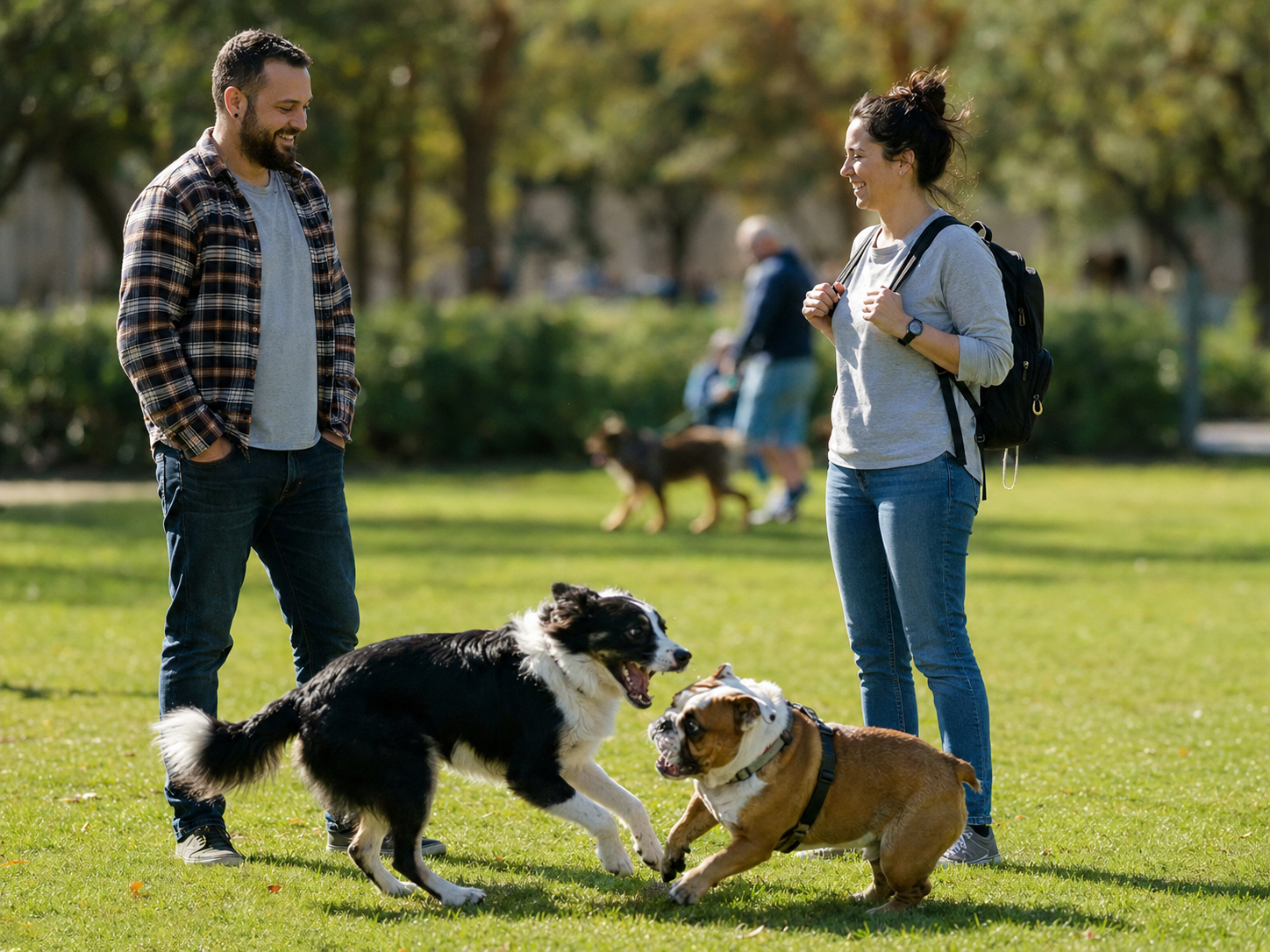
Meeting the love of your life at the dog park sounds like a rom-com premise, too tidy to be real. It is not. And the reason it works is not luck. The dog park quietly checks nearly every box that decades of relationship research say a good meeting place should, and it beats a dating app on most of them. Three couples let me pick apart how they got together, and read side by side, their stories read less like coincidences and more like the same machine producing the same result three times.
Why it works, before the stories
Sociologists have a name for the spaces where casual community forms outside home and work: the “third place.” Dog parks are an unusually good one, because they combine four things that rarely show up together. You return again and again, so the same faces repeat (psychologists call the warmth that builds from simple repeated exposure the mere-exposure effect). Everyone present has already passed a values screen: they are a dog person, outdoors, on a weekday, prioritizing their animal. There is a built-in, zero-pressure conversation starter standing right there wagging. And, uniquely, there is a living character reference attached to each candidate.
That last piece is not folklore. A well-known set of experiments by researchers Jane McNicholas and Glyn Collis found that simply having a dog present sharply and reliably increases friendly interactions with strangers, an effect so robust it held up even when the dog was trained to ignore passers-by. A dog makes its human read as more approachable and more trustworthy. More recent work links dog ownership to a stronger sense of community and more “anchored” local relationships. In other words, the science says the dog park should work. The couples below show what that looks like in practice, each one illustrating a different gear in the machine.
Kacie and Adam: repeated exposure (Durango, Colorado, 2013)
You know it is meant to be when your dogs come from the same shelter. Kacie and Adam Larson kept crossing paths at the one dog park in town with their dogs, Eddie and Ellie, then started spotting each other elsewhere, on hikes around Durango. Both dogs were just under a year old, and both had come from the La Plata County Humane Society.
This is the mere-exposure effect in its natural habitat. “Eddie and Ellie were instantly friends and kind of gravitated towards each other and loved playing,” Kacie recalls, “so naturally, Adam and I just started talking.” One hike still stands out: she was starting up the trail as Adam came down, and the instant they crossed paths, the dogs greeted each other and played. “I remember at that moment, I was like, ‘Oh my gosh, what is going on here?’” By the third or fourth run-in, Adam asked for her number. They got dinner and “have been inseparable since that first date.”
When they moved in together, the couple and both dogs, a Border Collie mix and a Pointer mix, crammed into a studio apartment. It went smoothly, Kacie says, largely because Eddie and Ellie had already bonded as thoroughly as their humans, “playing together, running around the studio apartment, and napping together in their crate.” The dogs are around 13 now, joined by a scrappy Terrier named Willow and a Cavalier King Charles Spaniel named Pip. Kacie is clear about the dogs’ role: “Had we not had them, we might not have done a lot of the things we did together,” from car camping to weekend travel. “Even today, they inspire us to get out and take a breather, to unplug and be in the moment.”
Cristina and Justin: the built-in vouch (Los Angeles, California, 2013)
Cristina Vericella and Justin Greenberg had gone to the same high school, but they really met at the dog park in their twenties. Cristina watched Justin crest a hill, lock eyes, and walk straight over, in a rust-red shirt that brought out the honey in his hazel eyes. “It was such a romantic moment,” she says. “It was kismet. He looked at me and said, ‘Did you go to Beverly Hills High School?’”
When he asked for her number, she hesitated, freshly back from living in Italy and unsure she was ready. “Let’s just have a nice date and talk,” he said. They texted all night. He brought flowers, they closed down the restaurant, moved to dessert at The Ivy and closed that too, overhearing Quentin Tarantino a few tables over discussing The Hateful Eight. “Only in LA.”
But the decisive moment was pure dog-park logic: the vouch. Justin dropped her off and came in to meet her Shetland Sheepdog, Oliver. “He did not love a lot of people, but he loved Justin,” Cristina says. “I remember him putting his paw in his lap and moving very close. It was like a sign for both of us: Oliver gave us the OK.” They were officially dating a week later. For years the two spent long afternoons with all four of their dogs, Oliver and the family Sheltie Charlie, plus Justin’s Aussie Penny and Poodle mix Lambchop, picnicking on the beach in Malibu, sometimes for five hours at a stretch. All four have since passed, and the couple has only recently felt ready to think about another. “No matter how much you treasure it, it’s still gut-wrenching,” she says. But she is unequivocal about the debt: “If they didn’t get us to go outside, we would not be together today.”
Jamie and Tom: the icebreaker (Chicago, Illinois, 2012)
It started as a joke, which is what a good icebreaker is for. Jamie and Tom Quinn were both regulars at the same park when their dogs became friends first: her one-year-old Labrador, Benny, and his one-year-old mixed breed, Dublin. After watching the pups play, Tom cheekily offered to chauffeur them to a dog bar for a one-on-one hang. They swapped numbers, and then he followed up: “Don’t bring the dogs.”
They lived two blocks apart, it turned out, and came to see that their dynamic mirrored the dogs’, “yin and yang.” Benny was wild and a little unhinged, the kind of dog you come home to find standing on the counter, while Dublin was shy. “Benny brought Dublin out of his shell, and Dublin helped bring Benny down to earth,” Jamie says. Her mother put it best: “Anyone who can handle you and that dog is a keeper.” Their pack of four settled into a weekend ritual of coffee and the Chicago lakefront, the dogs swimming, Jamie grateful to share it with someone who loved animals as much as she did. Benny and Dublin have both passed, but their role is settled fact in the marriage: “The dogs brought us together.”
If you want to run the experiment yourself
None of this requires being smooth. The machine does the work, so your job is just to feed it: become a genuine regular so exposure can compound, actually let the dogs interact instead of scrolling on a bench, and treat your dog’s read on a person as real data, because a dog who loves someone on sight is telling you something an app never could. The couples above did not out-charm anyone. They showed up repeatedly, let the dogs break the ice, and paid attention to who their dogs trusted. Situationships and ghosting thrive on low stakes and no context. The dog park offers the opposite: repetition, shared values, and a four-legged character witness. It is, as three couples and a stack of studies attest, a remarkably good place to fall in love.
References
- McNicholas, June, and Glyn M. Collis. “Dogs as Catalysts for Social Interactions: Robustness of the Effect.” British Journal of Psychology, vol. 91, no. 1, 2000, pp. 61–70. https://doi.org/10.1348/000712600161673
- Oldenburg, Ray. The Great Good Place. (Origin of the “third place” concept.) https://en.wikipedia.org/wiki/Third_place
- “Dog Ownership Enhances Anchored Personal Relationships and Sense of Community.” PLOS ONE. https://journals.plos.org/plosone/article?id=10.1371/journal.pone.0336957
Leila Torres leads our Living coverage, from home life and travel to the products and rescue stories that come with sharing a life with animals. She edits and writes across the section, with a soft spot for pieces about the bond between people and their pets.
Meet our experts ↗Keep reading
 Living'Certified' Pet Sitter Means Almost Nothing. Here's What Actually Vets OneSara Lim · 6 min
 LivingStop Dog-Proofing Your Home. One Designer Did the Opposite.Sasha Ford · 7 min
 LivingInside the 'Soho House for Dogs,' Where a Dog Park Costs $1,400 a YearSasha Ford · 6 min
 Living"My Last Dog Syndrome": Why Your New Dog Keeps Losing to a GhostDr. Nina Kohl · 7 min
 LivingForget the Heart Balloon: 6 Ways to Be Your Dog's Real ValentineSasha Ford · 5 min
 LivingThe Dog Who Calms Olympians Needed Help Himself. How Beacon Pulled ThroughDr. Mara Chen · 4 min