


This Illustrator Doesn't Draw Pets. She Draws Familiars.
Sofie Birkin's women are never alone. There's always an animal, and it's never decorative. Her rescue German Shepherd mix sleeps on a pile of bones like a dragon and has, she says, granted her scary-dog privilege.

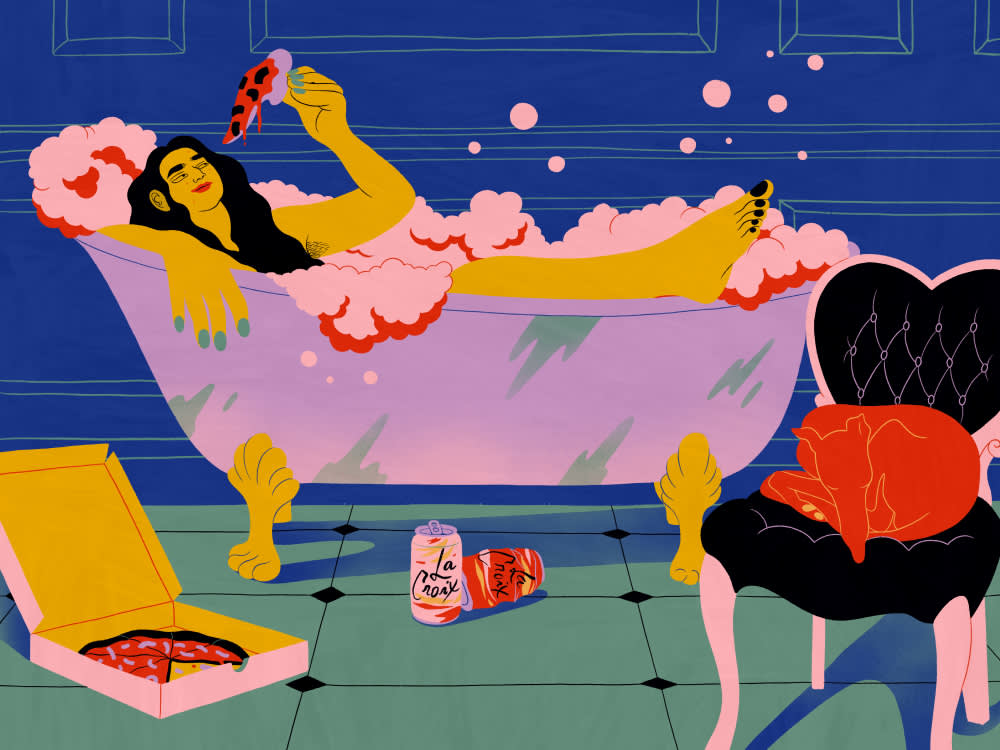
Look at enough of Sofie Birkin’s work and you notice the rule before you notice the animals.
The women in her illustrations, bold, sex-positive, fantastical, and fiercely queer, are frequently alone. But they are never alone alone. There is a dog on the chair. A cat curled at the foot of the tub. Something furred or feathered or occasionally scaled, sharing the frame.
Ask her about it and she does not describe pets. She has said she draws solitary women constantly, and that pairing one with an animal fleshes out who that woman is faster than anything else in the frame. The animals, in her framing, function less like pets and more like a witch’s familiar.
That distinction is worth sitting with, because it explains something about the way most of us actually live with animals, and it is not the way greeting cards describe it.
A familiar is not a pet
A pet is something you own. It is warm, it is decorative, it is grateful.
A familiar is something else: a companion with its own agenda, bound to you by an arrangement neither party fully controls. It knows things. It sees you. It occasionally acts on your behalf without being asked. And crucially, it makes you legible. In Birkin’s frames, what the woman keeps beside her tells you who she is faster than her face does.
That is a genuinely accurate description of what a dog does in a household, and a far better one than “companion animal.”
Born in the U.K. and working out of Denver, Birkin is self-taught, and she works as an illustrator, a muralist, and an installation artist. Apple, Google, Nike, Planned Parenthood, Billie, Insider, Bon Appétit, Bust, and The New York Times have all hired her. She illustrated Ruby Rare’s Sex Ed: A Guide for Adults and Jake Hall’s The Art of Drag, made a deck of erotic tarot cards, and has a permanent installation at Meow Wolf Denver. The full tarot deck she completed, Intimate Intuition for Laurence King, was the project she had always meant to do and had long assumed was too large to take on by herself. Having a team of writers and art directors around it, she says, is what made it possible, and she is proud of the research that went into every card.
The career was built on spite, which she will tell you herself
She is mostly self-taught. A commercial illustration job at a marketing agency, landed in 2016, gave her years of paid practice, and she did not go freelance full-time until 2021.
The years before that were a tour of jobs she is happy to describe as beneath her talents and beyond her patience. She was, by her own assessment, a bad bartender and a worse server. She bagged popcorn for tourists who made her repeat the word “butter” until it stopped meaning anything. There was a stint printing hockey slogans onto an enormous quantity of infant clothing, another assembling cheap charm jewelry by the thousand, and a brief and glorious period teaching bachelorette parties to construct fascinators, which ended when she was fired for plucking a pheasant on the premises. The low point involved gluing rhinestones into the shape of handcuffs onto bridal shoes destined for a police wedding, a task she describes as spiritually destructive.
The turn came from an insult. Home in Southend-on-Sea in 2016, a drunk friend from school told her, lovingly, that everyone was a bit disappointed, because they had all assumed she would be the one who made it.
Spite, she says, is the fuel that has never let her down. She went home, dropped to two days a week at work, and burned six weeks of savings assembling a portfolio, then applied everywhere that would take an application. A paid internship came out of it. That internship turned into the in-house illustrator role, and the role turned into the career.
She is fond of her hometown, in a manner she concedes is obligatory: crumbling Georgian frontages, gulls with genuine malice in them, and the wreckage of somebody’s chips flattened into the cobbles. Writing about the place without deploying the phrase “decaying glamour” is, she suspects, a prosecutable offense.
The dog is a sentient medieval gargoyle
On paper, he is Sir Arthur Pendragon the Once and Future King. In practice he is Arthur, because announcing the full title across a dog park would, she reckons, get her sectioned.
He came from a local shelter, RezDawg, about three years ago, a six-month-old stray. The DNA test came back mostly German Shepherd, with Pit Bull, Catahoula Leopard Dog, Chow Chow, and Beagle in the mix. Which is to say: a large mutt.
Nobody warned her about the sleeping, or the total absence of it. The thing that rescued her was the enforced nap, a technique she now evangelizes with the zeal of a woman who would happily knock on doors to spread the word to sleep-deprived puppy owners.
Arthur is a weirdo. She says this with unmistakable devotion. He is a dog who requires a preamble before people meet him: sweet, deeply independent, faintly neurotic. He despises camping, which she considers a betrayal of the entire species. He collects bones into a heap on her bed and sleeps on top of the pile like a small dragon guarding a hoard, an arrangement her allergic partner tolerates through what she describes as saintly patience and a steady supply of antihistamines.
He has decided that his purpose on earth is her protection, and on one genuinely frightening occasion he made good on it. She has, she notes, the benefit of a dog nobody wants to test.
The best quality, and the worst
The best thing about him is how he is with other dogs. She has yet to find one he cannot win over, and he takes small dogs under his protection. She has watched him step in, perfectly calmly, when a puppy was getting mobbed at the park.
The worst thing about him is the noise he makes at dawn, an urgent high whine issued from a dog who believes he is minutes from starvation. He is also, in the way German Shepherd owners will recognize instantly, the fun police. If his friends start acting up, he comes to fetch her so an adult can intervene.
Home is a grand old house carved into apartments, with a wild overgrown yard, and since every unit has a dog, the garden is a permanent summit. His closest friends, Mookie and Mia, belong to her two closest friends, and Arthur outweighs the pair of them several times over. Together, she says, the three of them are a feature-length animated film. His favorite word is “friend,” and a day without them puts him in a mood.
What she taught him, and what he taught her
She trains only with positive reinforcement, and she is proudest of his recall. Her favorite trick is “side,” which puts him on his flank on command so she can get at all four paws when he picks up snow or a thorn. It is a useful trick rather than a party trick, which tells you something.
He requires bribes. She is clear about that.
As for what he has trained her to do: he is very insistent about ear scratches, so she has mastered the art of drawing and petting him with her foot at the same time.
Does she think she and Arthur look alike? Not remotely. Her doppelgänger, she insists, lives downstairs: a Dachshund named Dank, an agreeable and talkative old gentleman with curly red hair, a long body, short legs, an appetite for attention, and a documented habit of stealing meat. She sees a great deal of herself in him.
The people who describe their dog as a weirdo are, in my experience, the people who are actually paying attention. Loving a dog in general is easy. Knowing that yours sleeps on bones like a dragon means you have been watching.
There were others before Arthur: a gentle old Black Lab called Angus, a rescued Golden Retriever called Rupert, both of whom she loved past all reason. She reads about dogs compulsively, which she ranks among her more dependable ADHD hobbies, and she accepts the label of obnoxious dog person without argument. What a dog gives a person, in her estimation, is one of the finest things on offer in a human life.
She takes commissions when she has room, and yes, she loves doing pet portraits.
What’s new since this was written
The commission market Birkin works in has been reshaped by generative image tools, and pet portraits sit at the center of it, because they are the single most requested category of personal commission there is.
The interesting result is not the one people predicted. Demand for hand-made pet portraits has, if anything, sharpened, because the thing an automated image cannot do is the thing Birkin is describing throughout this piece: notice. A generated portrait renders a dog. An illustrator who asks what your dog is actually like renders a familiar, one folded ear, the specific ridiculous sleeping position, the exact quality of the stare. The value was never the likeness. It was the attention that produced the likeness.
If you commission one, the practical advice from illustrators is consistent: send the bad photos too. The blurry one where the dog is mid-yawn tells an artist more about who they are than the posed one ever will.
References
- Sofie Birkin. Artist portfolio and commissions. sofiebirkin.com
- Laurence King Publishing. Intimate Intuition tarot deck. laurenceking.com
- Meow Wolf Denver. “Convergence Station: Artists.” meowwolf.com/visit/denver
- RezDawg Rescue. rezdawgrescue.org
Leila Torres leads our Living coverage, from home life and travel to the products and rescue stories that come with sharing a life with animals. She edits and writes across the section, with a soft spot for pieces about the bond between people and their pets.
Meet our experts ↗Keep reading
 LivingThere's No Right Time for Another Dog. Ask This Instead.Leila Torres · 6 min
 Living"Hypoallergenic" Barely Holds Up. The Breeds That Come Closest for Allergy SufferersDr. Lena Park · 8 min
 LivingHe's Fostered Almost 40 Pit Bulls. The Stigma Is the Only Thing He Can't Rehome.Leila Torres · 8 min
 LivingA Comment on Instagram Got a Two-Legged Street Dog a Mercedes WheelchairJames Okafor · 5 min
 LivingThey Came to Shoot a TV Show. They Left Having Saved 14 Dogs.Sara Lim · 6 min
 LivingHe Took a Puppy Out of an Abuser's Hands. A Cop Watched and Shrugged.Nina Vasquez · 6 min