


Scent Work Isn't a Party Trick. It Measurably Makes Your Dog More Optimistic.
Hiding treats in boxes sounds like a cute way to kill ten minutes. In the research, it changes how dogs interpret an ambiguous situation. Here is the science, and the at-home program.

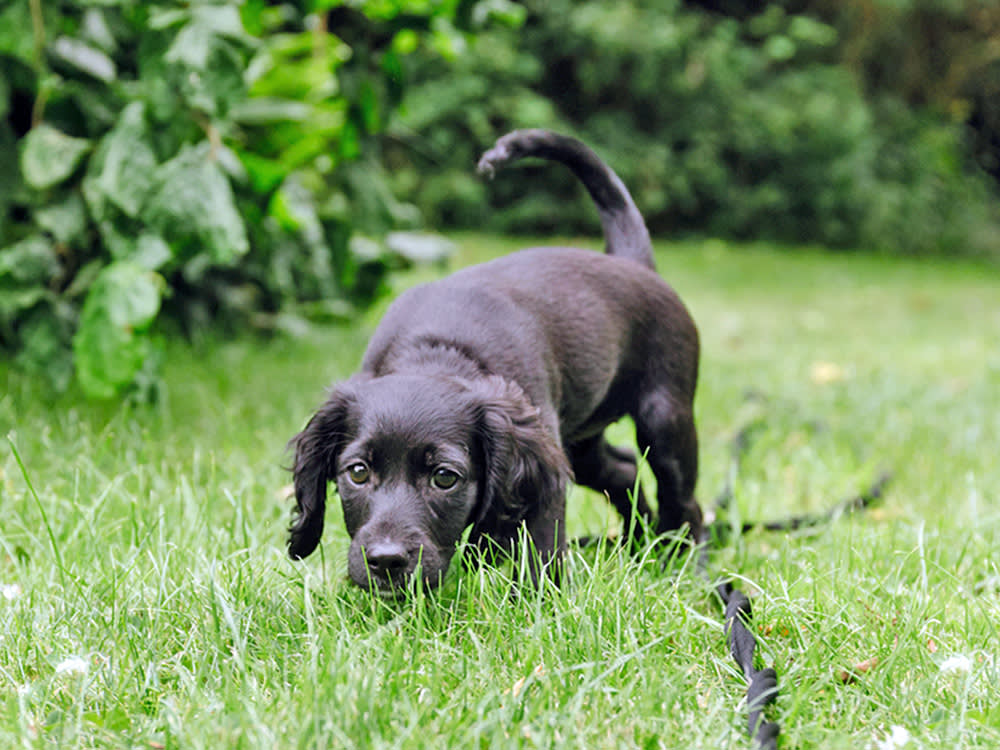
Your dog can detect some odors at concentrations of roughly one part per trillion. That fact usually gets used to sell a party trick: look what the nose can do, isn’t that neat.
The more interesting finding is what happens to a dog’s mood after they use it. In a study by Charlotte Duranton and Alexandra Horowitz, pet dogs who did a couple of weeks of nosework became measurably more optimistic in a cognitive bias test. Faced with an ambiguous bowl, one that might or might not have food in it, the nosework dogs were more likely to go check. A comparison group doing heelwork did not shift the same way.
That is not a trick. That is a dog changing how they place a bet on an uncertain outcome, which is about as close as we can get to asking a dog whether they feel hopeful.
If you have an anxious dog, a bored dog, a stiffening senior, or a dog whose brain outruns your schedule, this is the highest-return ten minutes you are not currently spending. And it costs nothing.
Why sniffing does something a walk does not
A walk moves a dog’s body. A search engages a dog’s judgment.
Scent work is unusual among dog activities because it is dog-led. In agility or obedience, you cue, the dog responds, you reward. In a search, you cannot help. You do not know where the odor has drifted, how it is pooling in the corner, or what the air currents are doing behind the couch. The dog solves it. You are the person holding the treats at the end.
That inversion is the whole point. The dog is not complying, they are deciding, testing, ruling out, and committing. Research reviewing scent-based activities makes exactly this distinction: scent work requires problem solving that is largely independent of the handler, unlike handler-directed canine sports.
The knock-on effects show up across the dog:
For the nervous dog, a search is a task with a guaranteed win. Anxiety is often a shortage of predictable good outcomes. A hidden treat is a small, findable, reliably good outcome, produced by the dog’s own effort.
For the high-drive dog, a search burns mental fuel that a lap around the block does not touch. A frustrated Border Collie is rarely a dog who needs more distance.
For the senior dog, it is enrichment that does not tax the joints. The nose ages far better than the hips do.
For the dog with no obvious problem, it is still the cheapest enrichment on the shelf, and it makes you better at reading them.
Owners tell me their dog is tired after a long hike and still restless by dinner. Ten minutes of searching often settles the same dog completely, because you finally gave the part of them that was awake something to do.
Getting set up takes about four minutes
One appealing scent. Something that makes your dog’s eyes widen. Freeze-dried liver, shredded chicken, a piece of hot dog. The stinkier, the better. If it does not smell like much to you, it is not carrying far enough to be a search.
Containers you already have. Muffin tins, cardboard boxes, food storage tubs, plastic cups. The requirement is that the treat is hidden from the eyes, so the nose has to do the work. If your dog can see the food, they are doing a vision exercise.
A quiet space. A bedroom, a spare corner, the low-traffic end of the living room. No blaring TV, no kids underfoot, no cat conducting surveillance from the bookshelf.
That is it. There is no gear tier you are missing.
The three starter games
Scent introduction
Hold the target where your dog can get a proper nose on it, whether that is food, a favorite toy, or a cotton ball you have scented. Give your cue one time, “find it” or “go sniff,” and pay the moment they engage with it. Keep it loose and encouraging. Nothing is being tested here. You are just teaching them that this smell is now a job that pays.
Find the treat
Hide a treat somewhere nearly visible. Behind a chair leg. Under the corner of a blanket. Let them find it fast, several times running. Then make it harder: new locations, more treats, a second room. Easy wins early build the persistence you will need later.
The box game
Set out three to five containers and put food in exactly one. Your dog’s job is to find the paying box. As they get better, swap the containers around between reps, slip in empty decoys, or add more of them. This is where you get to watch a dog rule out options, and it is genuinely fun to see the moment they stop checking box one first.
When to go harder
Once the basics are boring, escalate.
Room search. Hide the scent somewhere in a bigger room and let the dog work the whole space: behind cushions, under a table, in an awkward corner. Reward the instant they commit to the source, not when they look at you for help.
Outdoor work. Take it to the yard or a trail. Outdoors is a firehose of competing odor, so keep sessions short and start on leash. The extra noise and sensory clutter are real difficulty, not just a change of scenery.
Scent trails. Smear a treat along the floor or through the grass to lay down a path, then send your dog to work it. Keep the first ones short and straight. Stretch the distance later, then bend it around corners.
The rules that make it work
Pay the try, not the result. A dog who comes up empty gets redirected and cheered on, never corrected. Scolding a search kills it outright, because a dog who has been punished for guessing stops guessing, and guessing is the whole activity.
Break treats small. For a food-motivated dog, tiny pieces let you pay frequently without turning training into a second dinner. For a toy-driven dog, a quick tug or ball toss is the jackpot.
Five to ten minutes, then stop. End on a success, even a small one. If your dog finds the treat fast, resist the urge to immediately make it brutal. Celebrate and quit while it is still good.
Add one variable at a time. New room, or new container, or a decoy, or a distraction. Not all four. The goal is a stretch, not an ambush.
Slot it into the day you already have. Before dinner. After a walk. On a rained-out afternoon when the park is a swamp. Consistency is what builds the skill, and a dog with a job is a dog who is not redesigning your shoes.
Nose games your dog does not need you for
If you are pressed, the low-effort version still counts. Scatter your dog’s kibble across a towel and roll it up. Toss a handful of dinner into the grass instead of the bowl. Hide the last few pieces around one room before you leave for work. The dog is still solving; you are just not officiating.
What newer research adds
Since the original nosework and optimism findings, the picture has filled in.
Newer work suggests scent training is not only a mood intervention but a cognitive one. Dogs trained in scent work have shown better inhibitory control, meaning they are more able to pause and assess instead of reacting on impulse, and better cognitive flexibility, meaning they adapt to new problems and new environments more readily. Dogs who do scent work also show more persistence when a problem gets hard, which is exactly the trait most owners wish their dog had.
There is also a growing body of review work mapping what scent activities do and do not deliver, and a 2025 study of dog trainers’ own perceptions found that scent-based activities have become a routine part of behavior work, not a novelty. Trainers reach for them because they are dog-driven and because they work on the nervous dogs.
None of this requires a class, a title, or a competition. It requires a handful of chicken and a stack of boxes you were going to recycle anyway.
References
- Duranton, C., and A. Horowitz. “Let Me Sniff! Nosework Induces Positive Judgment Bias in Pet Dogs.” Applied Animal Behaviour Science, vol. 211, 2019, pp. 61–66. doi.org/10.1016/j.applanim.2018.12.009
- “The Value of Sniffing: A Scoping Review of Scent Activities for Canines.” Applied Animal Behaviour Science, 2024. sciencedirect.com/science/article/pii/S0168159124003332
- “Scent Work Is Incorporated in Almost Everything I Do: Investigating Dog Trainers’ Perceptions of Scent-Based Activities for Companion Dogs.” Applied Animal Behaviour Science, 2025. sciencedirect.com/science/article/pii/S0168159125003351
- “Does Nose Work Training Affect Dog Executive Function and Physical Fitness in Humans and Dogs?” PubMed Central. pmc.ncbi.nlm.nih.gov/articles/PMC12896905/
- “Development of an Automated Human Scent Olfactometer and Its Use in the Training of Detection Dogs.” PLOS ONE, vol. 18, 2023. doi.org/10.1371/journal.pone.0299148
Dr. Kohl is a board-certified veterinary dentist with a particular interest in preventive oral care. She reviews all dental health content at The Pet Times and contributes practical guides on home dental routines, professional cleaning, and oral disease prevention.
Meet our experts ↗Keep reading
 TrainingYour Dog Doesn't Need a Muzzle. Train Them for One Anyway.Dr. Mara Chen · 7 min
 TrainingExcited Isn't the Same as Happy. 8 Signs Your Dog Is Over Threshold.Dr. Nina Kohl · 8 min
 TrainingYour Rescue Dog Isn't Being Difficult. They're Decompressing.Dr. Mara Chen · 8 min
 First DaysYour Puppy Isn't Regressing. They're in a Fear PeriodJordan Ellis · 8 min
 TrainingYour Dog Isn't Reading Your Face. They're Reading Your Hand on the Leash.Dr. Lena Park · 8 min
 TrainingThe Puppy Mistake That Costs More Dogs Than Parvo DoesDr. Nina Kohl · 7 min