


Charlotte's Two Dogs Are the Most Damning Thing in "Sex and the City"
The show gave its most devoted animal lover a Cavalier King Charles Spaniel and then an English Bulldog. Norway has banned the breeding of one of them. A look at the pets of SATC, and what they say about how we choose dogs.
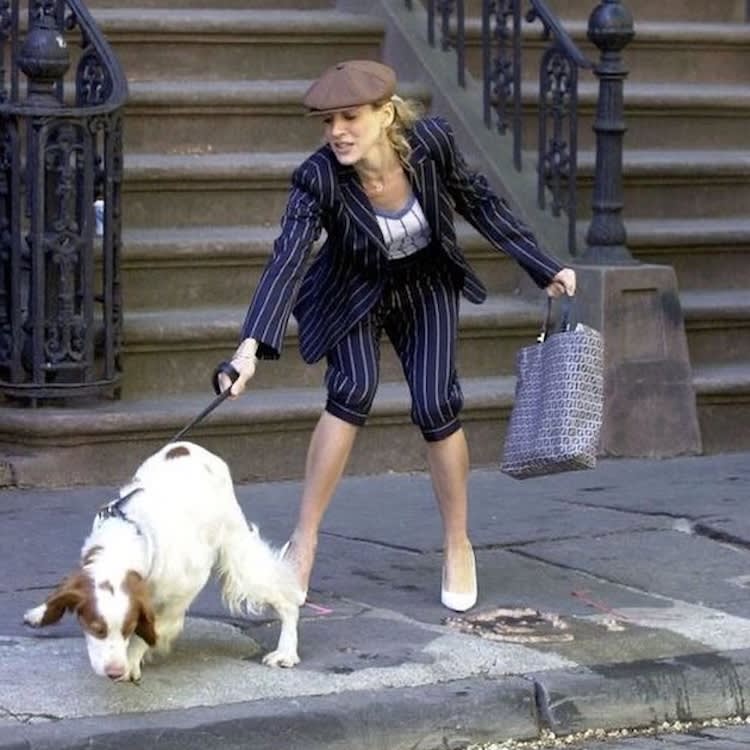
The pets of Sex and the City were never just set dressing. Elizabeth Taylor the Cavalier King Charles Spaniel, Pete the Brittany, Baby the humping Yorkie, and eventually Shoe the kitten were doing real narrative work, telling you exactly what kind of person each woman was before she opened her mouth.
They are also, viewed from 2026, an accidental documentary about how people pick dogs. Because the show’s most dedicated animal lover was handed two breeds that sit at the very center of the modern argument about whether we should be breeding certain dogs at all. And the show, being a show about desire, did not notice. That is the interesting part.
Charlotte’s Cavalier, and the ban
Charlotte York-Goldenblatt gets Elizabeth Taylor, a Cavalier King Charles Spaniel, from a woman she meets in the park. Elizabeth Taylor turns out to be pregnant, the York-Goldenblatts keep the whole litter, and the dogs become a fixed part of Charlotte’s on-screen identity, right down to the first film’s scene of her jogging through a wintry Central Park with the pack.
Cavaliers are, by temperament, exactly the dog a Charlotte would choose. They are also one of the most medically compromised breeds in the world. Myxomatous mitral valve disease afflicts a majority of Cavaliers by five years old and close to all of them by ten, if they live that long. Many also develop syringomyelia, a painful condition caused by a mismatch between skull size and brain size, in which the brain does not fit properly in the skull.
That is not a fringe welfare complaint. In 2022, a Norwegian court effectively banned the breeding of both English Bulldogs and Cavaliers. On appeal, the Borgarting Court of Appeal reversed the bulldog ban as an overreach, and upheld the ban on breeding Cavaliers, specifically citing syringomyelia. A European court looked at this breed and concluded you cannot ethically keep making them.
And then the show got Charlotte a bulldog
Here is where it becomes almost too neat. In And Just Like That, enough years have passed that Elizabeth Taylor has quietly died, and Charlotte’s new dog is an English Bulldog named Richard Burton, a knowing joke about Taylor’s most famous husband.
It is a great gag. It is also a swap from one breed at the center of the Norwegian case to the other. Bulldogs are the flagship brachycephalic breed, the flat-faced dogs whose skull shape brings breathing difficulties, heat intolerance, sleep problems, and frequently surgery. Norway’s ban on breeding them was overturned on appeal, but nobody involved argued the dogs were healthy. The disagreement was about whether a court could prohibit a breed outright.
The writers were not making a point about breeding. They were making a joke about Elizabeth Taylor’s love life. The fact that the two dogs a fictional New Yorker would obviously own happen to be the exact two breeds at the heart of an international welfare test case is precisely the point. We choose these dogs because they look how they look, and the looking is the problem.
Pete, and the dog most people would actually be happy with
Aidan Shaw arrives with Pete, a Brittany, and Pete does more work in that meet-cute than Aidan does. The dog bounds over, covers Carrie in affection, and the introduction is made. Later Carrie is trusted to walk him, gets distracted by Mr. Big, and Pete promptly disappears into New York City before being found safe.
Brittanys are a French bird-hunting breed, and they come with the traits that implies: energetic, intelligent, loyal, and desperate to be with their people. They are also, relative to the show’s other dogs, structurally sound. A Brittany’s problems are behavioral and they are earned. A bored, under-exercised Brittany in a Manhattan apartment will make your life difficult, and a dog who runs off the moment the handler stops paying attention is not a plot device. It is a working breed telling you it has not had a job today.
Which is the quiet lesson of that storyline. The dog who is hardest to live with is often the healthiest one in the room.
Baby, and the behavior everyone laughs at
Samantha adopts Baby, a Yorkshire Terrier, who makes her screen debut mounting a stuffed toy while a shelter worker explains that she has been spayed and has not lost the urge. Baby goes on to hump a pillow in the background of a New Year’s Eve montage and, memorably, one of Carrie’s $300 pillows.
It is played for laughs, and it is a real behavior that confuses a lot of owners. Humping is not primarily sexual in a spayed dog. It is an outlet, and it shows up in play, in overexcitement, and very often in dogs who are aroused and conflicted and do not know what else to do with the feeling.
“A pillow is a victimless target and I do not lose sleep over it,” says Dr. Nina Kohl. “What gets my attention is the dog who does it to other dogs, because that is usually a dog who has hit a level of excitement they cannot handle and has run out of ideas. You do not fix that with a correction. You fix it by pulling them out of the game one beat before they get there.”
The practical version: interrupt before it starts rather than after, redirect into a low-arousal activity, and pay attention to what tends to precede it. An object is a fine outlet. A guest’s leg is not, and it is your job to intervene before your dog gets there.
Shoe, and the one genuinely happy ending
Carrie’s kitten, Shoe, arrives in the second season of And Just Like That, delivered by Che Diaz, and stays because he keeps climbing into the Manolos. Then the story leaves the screen entirely. Sarah Jessica Parker adopted the kitten from the Connecticut Humane Society. He now lives with her family, goes by Lotus, and turns up on her Instagram alongside the other household cats.
A shelter kitten, cast in a role, taken home by the actor. Of all the animal storylines in this franchise, the one with no breeding, no pedigree, and no ethical asterisk is also the only one where the animal got a real-life happy ending. That is not a coincidence, and it might be the show’s most honest statement about pets.
And Just Like That wrapped with a two-part finale in August 2025, ending the franchise after three seasons. So this is, for now, the complete menagerie.
What newer research adds
The most consequential development is the one already mentioned: Norway’s appeals court in 2023 overturned the English Bulldog breeding ban while upholding the Cavalier one, which makes the Cavalier ruling the strongest legal statement any country has made about the ethics of breeding a specific dog.
It is not the only lever. In Cavaliers specifically, mandatory heart-screening breeding schemes, which use auscultation and echocardiography to keep affected dogs out of the breeding pool, have been shown to reduce the prevalence of mitral valve disease over an eight to ten year period. That is the encouraging half of the story. The problem is soluble, if breeders are made to solve it.
If you have fallen for a flat-faced dog or a Cavalier, none of this means you love the wrong dog. It means you should go in with your eyes open, ask for the health testing on the parents, budget for the cardiologist, and understand that when a court in Oslo says this breed cannot ethically be reproduced, they are talking about the breeding, not about your dog on the sofa.
References
- Borgarting Court of Appeal ruling on dog breeding, reported in Veterinary Record. “Norway partially overturns breeding ban.” https://bvajournals.onlinelibrary.wiley.com/do/10.1002/vetr.00100070
- Birkegård, A. C., et al. “Breeding Restrictions Decrease the Prevalence of Myxomatous Mitral Valve Disease in Cavalier King Charles Spaniels over an 8- to 10-Year Period.” Journal of Veterinary Internal Medicine, 2016. https://pmc.ncbi.nlm.nih.gov/articles/PMC4913653/
- Royal Veterinary College. “Brachycephalic dogs: the health consequences of flat-faced breeds.” https://www.rvc.ac.uk/vetcompass
- Connecticut Humane Society. https://cthumane.org/
- Variety. “‘And Just Like That’ Ending: Season 3 Will Be Final.” https://variety.com/2025/tv/news/and-just-like-that-ending-season-3-1236476725/
Nina Vasquez writes about life at home with pets and the relationships at the heart of it. Her work covers day-to-day living, people-and-pet stories, and the products that fit into a real household, with a warm, grounded take on everyday pet ownership.
Meet our experts ↗Keep reading
 Health & WellnessThe Hardest Part of Your Vet's Job Isn't the Medicine. It's Everything Else.Dr. Amara Solis · 5 min
 Health & WellnessCan't Afford the Vet Bill? Don't Panic-Post a GoFundMe YetMarcus Webb · 8 min
 Health & Wellness'You'll Just Know' Is the Cruelest Advice in Pet Care. Ask These 12 Questions Instead.Dr. Lena Park · 10 min
 Health & WellnessYour Vet Might Answer Your Email. Here's How Not to Get Ignored.Dr. Lena Park · 6 min
 Health & WellnessWhether Pet Insurance Covers the Vet Depends on One Question: Why Are You There?Leila Torres · 7 min
 Health & WellnessThe Only Pet Insurance Question That Matters: Can You Write a $6,000 Check on a Tuesday?Marcus Webb · 6 min