


How to Break Up a Dog Fight Without Getting Bitten
The safest way to stop a dog fight is to never let it start, and the second safest is to break it up without putting a hand near a mouth. A trainer and an ER vet on the cues, the methods ranked by risk, and the aftercare most people forget.

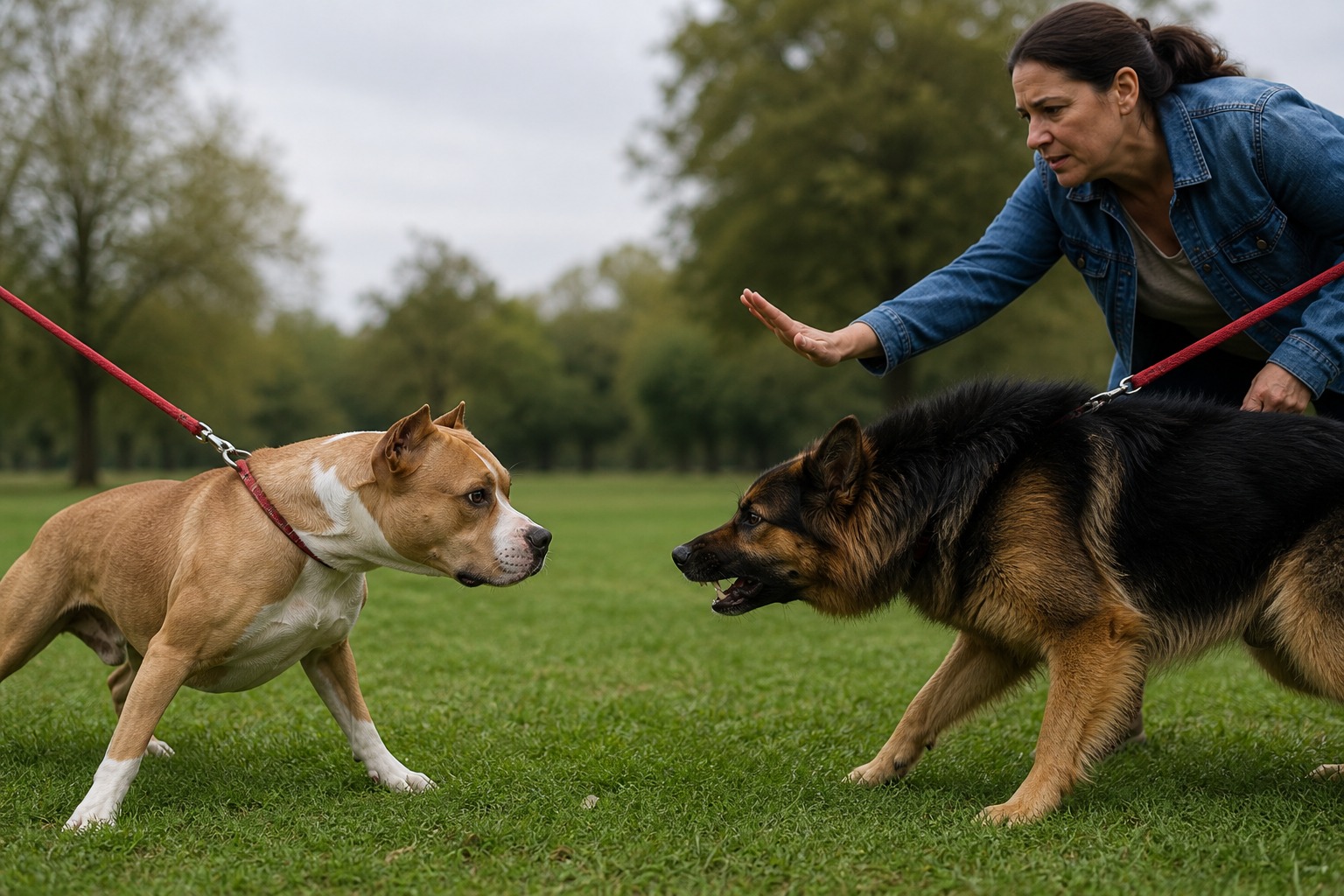
The most useful thing anyone can tell you about breaking up a dog fight is that the safest break-up is the one you never have to do. Almost every serious fight is preceded by seconds of warning that most people miss, and the owners who avoid the bites are the ones who learned to read those seconds, not the ones with the bravest technique. So this guide is built backwards from the way most are. It starts with prevention, because that is where the real safety lives, and only then works through the break-up methods, ranked honestly by how likely each is to get you hurt.
Because here is the uncomfortable truth the methods section has to open with: there is no guaranteed safe way to physically break up a dog fight. Every option carries risk. The goal is to stack the odds, choosing the approach that is most likely to work and least likely to put your skin near a mouth, and to know in advance which is which so you are not improvising while two dogs are screaming.
The fight you can see coming
Dogs almost never go from calm to fighting without a tell. They go through a ladder of signals, and the early rungs are quiet enough that humans walk right past them while the other dog reads them loud and clear.
The single most overlooked cue is the hard stare. “A hard, frozen stare is the signal people miss most, because it does not look like aggression, it looks like nothing,” says certified dog trainer Jordan Ellis. “But to the other dog it is a direct challenge, and it is very often the thing that lights the match.” Because the stare is so easy to miss, owners frequently blame the wrong dog for starting a fight; the one who lunged was often responding to the one who froze.
Watch for the rest of the ladder too: a stiff, still body, a slightly raised and trembling corner of the lip, a low growl, and the easily misread “stress signals,” lip-licking, yawning, sudden scratching or sniffing, and pointedly turning the head away. None of these mean a fight is certain. All of them mean tension is rising and it is time to act.
And acting, at this stage, is easy. You calmly call the dogs apart before contact and reward them for coming. “If owners intervened at the freeze instead of at the first bite, I would treat a fraction of the dog-bite cases I see,” Ellis says. The majority of serious bite cases she works with have a history of low-level spats that nobody interrupted, until one finally escalated. Calling a tense dog away and paying them for it is not avoiding the problem. It is the whole solution.
Build a break-up kit before you need one
If you have two dogs at home, a dog who has scuffled before, or you frequent dog parks, prepare for the bad day while it is still a calm one. Keep an air horn or a can of compressed air where you can grab it. Hang a slip lead or two by the door. Know which lightweight, rigid thing in each room could serve as a barrier, a baby gate, a cookie sheet, a piece of plywood, a trash-can lid. People who have these decided in advance act faster and reach in less. People improvising tend to reach in with their hands, which is exactly what we are trying to avoid.
The methods, ranked by risk
If a fight does break out, run down this list in order. Each step up the ladder is more likely to work and more likely to hurt you, so you only climb as far as the severity forces you to.
1. Distraction (lowest risk)
Distraction tries to break the dogs’ focus without touching them. It does not always work, but it almost never makes things worse, so it is always the first thing to try.
A sudden loud noise, banging two metal objects together, an air horn, a sharp clap of compressed air, can startle dogs out of a fight, especially dogs who are not deeply committed or who want to disengage but cannot. A blast of water can do the same: a hose if one is somehow within reach, or a dumped bucket. A citronella spray aimed at their faces works on the same principle. The honest limitation is that committed fighters often ignore all of this, and dogs rarely fight conveniently next to a hose. But it costs you nothing to try first, so you do.
2. Separation without using your hands (moderate risk)
If distraction fails, the next tier puts something between the dogs that is not you.
A large, rigid barrier is the move: slide a piece of plywood, a baby gate, a cookie sheet, or even thick poster board down between the two dogs to wedge them apart. The bigger the barrier, the farther your hands stay from teeth, so use the biggest thing you can lift. The catch is coordination, doing this cleanly mid-fight is genuinely hard, which is one more reason prevention beats intervention.
The wheelbarrow method is the best hands-on option because, done right, it keeps your hands at the back of the dog, far from the front. With two people, each grabs the hind legs of one dog and lifts, then, crucially, backs away in a slow circle rather than straight back, so the dog cannot spin around and bite. Dogs have almost no leverage with their back legs off the ground. The danger is a solo attempt or bad timing: if one dog is lifted and the other breaks free, everyone is now worse off. This is a two-person technique.
3. Hands, only if a life is at stake (highest risk)
Putting your hands near the dogs’ front ends, grabbing collars, reaching for the toy or food they are fighting over, is the single most reliable way to get bitten, because a dog in fight-drive will redirect onto whatever touches its head. It is also, honestly, most people’s first instinct, which is exactly why it causes so many injuries. Reaching in is a last resort reserved for when a dog’s life is clearly in danger and nothing else has worked. If you must, grab a collar from behind and twist it to cut off air briefly while pulling back and away, and accept that you are taking a real chance of being bitten.
The part everyone forgets: after the fight
Getting the dogs apart is not the end. Two things still need to happen, and the second one sends people home from the ER less often than it should.
First, keep the dogs fully separated and let everyone come down. Adrenaline runs high for a while after a fight, and dogs who are reintroduced too soon often go right back at it. Crate them in different rooms.
Second, check both dogs for wounds, and take bites seriously. Dog-bite punctures are deceptive. The skin opening is small, but the teeth carry bacteria deep into the tissue, and the damage underneath can be far worse than the surface suggests. “A puncture that looks like nothing can seed a nasty infection or an abscess a few days later, and bites over the chest or belly can hide injuries that need surgery,” says emergency veterinarian Dr. Ravi Mehta. “Any actual bite wound, even a small one, is worth a same-day call.” Watch in the days after for swelling, heat, discharge, limping, or a dog who goes quiet and off their food, all signs the wound is turning. And if you were bitten, clean it well and call your own doctor, because dog-bite wounds in people frequently need antibiotics and sometimes more.
Then do the work that prevents the next one. Figure out what actually triggered this fight rather than writing it off as a fluke, a resource they were both guarding, a greeting that went wrong, a tense history between these two, so you can manage the trigger instead of waiting to referee again. The fight you break up safely is good. The fight you read coming and defuse at the freeze is better, and it is a skill you can absolutely learn.
References
- American Veterinary Medical Association. “Dog Bite Prevention.” https://www.avma.org/resources-tools/pet-owners/dog-bite-prevention. Accessed June 2026.
- Merck Veterinary Manual. “Bite Wounds in Animals.” https://www.merckvetmanual.com/emergency-medicine-and-critical-care/wound-management/bite-wounds-in-animals. Accessed June 2026.
- American Society for the Prevention of Cruelty to Animals. “Dog Body Language.” https://www.aspca.org/pet-care/dog-care/dog-body-language. Accessed June 2026.
Tom Hadley writes about training and behavior, helping owners understand what their pets are trying to tell them. His work covers everyday manners, decoding common behaviors, and the small changes at home that make dogs and cats easier to live with.
Meet our experts ↗Keep reading
 TrainingYour Dog Puts Up With Your Kisses. That's Not the Same as Loving ThemDr. Nina Kohl · 5 min
 LivingThe Dire Wolf Fantasy Is Filling Shelters With Real HuskiesMarcus Webb · 6 min
 TrainingWhining Is Your Dog's Word for Fear. Barking Is the One for Frustration.Dr. Lena Park · 8 min
 LivingIs Your Dog Really Jealous, or Just Afraid of Missing Out? The Science Is Messier Than the Headlines.Dr. Nina Kohl · 5 min
 TrainingYour Dog Has a Favorite Paw. What Its 'Strength' Says About Their Nerves Is the Real Surprise.Dr. Ravi Mehta · 6 min
 TrainingYour 'Talking' Dog Isn't Reading Your Body Language After AllDr. Ravi Mehta · 5 min