


A Portrait Photographer's Cat Refuses to Be Photographed. That's the Lesson
Bridget Badore's career is making people feel seen. Her rescue cat Queso wants nothing to do with being perceived, and in teaching her owner about boundaries, abandonment, and grief, she became the better teacher.
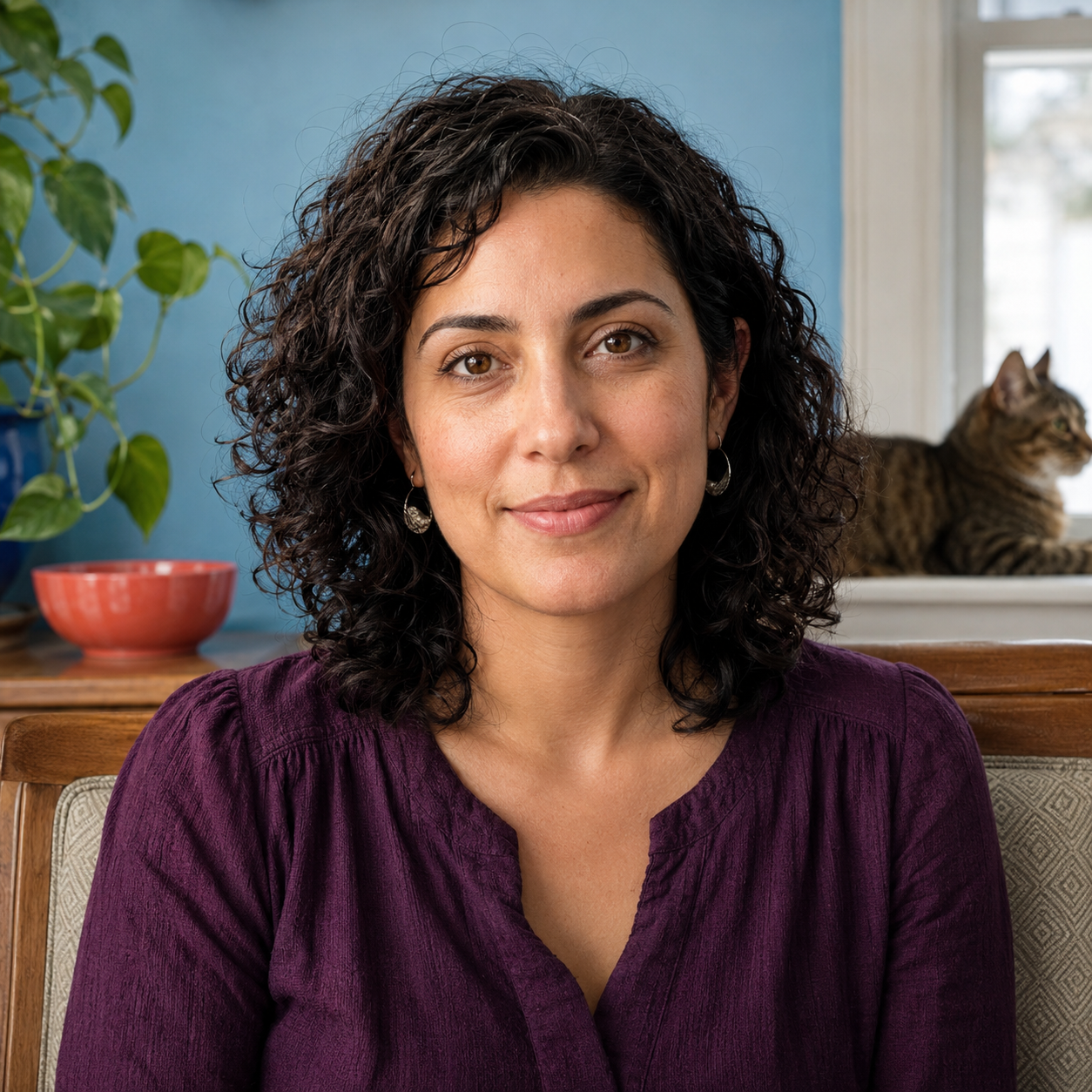
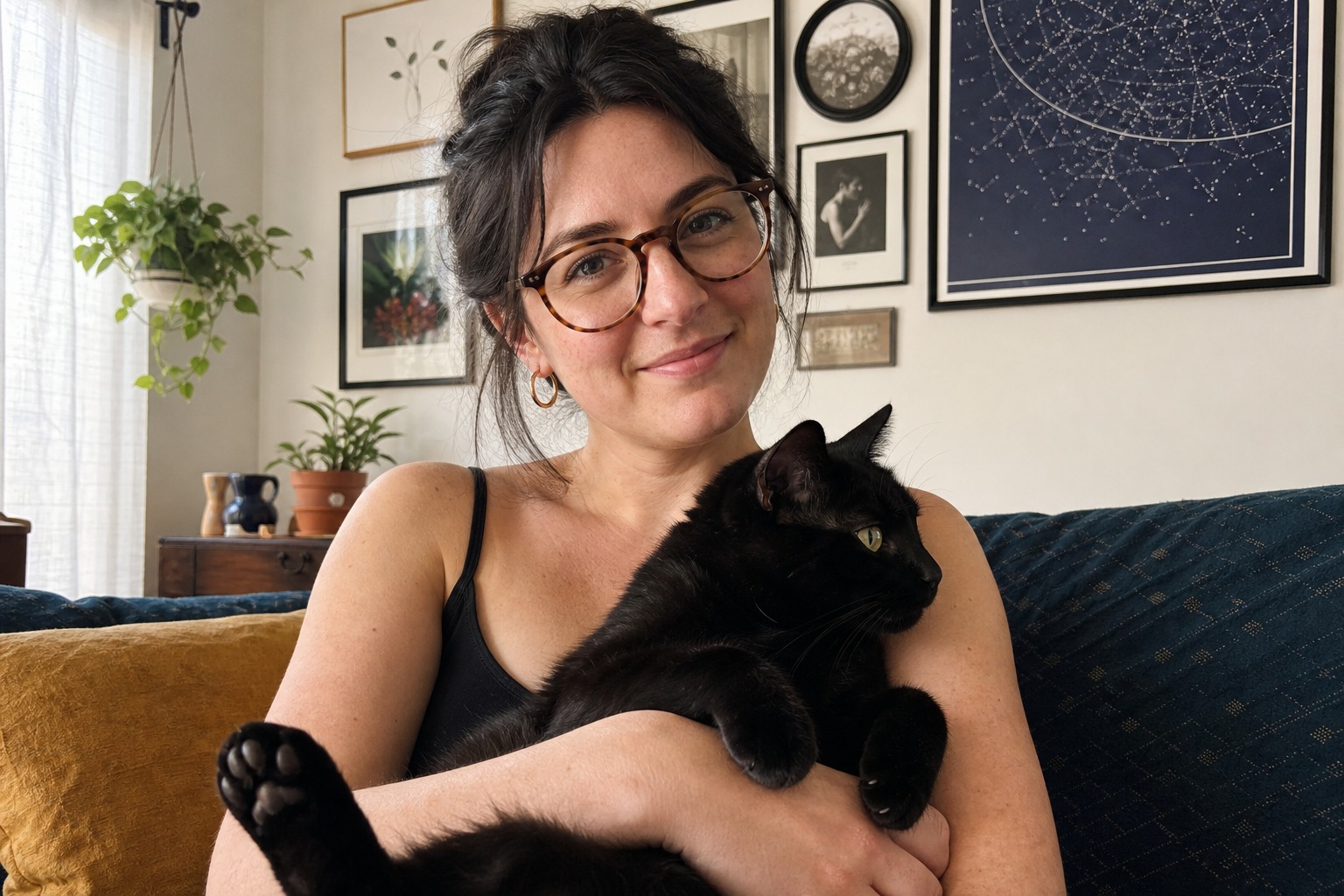
Bridget Badore makes her living getting people to drop their guard. Her ethereal portraits, run in The New York Times, New York Magazine, InStyle, Vogue India, The Cut, Esquire, and The New Yorker, depend on coaxing strangers into being open in front of a lens. By her own description she is “a person who loves to talk about big feelings,” the kind who turns a missed shot into a thousand-word newsletter and overshares freely online. And she lives with a creature engineered to do the exact opposite. Queso, her fluffy rescue, has made a daily ritual of refusing to be seen. “We have a security-type camera at home so I can check on her when I leave,” Badore says, “and she knocks it over every single day. She walks right up to it and swipes it until it falls face down. She will not be surveilled.”
That is the joke at the center of this household, and also its point. A documentarian of human vulnerability shares her home with a subject who declines to be documented. It would just be funny if it were not, in Badore’s telling, the entire curriculum. Queso is not the muse who sits still for the artist. She is the instructor who shows the artist how to stop performing.
The subject who fights the lens
Badore can laugh at the professional indignity. “Queso will not tolerate being photographed professionally. Actually, she hates being perceived in any capacity,” she says. Bring out the real camera and Queso turns pugilist, which Badore counts as a particular waste, given the cat’s natural gift for finding her light. The handful of decent shots that exist were stolen on a phone. For someone whose gift is opening people up in front of a camera, raising a subject who treats the camera as an enemy is, she says, “a tale as old as time, the artist with the athlete child.”
Queso arrived by an accident of geography. She was pulled off a beach in Puerto Rico by The Sato Project, a rescue that, as Badore notes, “typically only rescues dogs, but apparently they found her alone on the beach and took her in.” Her breed is a mystery; her temperament is not. “She’s the softest, fluffiest cat I’ve ever known with the biggest attitude.” The household even shares a star sign. “She’s a Taurus, which is great because my partner and I are also Taurus babies. Queso and I are both anxious, and we’re at our best when everyone we love is in one place: the couch.”
The boundaries master class
What Badore keeps circling is not Queso’s cuteness but her self-possession. The thing a portrait photographer spends her career chasing in other people, the ability to ask for what you need without apology, is something her cat simply has. “I’m very curious about boundaries, and Queso is an expert, so I can learn a lot from her,” she says. “Cats are fiercely independent but also very needy and cuddly, and I identify with that duality in my core.”
That duality dictates how they bond, strictly on Queso’s terms. “She’s very elusive and doesn’t like to come out and show how much she cares. Queso comes to you, not the other way around.” Most people would read that aloofness as rejection. Badore reads it as recognition. “I think Queso and I both have abandonment issues, so I try not to take it personally when she doesn’t want to cuddle right away. She needs to feel out a situation before she lets her guard down. I can relate to that, or am I just projecting onto my cat?”
The lesson scales up into her creative life. At the weekly artist group she hosts, one conversation crystallized it. “We were talking about how we should all be more like cats,” she says. “As artists, we’re always like, can I do this? Am I doing it? And cats just do it,” she says. Nobody ever conditioned a cat to disguise a need, so the need simply gets met, beginning with whichever patch of carpet currently holds the sun. For a photographer whose whole job is getting other people to lower their guard, the animal who never raises hers is the better example.
What a fluffy animal does for a nervous system
Badore is candid about her mental health, and Queso functions, literally, as ballast. “Putting my face in Queso’s belly does WONDERS for my will to live,” she says. “When she’s napping in the sun and I’m about to launch into my third panic attack, I sit right in front of that sleepy monster and stick my face in her fluff. Face full of fluff a day keeps the doctor away.” Even the cat’s pettier habits get reframed as care. The one who rolls across the keyboard until it “threatens to delete all of my work” is just signaling it is time for a break. The one who chews through charging cords is “very helpful” in keeping her current on equipment. The dependence runs both ways, though Queso would never cop to her half. “A fluffy creature relying on me every day keeps me soft,” Badore says. “Don’t tell her I told you that. She doesn’t want people to think she relies on anyone.”
Grief, with a cat in the room
The deepest thing Queso does for Badore is the one that surprised her most, and it reaches back decades. Badore co-hosts a community chat called Dead Parent Club, and asked whether an animal helps her hold loss, she goes somewhere unexpected: her first cat, Thomas O’Malley, a “feisty little orange cat” from childhood. “I more openly grieved for Thomas when he died than I did for my dad,” she says. Her father died when she was three; Thomas a few years later. As a small girl she drew them both as angels, compulsively, and the cat angel kept claiming as much of the page as the dad angel, sometimes more. A pet’s death, she reasons now, is a loss sized for a child’s comprehension in a way a parent’s never can be.
That a pet can be the safer doorway into grief, the loss a small child could actually let herself feel, is the quiet core of how Badore relates to animals now. Queso, she says, keeps her compassion in working order, and that compassion is a load-bearing wall in whatever structure holds a person to her own life. Ask her to picture a world without the cat who refuses to be photographed, and the unflappable oversharer briefly loses her composure. “Absolutely not, and I have an existential crisis every time I think about it. PLEASE DON’T MAKE ME THINK ABOUT IT.” The photographer who spends her days helping strangers feel seen has, at home, a small fierce animal who will not be seen at all, and who has somehow taught her more about being a person than any subject ever did.
References
- Bridget Badore, portrait photography portfolio. bridgetbadore.com.
- The Sato Project, Puerto Rico dog rescue. thesatoproject.org.
Nina Vasquez writes about life at home with pets and the relationships at the heart of it. Her work covers day-to-day living, people-and-pet stories, and the products that fit into a real household, with a warm, grounded take on everyday pet ownership.
Meet our experts ↗Keep reading
 LivingThe 'Crazy Cat Lady' Was Queer History All AlongLeila Torres · 4 min
 LivingThe 'Stray' Movie Has One Job: Don't Let the Cat TalkSasha Ford · 6 min
 LivingYour Cat's Name Was Picked by a Celebrity. You Just Don't Know Which OneJordan Ellis · 5 min
 LivingShe Built Her Cat a Sparkly Palace. The Cat Wanted the Cardboard.Nina Vasquez · 5 min
 LivingBrooklyn's Cat Cafe Flipped the Model: It's a Rescue Clinic With a Cafe AttachedSara Lim · 6 min
 TrainingYour Kitten Isn't Kissing You. It's Filing You Under 'Family.'Dr. Amara Solis · 7 min