


A Frenchie Died Mid-Flight. Every Flat-Faced-Dog Owner Should Read Why
Michael Contillo is suing Alaska Airlines after his French Bulldog Ash died mid-flight. Beyond the lawsuit, the case is a hard lesson in how to fly a brachycephalic dog safely.

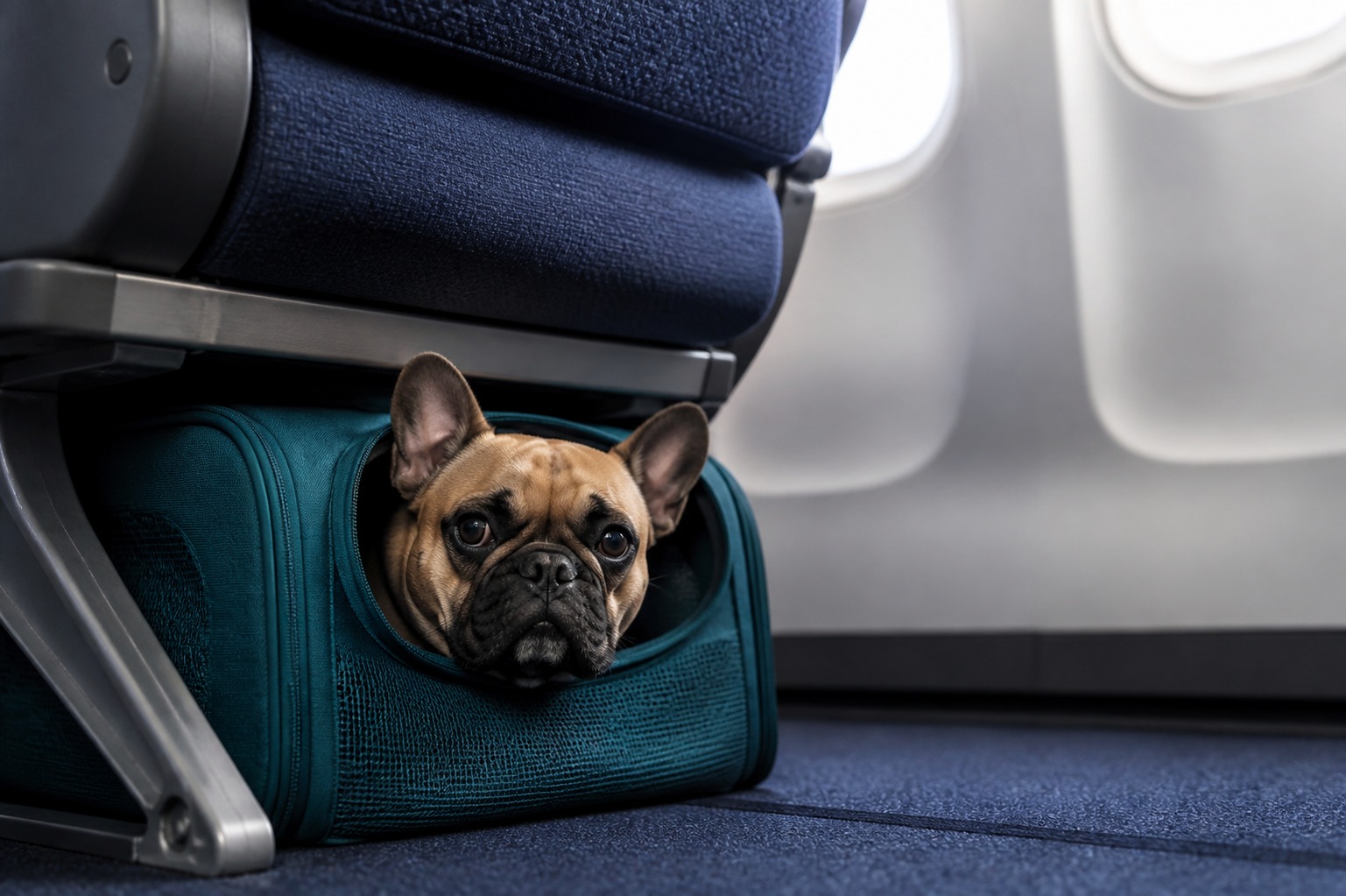
A four-year-old French Bulldog named Ash died on a cross-country flight, and his owner is now suing the airline. The lawsuit will run its course in a courtroom. But the part of this story that can actually protect another dog is not the legal claim, it is the chain of small decisions around it, because nearly every one of them is something a flat-faced-dog owner can plan for before they ever reach the gate. So we are going to start there, then lay out exactly what happened.
First, the part you can act on: a pre-flight plan for a flat-faced dog
If you share your life with a French Bulldog, Pug, Boston Terrier, Boxer, Bulldog, or any other short-nosed breed, the single most important thing to understand is that stress is not a minor inconvenience for these dogs. It is a medical risk multiplier. Before you book a flight, work through this:
- Talk to your vet weeks ahead, not the night before. Ask specifically whether a calming medication or sedative is appropriate for your dog, and whether your dog should fly at all given their airway, heart, and weight.
- Fly in the cabin, never cargo. Most major U.S. airlines, including American and United, will not accept brachycephalic breeds in the cargo hold at all, precisely because the heat, poor airflow, and stress are dangerous. Cabin travel, where the temperature and pressure are regulated and you can watch your dog, is the only reasonable option, which also means your dog must be small enough to fit an under-seat carrier.
- Mind the temperature. Heat and snub noses are a deadly combination; some airlines refuse snub-nosed breeds in cargo entirely once temperatures climb past the mid-70s Fahrenheit. Book early-morning or overnight flights in warm months and avoid layovers in hot-climate hubs.
- Carry proof and a plan. Bring recent vet records, get a pre-travel exam, and know your dog’s normal breathing so you can spot trouble fast.
- Hold your ground on seating. As Ash’s case shows, where your dog sits, and how calm the cabin is around them, is not a trivial detail. If you have paid for a specific spot for medical reasons, say so clearly and do not let it be waved away.
A flat-faced dog has no margin: stress that a Labrador would shrug off can tip a Frenchie into a breathing crisis within minutes. That’s why I lean toward preventing the stress with a sedative rather than scrambling to manage a crisis mid-flight. And for any flat-faced dog with a heart condition, the altitude change adds its own load, so that’s a conversation to have with your vet well before you book.
The reason all of this matters is anatomical. Brachycephalic dogs are born with narrowed nostrils and an elongated soft palate that crowds the airway, a cluster of issues known as brachycephalic obstructive airway syndrome, or BOAS. They are essentially breathing through a straw, and difficulty breathing feeds directly into overheating, heart strain, and panic. A calm Frenchie on the ground can become a Frenchie in respiratory distress within minutes if the situation turns. That is the lens to read the rest of this story through.
What the complaint alleges
On February 1, Michael Contillo flew from John F. Kennedy Airport in New York to San Francisco International alongside his father, his four-year-old French Bulldog Ash, and his second dog, Kora. According to the complaint, which Contillo’s attorney provided to us, the group was asked to move from first class to economy “for safety purposes” moments before takeoff. Contillo says the relocation left Ash extremely anxious, which triggered breathing trouble during the flight. By the time the plane landed, Ash had died.
Per the filing, Contillo’s carriers met the airline’s stated requirements, which allow up to three dog carriers total in first class. He says he booked in-cabin spots in advance, paid the $100-per-dog fee, and had both dogs examined at a New York City veterinary office before traveling. He also says he tried to explain the danger to the crew, telling them, the complaint states, that “the dog was calm at the moment but would not be calm anymore now that the plane was full of people. To move the dogs now would make them very anxious and excited, which would lead to extremely dangerous breathing and heart problems. This change could be lethal for a dog, especially right before you change altitudes.”
Contillo also says he was told to keep the carriers closed during takeoff and was not allowed to check on Ash until the plane reached altitude. By then, the complaint alleges, “Ash’s body was entirely in rigor mortis.” Contillo described the aftermath to the outlet Silicon Valley: “They see our dead dog. They see me crying. Not a single one of them stops to offer any help or condolences.” He added that a crew member “loudly stated, ‘Now you’re going to blame us for killing your dog.’”
Where the case stands
Contillo had flown with both dogs in first class on Alaska, San Francisco to New York, in November 2023 without incident. His attorney, James Drake of Drake Law Group, says the airline declined a proposed settlement; the suit, filed in October 2024, claims negligence, negligent infliction of emotional distress, and related counts, and seeks punitive damages. Reached for comment, Alaska Airlines said only that it does “not comment on litigation,” and as of this writing the case remains unresolved.
“All he wanted was to take a trip with his father and his two pets,” Drake says. He adds that the family was given no real chance to respond in the moment: “You’re not gonna give a statement with your dead animal in the middle of the airport.” What they want, he says, is acknowledgment and change: “An apology and maybe some changes to prevent something like this from happening in the future, that’s all we really want.”
The legal stakes reach beyond one family. Lisa Milot, an animal-welfare law expert and professor at the University of Georgia School of Law, notes that “the law with respect to companion animals is in flux,” and that cases like this can push it forward. She also makes a point that lands squarely on the prevention checklist above: “Pet owners are generally in a better position to know of anxiety, physical conditions, or other factors that might put their particular animal at higher risk than the typical animal, or higher risk than airline staff might anticipate.” In other words, you are your dog’s best advocate, and on a flight with a flat-faced dog, that advocacy can be the difference between a stressful trip and a tragedy.
References
Not a substitute for your vet. Our guidance is educational. For urgent symptoms, contact a vet or emergency clinic right away. Editorial standards
Dr. Chen is a small-animal veterinarian who leads health and safety coverage at The Pet Times. She writes and reviews the bulk of our illness, condition, and safety content, translating clinical guidance into clear, practical advice owners can act on at home.
Meet our experts ↗Keep reading
 Health & WellnessYou Dog-Proofed the Yard and Forgot the SkyDr. Mara Chen · 6 min
 Health & WellnessIt's Not Just Fireworks. Your Smoke Alarm Might Be Terrifying Your Dog.Dr. Lena Park · 5 min
 Health & WellnessDon't Skip Your Dog's Summer Workout. Move It. Here Are 7 Ways.Dr. Lena Park · 7 min
 Health & Wellness21 Dogs Died at One Kennel Because Nobody Had to CheckJordan Ellis · 6 min
 Health & WellnessThe 'Mystery Dog Illness' Wasn't a Mystery. Here Are 8 Ways to Keep Your Dog Out of It.Dr. Mara Chen · 7 min
 Health & WellnessThe Coyote Vest Is a Punchline Until It's All That's Between Your Dog and a CoyoteDr. Lena Park · 6 min