


The Real Danger of Tying Your Dog Outside a Store Isn't Your Dog
You trust your dog to sit calmly while you run in for milk. That was never the question. The risk in leaving a dog tied outside is everything around them you can't control, and here's how trainers weigh it.

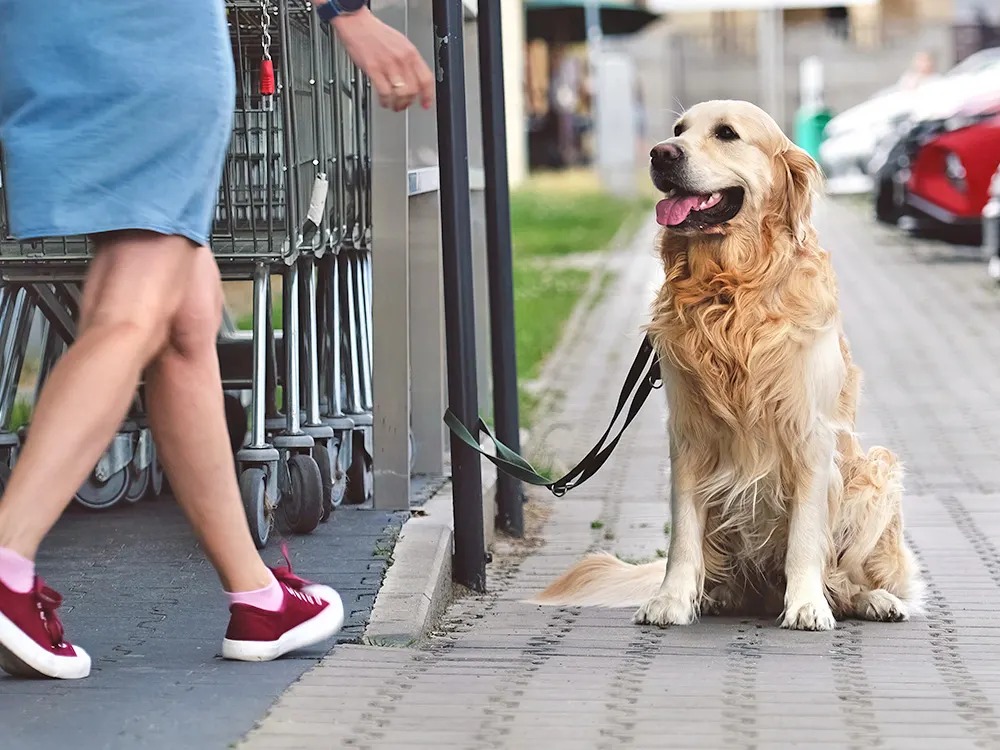
It always starts innocently. You’re out on a long walk, you pass the grocery store, and you remember you’re out of toilet paper. Or the coffee shop calls, or the burrito place ruins you with a single whiff. A two-minute errand, and your dog is right there, calm as anything. So you loop the leash around a pole and step inside. What could happen?
That question, “will my dog behave,” is the wrong one, and it’s why this feels harder than it should. The trainers who work through this daily don’t lose sleep over whether your dog will sit nicely. They lose sleep over everything else: the stranger who reaches in, the loose dog that trots up, the person who could untie the leash, the food dropped on the sidewalk. The real hazard of tying your dog outside a store isn’t your dog. It’s the uncontrolled world you’re leaving them alone in.
The experts don’t fully agree, and that tells you something
Ask several trainers and you won’t get one clean answer, which is itself the honest reveal: this is a judgment call, not a rule. On one end, some professionals won’t recommend tethering a dog outside under any circumstances. On the other, some say a specific kind of dog can handle a few minutes under the right conditions. The gap between those positions is exactly where you have to think for yourself.
What every trainer flags first is how much sits outside your control. A stranger might approach. A squirrel might bolt across the path. Another dog might come over to play, or to pick a fight. You can train your dog beautifully and still not train the sidewalk. A dog that draws confidence from its person can slide into fear or anxiety the moment that person disappears through a door.
People frame this as a question about their dog’s manners, and it’s really a question about odds. Even a lovely, bomb-proof dog is suddenly the only variable you’ve locked down in a scene full of ones you haven’t. That’s the part that should give you pause, not whether your dog knows how to sit.
Which dogs are simply not candidates
Before you weigh the situation, weigh the dog, honestly. A tethered dog needs to feel safe while alone and out of sight, which rules a lot of dogs out. The dog should stay calm, quiet, and unbothered if a random person walks up to say hello. That leaves off the list any dog that’s reactive, easily rattled in new settings, or unsure of itself. Dogs with separation anxiety are a firm no, they’re likely to panic, bark, and throw themselves against the leash the second you’re gone. If that’s your dog, the decision is already made, and there’s no shame in it.
Count all the hazards, not just the behavioral ones
Even with the right dog, the list of what could go wrong is longer than most people picture, and only some of it is about behavior.
The behavioral risks are real: a dog that gets anxious can turn defensive and bark, lunge, or even snap at a stranger, endangering the dog and other people and opening you to liability. And it cuts both ways, because if you’re not there to see it, a stranger could claim your dog did something it didn’t, and you’d have no way to know what actually happened.
But the non-behavioral hazards are just as serious. Someone could feed your dog something harmful. Your dog could find and swallow something off the ground. The dog could work itself loose, or someone could deliberately untie it, the fear that keeps a lot of pet parents from ever trying this. And the environment adds its own dangers: a dog left fully out of sight, in extreme heat or cold, or in a high-traffic spot, is exposed in ways a leash can’t fix. Microchips, worth remembering, are not GPS trackers, so a dog that vanishes isn’t a dog you can simply locate on your phone.
If you do it anyway, shrink the risk
Plenty of people tether their dogs outside stores, and the fact that it’s common doesn’t make it right for yours, only you know what your dog can handle. But if you decide the situation genuinely fits, a few practices lower the odds of trouble:
- Keep it brief. Minutes, not a shopping trip. No trainer endorses leaving a dog tied through a 30 to 45 minute spree.
- Stay in sight. Position yourself to check on your dog every couple of minutes, so you can see that they’re safe and that people are leaving them alone. Ideally no one interacts with your dog at all while you’re gone, though that’s one of the things you can’t control.
- Use a harness, not a collar. If the dog bolts after something and hits the end of the line, a harness spreads the force and helps prevent neck injury.
- Anchor to something solid. Tether to a sturdy, immovable object like a short pole or a bollard, and avoid anything with an open end the dog could slide the leash off of.
- Use a secure leash. A multi-clip leash or a proper tether that clips back to itself is far less likely to come undone than a leash simply looped around a post.
The simplest answer is usually the best one
Notice how much has to go right, the perfect dog, the perfect anchor, the constant sightline, the short clock, before tying up outside a store becomes reasonable. When that many conditions have to line up, the low-drama option starts looking awfully good. For a lot of dogs, the safest, calmest choice is to skip the pit stop, walk home and come back, or bring a friend along to hold the leash while you duck in. When you’re not sure, that uncertainty is your answer: take them home. The errand can wait. The dog is the point.
References
- Overall, K. L. Manual of Clinical Behavioral Medicine for Dogs and Cats. Elsevier, 2013. https://www.elsevier.com/books/manual-of-clinical-behavioral-medicine-for-dogs-and-cats/overall/978-0-323-00890-5
- American Veterinary Medical Association. “Dog bite prevention.” https://www.avma.org/resources-tools/pet-owners/dog-bite-prevention
- ASPCA. “Microchipping Your Pet.” https://www.aspca.org/pet-care/general-pet-care/microchipping-your-pet
- American Kennel Club. “Separation Anxiety in Dogs.” https://www.akc.org/expert-advice/health/separation-anxiety-in-dogs/
Common questions
What kind of dog should never be tied up outside?
A dog that's reactive, nervous in new situations, or has separation anxiety should not be left tethered alone. Being out of sight from their person can tip them into fear, barking, lunging, or panic.
How do I make tying my dog up safer if I do it?
Keep it very short, stay where you can check on them every couple of minutes, use a harness rather than a collar, and tether to a solid immovable object like a bollard, ideally with a leash that clips back to itself so it can't slip free.
Dr. Kohl is a board-certified veterinary dentist with a particular interest in preventive oral care. She reviews all dental health content at The Pet Times and contributes practical guides on home dental routines, professional cleaning, and oral disease prevention.
Meet our experts ↗Keep reading
 Health & WellnessThe Eclipse Won't Freak Your Dog Out. You Might.Dr. Priya Nair · 5 min
 LivingA Wolfdog Is Not a Fluffier Husky. Nobody Can Tell You What You Actually Own.Dr. Ravi Mehta · 8 min
 LivingThe 'Dog Days of Summer' Were Never About DogsNina Vasquez · 7 min
 LivingA Lab From Brazil Went Back-to-Back. The Better Story Was in Third.Nina Vasquez · 5 min
 TrainingBefore You Cut a Hole in Your House, Answer This: What Else Can Fit Through It?Marcus Webb · 8 min
 Health & WellnessThanksgiving Is Rigged Against Your Dog. 7 Ways to Beat ItDr. Lena Park · 8 min