


Yes, You Can Leash-Train a Cat. No, Not Every Cat Wants It.
The Instagram adventure cats hiking Banff make it look effortless. Here's the honest, step-by-step version: how to harness-train a cat, what gear actually helps, and how to tell whether your cat is a candidate or a hard pass.

Affiliate disclosure. This article contains affiliate links. We may earn a small commission if you buy through a link, at no extra cost to you. How we handle recommendations.
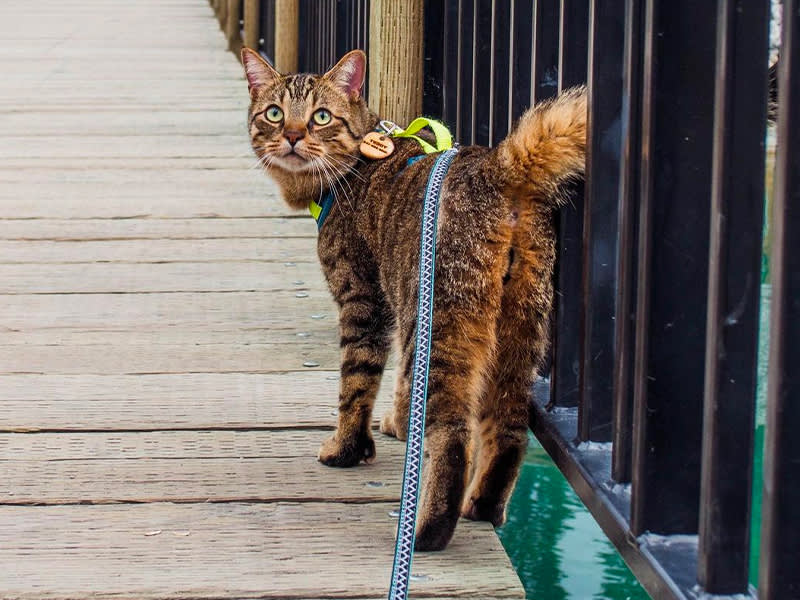
The adventure cats you see on Instagram, riding in backpacks through Banff, watching sunsets from a kayak, padding along a mountain trail on a leash, make the whole thing look like a personality trait a cat is simply born with. Some of that is true. But most of what makes an adventure cat is patient training, the right gear, and one honest decision up front: whether your particular cat actually wants this life at all.
That decision is the thesis of this guide, because it’s the step people skip. Leash-training a willing cat is very doable. Forcing it on an unwilling one is miserable for both of you. So we’ll start there, then walk through the how.
First, is your cat a candidate?
There’s no universal answer here, because there’s no universal cat. The honest test is behavioral. Watch what your cat already does: parking at the window for hours, crying at the door, darting for the gap every time it opens. That kind of outward pull is the raw material this training works with. Selvynna Tang, who documents her cat Teddy’s hikes, paddles, and Banff sunsets on Instagram, has said Teddy was exactly this cat — an apartment cat who ignored toys, watched the window, and bolted for every open door. Walks became his outlet because nothing indoors was doing the job.
The flip side matters just as much. Plenty of cats want nothing to do with a harness, and pushing a cat who dislikes it isn’t a training problem to overcome, it’s a preference to respect. If yours hates it, stop. And the goal can be modest: a harnessed loll in the backyard is a real destination in its own right, not a consolation prize.
Age tilts the odds, too. Kittens generally take to a harness far more easily than adults; the earlier you start, the smoother it tends to go. An older cat can still learn, but budget real patience and treat session one as reconnaissance, not a milestone.
The single best predictor of a happy adventure cat is that the cat opts in, not that the human is determined. Start indoors, keep every session short and rewarding, and treat the harness like a fun cue rather than something that gets wrestled onto them. If your cat is choosing to move toward the door in the harness, you’re on the right track. If they flatten and freeze, you have your answer.
The step-by-step
Start entirely indoors. Fit the harness properly, then let your cat wear it around the house in brief, treat-soaked sessions until it stops being interesting. Some cats will try to back out of a harness the first time; others barely notice it. Either way, the goal is boredom, not tolerance.
Once the harness is a non-event, add the leash indoors and let your cat drag it, then practice following them around. You want the sensation of light leash pressure to be old news before the outside world enters the picture.
Then go outside, small and dull on purpose. The first outings should be a few minutes right by the door or in a quiet, enclosed yard. Let the cat lead and sniff at first. Build up duration across many short sessions rather than one ambitious hike.
Expect the rules to change with the terrain. Tang has described running things two ways with Teddy: open parkland is his to explore while she follows, but a marked trail comes with one condition — stay on it. Her enforcement is gentle and boringly consistent: walk ahead, call, and a refusal earns him a stint in the backpack. What that consistency buys, in her telling, is a cat who eventually stops testing the boundary at all. Keep a regular schedule on top of it; a cat who can predict the walk starts anticipating it.
The gear that earns its place
You don’t need much, but a few pieces matter.
A well-fitting harness is non-negotiable. The RC Pets Moto Control Harness — the one Tang puts on Teddy — has earned a following among cat walkers, and its spec sheet explains why: a grab handle up top lets you lift a spooked cat without reaching toward their face, and it offers a choice of two leash rings. Whatever you choose, fit is everything, because a loose harness is an escape waiting to happen.
For any real hiking, a cat backpack does double duty: transport when the cat is tired, retreat when the world gets loud. Tang calls the pack Teddy’s den on the move — when he’s done engaging, he climbs in and sleeps. Pick one you can comfortably carry loaded, because your own water and essentials are coming along too.
Round out the kit with treats (the training currency, doubly so for a food-motivated cat), a collapsible water bowl, up-to-date flea-and-tick prevention, a jacket for cold weather, and poop bags — trail cats produce exactly what trail dogs do.
The hardest part nobody warns you about
Ask experienced cat walkers what actually goes wrong out there, and the cat is rarely the answer. Loose dogs are. Unleashed dogs turn up even on leash-only trails, and a dog charging in can flip a calm outing into a panic in seconds — Tang has named this the single hardest part of hiking with Teddy. The move is preemptive: the moment you spot an off-leash dog, lift your cat or get something solid between them. Scanning the trail ahead matters more here than any training cue.
And a smaller warning: a cat on a leash draws a crowd. Expect strangers to stop you, ask for photos, and want the full backstory. Budget a few extra minutes per outing for your cat’s new fans.
What newer research adds
The adventure-cat movement has matured from a novelty into something the training world takes seriously, and the current guidance lines up with the go-slow, cat-led approach above. The strongest, most consistent finding is about age: young kittens take to leash training at dramatically higher rates than cats over a couple of years old, so if you’re starting with a kitten, you have a real window worth using.
The other shift is framing. Leash walking is increasingly discussed not as a cute trick but as legitimate enrichment, a way to give indoor cats safe access to the mental stimulation, exercise, and novel scents they’re otherwise missing, which can head off boredom-driven behavior problems. The three things experts now stress most for a safe outing are a properly fitted harness, gradual conditioning to being outdoors, and controlling the environment. In other words, exactly the unglamorous fundamentals, not the scenery.
Jordan Ellis is a certified professional dog trainer with a decade of experience working with rescue organisations and private clients. They specialise in anxiety, reactivity, and positive reinforcement methods, and review all training and behaviour content at The Pet Times.
Meet our experts ↗Keep reading
 LivingYou Bought the Bed. She Sleeps in the Drawer. She's Not Being Rude.Dr. Nina Kohl · 6 min
 Living"Eco-Friendly" Cat Gear Is Mostly a Sticker. 6 Swaps That Aren't.Nina Vasquez · 8 min
 Product PicksThe Ripple Rug Isn't a Cat Toy. It's Reconfigurable Terrain.Nina Vasquez · 4 min
 Product PicksThe Prettiest Litter Box Cover Is Useless If Your Cat Boycotts ItSara Lim · 8 min
 LivingThe Cat Decides When the Photo Shoot Is Over. Never the Photographer.Sasha Ford · 6 min
 Health & WellnessA Blind, Paralyzed Cat Isn't a Tragedy. It's a Setup Problem.Dr. Nina Kohl · 7 min