


Blanket Sucking Is Adorable. The Day They Swallow It Isn't.
Most kittens who nurse on fabric are doing something harmless and self-soothing. A small group is on the road to pica, and the research now points to which kittens, and to the one sign that separates the two.

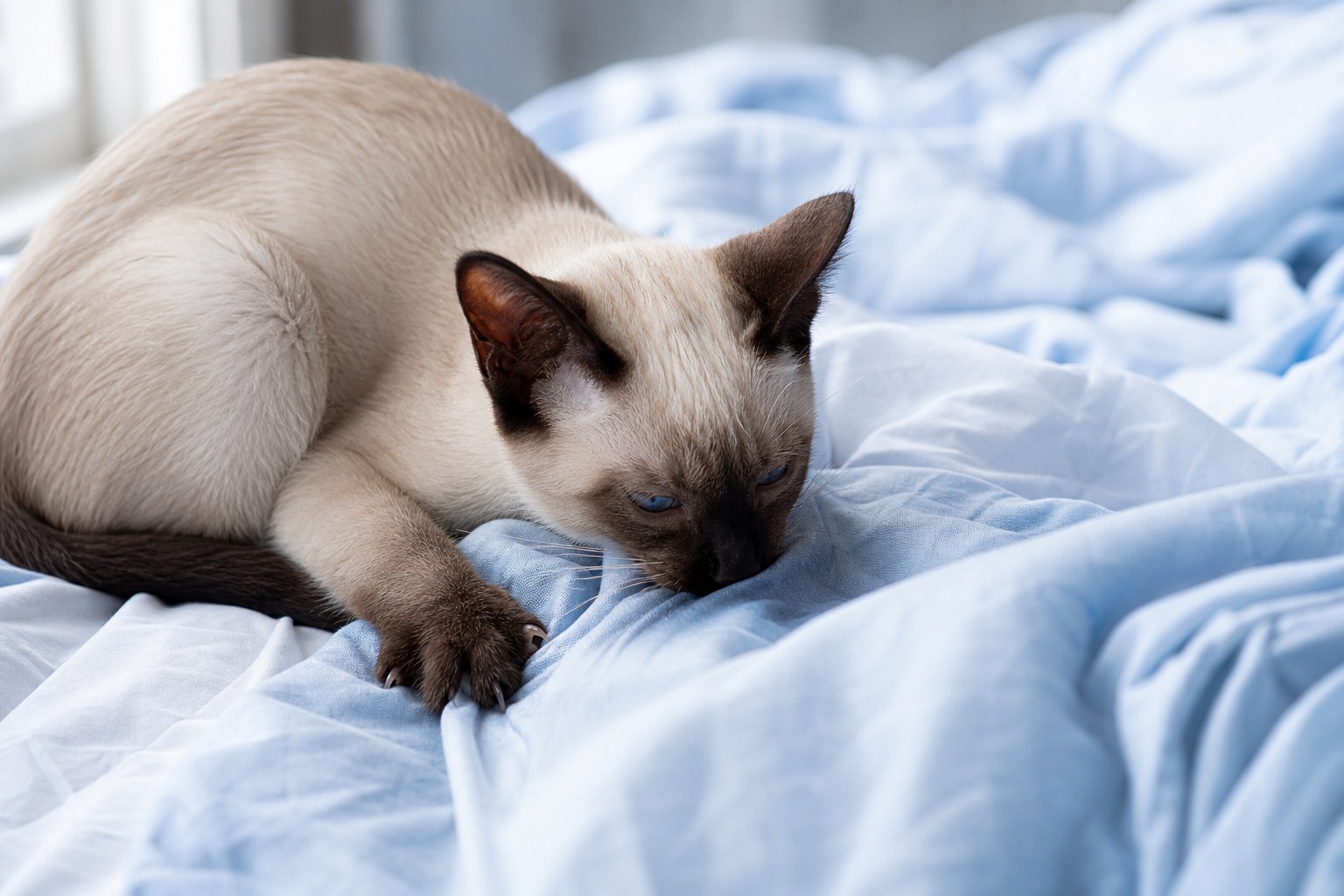
You are on the sofa with a purring kitten in your lap when they find the corner of the throw blanket, latch on, and start rhythmically nursing it like it owes them milk. Their paws knead. Their eyes go half-shut. It is one of the most disarming things a small cat can do.
It is also the exact behavior that, in a minority of cats, turns into a surgical bill.
Both of those are true, and the gap between them is not as mysterious as it feels. The question is not whether your kitten sucks on fabric. It is whether any of the fabric is going down. Everything else is detail.
Why the sucking starts in the first place
A kitten is born with a nursing reflex, and that reflex is doing two jobs, not one. It gets milk in, and it makes the kitten feel safe. Those two things get wired together at the very beginning of life, and the wiring does not vanish the moment the milk does.
So a soft, warm, human-smelling blanket is a rather logical substitute. Here are the seven reasons this shows up, ranked roughly by how often they are the real explanation.
1. The nursing reflex outlasted the nursing
The single most common driver, and it is strongest in kittens who were separated from mom early. A kitten pulled from the litter before they were done nursing keeps the reflex, and goes looking for somewhere to put it. Fabric that is soft, slightly stretchy, and warm from a body is the closest thing on offer.
2. It is a self-soothing habit
Rhythmic sucking is calming, in cats for the same reason it is calming in human infants. It lowers arousal. A kitten who reaches for the blanket when the vacuum starts, when guests arrive, or when the household gets loud is doing the cat version of grabbing a comfort object, and that is a functional coping skill, not a defect.
3. It smells like you
Underrated. A blanket that carries your scent is not a random object to a cat, it is a piece of the person they are bonded to. This is why the target is so often your throw, your sweatshirt, or your side of the bed, and almost never the clean one out of the linen closet.
4. Teething
Between roughly three and six months, adult teeth are pushing through sore, inflamed gums. Pressure on the gums feels good. A blanket is available, soft, and provides that pressure. This version is usually short-lived and resolves on its own as the mouth settles.
5. Boredom
A kitten with nothing to do will find something to do, and a repetitive oral habit is a cheap way to fill the hours. If the sucking clusters at the times of day when nothing is happening, and it disappears during play, boredom is doing more of the work than anxiety.
6. Stress and anxiety
The louder cousin of self-soothing. A house move, a new baby, a new pet, a renovation, a change in your hours: any of it can push a sensitive kitten toward a repetitive comfort behavior. The tell here is that the sucking gets more frequent and more intense when the environment changes, and eases when it settles.
7. Something is off medically or nutritionally
The least common but the most important to rule out. An unbalanced diet, an unmet nutritional need, and, notably, an abnormally intense appetite can all push a cat toward mouthing things that are not food. Gastrointestinal discomfort can too. This is the category where blanket-sucking is not a habit at all, it is a symptom.
The kittens who worry me are not the ones who nurse a blanket to sleep, they are the ones who are ravenous all the time and chewing. A cat who cannot get full is a cat who is telling you something is wrong upstream, and the fabric is just the first thing their mouth landed on.
The one line that matters: sucking versus swallowing
Everything above is about why. Here is the practical sorting rule.
Sucking is soothing. Chewing is ingesting. Ingesting is a medical emergency waiting on a date.
Harmless looks like: latching on, rhythmic nursing, kneading, purring, maybe a bit of drool, and eventually falling asleep. The blanket ends up damp. It does not end up shredded.
Concerning looks like: grabbing fabric with the back teeth, tearing pieces off, and the pieces disappearing. Frayed holes appearing in the same blanket. Threads and fabric fragments showing up in the litter box, or in vomit.
The reason this is not an over-reaction: swallowed fabric is a classic cause of a linear foreign body, where a long strip of material catches at one end and the intestine bunches up along it like a curtain on a rod, and can be cut through from the inside. It is one of the more dangerous things that happens in a cat’s abdomen, and the first day of it just looks like a slightly quiet cat who has gone off dinner.
If you know or suspect your cat swallowed fabric, call your vet. Same day. Do not wait it out.
Other signs that warrant a call: vomiting, a drop in appetite, straining or nothing in the litter box, lethargy, or a cat who growls and bristles when you approach their fabric object.
What to do about it
If it is harmless sucking, you do not have to do anything. That is worth saying plainly, because a lot of owners try to stamp out a behavior that was never a problem. If the blanket is intact and the kitten is content, let them have it.
If you want to redirect it, or if you are seeing early chewing:
- Give the mouth a legal job. A safe chew, a lick mat, or a puzzle feeder gives the kitten a place to put the oral energy that is not your duvet.
- Remove the tempting fabrics, not all comfort. Wool, loose-weave knits, and anything that frays are the worst offenders. Swap them for tightly woven, durable fabrics that will not come apart into swallowable strings.
- Add play, on a schedule. Two short, real predatory play sessions a day, wand toy, chase, catch, do more for a repetitive habit than any amount of scolding.
- Make the environment boring in a good way. Predictable routines, safe hiding spots, and stable feeding times take the fuel out of anxiety-driven versions.
- Check the diet with your vet. Especially if the appetite is enormous. Rule out the medical causes before you decide it is behavioral.
Never punish it. Punishment reliably makes an anxiety-driven behavior worse, and adds you to the list of things the cat is anxious about.
What newer research adds
The old advice named Siamese and Burmese as the at-risk breeds and stopped there. The research got more specific and more interesting.
A case-control study of 204 Siamese and Birman cats found that compulsive wool-sucking has different risk factors in different breeds. In Birmans, early weaning and a small litter size raised the risk. In Siamese, they did not, but the presence of a medical condition did. And in a finding that ties the whole thing together, an abnormally intense appetite was present in essentially every affected cat.
That last point deserves to change how you read the behavior. A cat who cannot stop eating is not a greedy cat, they are a cat with a signal to chase down.
A more recent case-control study of pica and chewing in privately owned cats also turned up environmental risk factors that nobody would have guessed: moving house when the cat was around six to twelve months old, living in a rented rather than owned home, and, oddly, living in a household with no dog when the cat was two to four months old. The mechanism is unclear. But the pattern points the same direction as the rest: early instability, and an animal whose developmental window did not go smoothly.
The bottom line
Most blanket-sucking kittens are doing something charming, harmless, and probably permanent, and you can leave them to it.
Watch the fabric, not the habit. A damp blanket is a happy cat. A blanket with a hole in it is a phone call.
References
- Borns-Weil, Stephanie, et al. “A Case-Control Study of Compulsive Wool-Sucking in Siamese and Birman Cats (n = 204).” Journal of Veterinary Behavior, 2015. sciencedirect.com
- “Characterization of Pica and Chewing Behaviors in Privately Owned Cats: A Case-Control Study.” Journal of Feline Medicine and Surgery. pmc.ncbi.nlm.nih.gov
- International Cat Care. “Pica in Cats.” icatcare.org
Common questions
How do I tell harmless sucking from pica?
Watch the mouth, not the blanket. A kitten who nurses, kneads, drools a little, and drifts off is soothing. A kitten who is grabbing, chewing, tearing, and swallowing fabric is ingesting, and that is the version that lands cats in surgery.
What should I do if my cat swallowed part of a blanket?
Call your vet right away, and do not wait to see if it passes. Fabric is one of the classic causes of a linear foreign body, which can bunch the intestine and cut through the wall from the inside. It is an emergency that looks calm for the first day.
Which cats are most likely to do this?
Oriental breeds are heavily overrepresented, especially Siamese, with Birmans and Burmese also showing up frequently, which points at a genetic component. A history of early weaning matters too, though the research suggests it matters more in some breeds than others.
My three-month-old still tries to nurse. Is that a problem?
Not by itself. Kittens weaned early often keep the reflex much longer, and a soft, warm, human-smelling blanket is a very reasonable substitute for a mother who is gone. It becomes a problem only if the fabric starts going down.
Dr. Park is a board-certified emergency and critical care specialist. She reviews our health and safety content for clinical accuracy and contributes guides on recognising urgent conditions. Her focus is helping owners act quickly and correctly when it matters most.
Meet our experts ↗Keep reading
 First DaysThere's No 'Best' Kitten Dewormer. Why the Schedule Beats the BrandDr. Mara Chen · 7 min
 Health & WellnessYour Vet Injects Your Kitten in the Leg for a Reason. It Isn't Convenience.Dr. Priya Nair · 9 min
 First DaysYour Kitten's First Year Is a Series of Doors That CloseDr. Lena Park · 8 min
 First DaysYour Home Is Full of Cat Hazards. Fix the Deadly Ones First.Dr. Ravi Mehta · 6 min
 First DaysYour Kitten Is Losing Teeth Right Now and You'll Probably Never See It HappenDr. Priya Nair · 6 min
 First DaysThe Kitten Nursing Clock Is a Lie. Watch the Milestones InsteadDr. Priya Nair · 6 min