


A Dam Broke and the Dogs Went to the Rooftops. Three Years Later, the Water Is Still the Story.
When the Nova Kakhovka dam collapsed in June 2023, volunteers waded through contaminated, mine-laced floodwater to pull pets off roofs. What happened to those animals, and to the groups who went in for them.
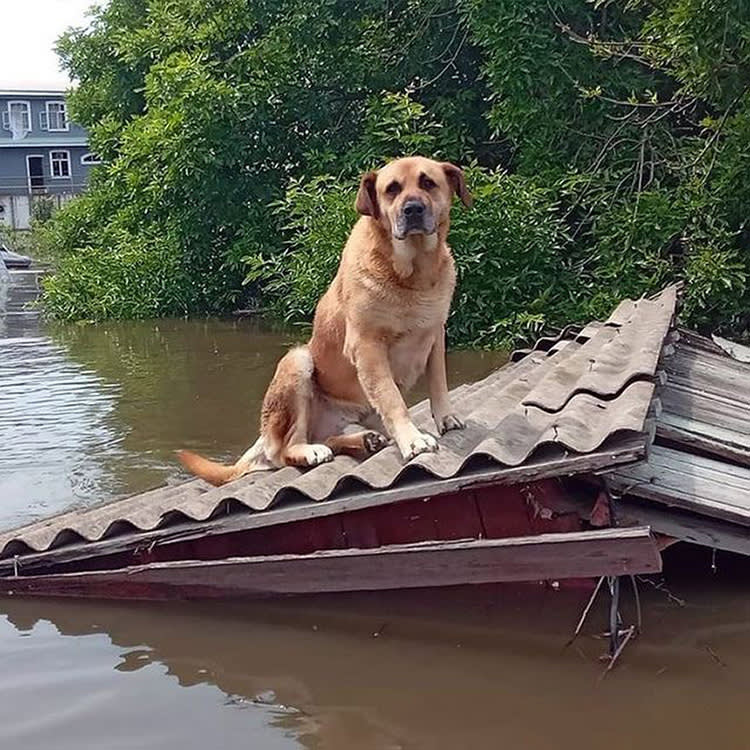
The photographs from that first week all look the same, and they are the reason anyone remembers this at all: a dog on a roof.
Not a dramatic rescue. Just a dog, sitting on the corrugated peak of a submerged house, waiting, with brown water where the street used to be.
On June 6, 2023, the Nova Kakhovka dam in Kherson, Ukraine, collapsed. More than 6,000 people were ordered out. The evacuation was led, in large part, by volunteers, and the water they went into was not simply water. It was contaminated with sewage, fuel, and agricultural chemicals. It was moving through an active war zone. And it had lifted landmines out of the ground and redistributed them, invisibly, across the flood plain.
Into that, people went in boats to get animals off roofs.
Why the animals were still there
The question people ask, always, is why the pets were left behind. It is worth answering plainly, because the answer is not negligence.
Mass evacuations move fast and they move people. Buses, trains, and boats have rules about animals, or their operators improvise rules on the spot. Many owners left believing they were going for a day. Some were physically prevented from bringing an animal. Others were not home when the water came, because the collapse happened in the early hours and the flooding moved quickly downstream through villages that had no time to plan anything.
So the animals stayed where they were, and the water rose around them, and they went up. Onto roofs, into garages, onto whatever floated.
Volunteer Volodymyr Holubnichii, speaking to ABC News at the time, put it in terms that refused the usual hierarchy: every life has worth, and the species of the life does not change the arithmetic. He was not from Kherson. He was from Kharkiv province in the north, a safe distance from the flooding, and he and his colleagues at Animal Rescue Kharkiv drove south into it anyway.
The scale nobody could see from a rooftop
The pets on the roofs were the visible catastrophe. Underneath it was a much larger one.
Within days, Ukraine’s president said 50,000 hectares of forest had been flooded and that roughly 20,000 animals and 10,000 birds were at immediate risk of dying. Ecologists warned that around 20 species could vanish from the region entirely. Fish were left stranded and gasping on newly exposed mud flats as the reservoir emptied. Fledgling water birds lost their nests, and then lost the food supply that would have fed them.
Downstream, the water carried silt, oil products, pesticides, heavy metals, and raw wastewater into the lower Dnipro and out into the Black Sea, where the damage stopped being something you could photograph and started being something that would take a generation to measure.
Ukrainian scientists who have tallied the consequences describe it in decades, not months.
The groups who went in, and what they had already survived
The organizations working in Kherson that June were not new to this. They had been operating for over a year inside a war.
United for Animals was in Kherson from the first day, pulling pets out, providing veterinary care, and delivering thousands of pounds of pet food. Before the invasion the group’s work was almost unrecognizable from what it became: campaigning against fur at Ukraine Fashion Week, getting animal circuses banned in dozens of cities, pushing animal-rights legislation. After it, the numbers changed shape entirely, and by the time of the dam collapse they had rebuilt more than 10 shelters, evacuated more than 1,300 animals, and distributed more than 599 tons of food.
Animal Rescue Kharkiv put over 70 volunteers into Kherson, working through hazardous water to take animals off rooftops, out of garages, and off floating wreckage. Their count passed 100 animals and kept climbing.
Nova Ukraine did the unglamorous part that makes the rest possible: water pumps, waders, drinking water, first aid kits, and food packs, delivered to the people doing the pulling, including the Animal Rescue Kharkiv volunteers and the pet owners who had stayed.
PETA Germany partnered with Animal Rescue Kharkiv and sent five boats and three rescue teams. The organization had been working in Ukraine since the war’s outbreak, delivering food, standing up clinics and shelters, and by then had rescued over 11,000 animals.
Gyvūnų Gerovės Iniciatyvos, a Lithuanian animal welfare group, funded the purchase of a boat and sent carriers and cages for the evacuation. Their prior contribution to Ukraine was already substantial: over 160 tons of food, 12,000 rabies vaccine units, and more than 300,000 euros to shelters and projects.
The International Fund for Animal Welfare worked the receiving end, supporting partners in Mykolaiv, the neighboring city absorbing displaced people and animals, with pet food, volunteers, and veterinary ambulances.
Read that list again and notice what it actually is: not a disaster response assembled in a week, but an infrastructure that already existed, built over a year of war, that could be pointed at a new emergency in days. That is the thing worth understanding about how animals get saved in a war zone. The boat gets bought before the flood.
What the water left behind
The reservoir did not refill. It drained, and the enormous body of water that had sat there since the 1950s became a landscape again.
What has grown back is the strangest part of this story. Within a year, roughly a third of the former reservoir bed had been colonized by willow forest, springing up out of the exposed sediment, and wildlife from the surrounding steppe began moving into ground that had been underwater for seventy years.
That is not a happy ending, and researchers have been careful not to let it be read as one. The chemicals are still in the sediment. The species that lost their habitat did not get it back. The downstream ecology of the Dnipro delta and the Black Sea coast was altered in ways that will take decades to settle, and the flora and fauna of the region are still years from adjusting to whatever the new reality is.
But it does mean the story did not end when the news cameras left, and neither did the work.
What actually helps, three years on
The instinct after a disaster like this is to donate in the first week, when the images are everywhere, and then to move on. The groups on the ground will tell you that the first week is not when the money is scarcest.
If you want to help animals in Ukraine now, the useful moves are unglamorous:
- Give to the organizations that were already there and still are. United for Animals, Animal Rescue Kharkiv, Nova Ukraine, and IFAW are all still working, and their capacity is built on predictable funding rather than emergency spikes.
- Give unrestricted where you can. A donation earmarked for flood rescue in Kherson is useless the following month. A donation the group can spend on fuel, food, or a boat is not.
- Fund the boring things. Food, veterinary supplies, vaccination programs, and shelter rebuilding are what keep animals alive between the emergencies, and they never trend.
And the thing worth sitting with, if you are reading this a long way from any of it: the volunteers who went into that water were, mostly, ordinary people who had decided that “animal” and “person” were not different enough categories to justify leaving one behind.
That is a decision available to anyone. It just costs more in Kherson.
References
- Reuters and ABC News reporting on the Nova Kakhovka dam collapse, June 2023.
- World Health Organization, Regional Office for Europe. (2023, June 13). WHO steps up its humanitarian response in southern Ukraine following the destruction of the Kakhovka Dam. https://www.who.int/europe/news/item/13-06-2023-who-steps-up-its-humanitarian-response-in-southern-ukraine-following-the-destruction-of-the-kakhovka-dam
- Science. (2023). Ukrainian scientists tally the grave environmental consequences of the Kakhovka Dam disaster. https://www.science.org/content/article/ukrainian-scientists-tally-grave-environmental-consequences-kakhovka-dam-disaster
- ReliefWeb. (2023). Catastrophic impact of Nova Kakhovka dam collapse to be felt for decades. https://reliefweb.int/report/ukraine/catastrophic-impact-nova-kakhovka-dam-collapse-be-felt-decades
- International Fund for Animal Welfare. Ukraine response. https://www.ifaw.org/projects/rescue-animals-ukraine
- Nova Ukraine. https://novaukraine.org/
Jordan Ellis is a certified professional dog trainer with a decade of experience working with rescue organisations and private clients. They specialise in anxiety, reactivity, and positive reinforcement methods, and review all training and behaviour content at The Pet Times.
Meet our experts ↗Keep reading
 LivingThe Unlikely Shelter Marketing That Works: Kids With PaintbrushesLeila Torres · 5 min
 LivingBroadway Barks Rehomed 2,000 Animals by Hijacking Actors' One Daily BreakNina Vasquez · 4 min
 LivingHalf of Survivors Won't Leave Without the Dog. Only 12% of Shelters Take One.Nina Vasquez · 9 min
 LivingYou Don't Have to Adopt a Dog to Get the BenefitClaire Sutton · 6 min
 LivingSome States Once Banned Black Families From Owning Dogs. A Yale Scholar on Why That Still Echoes.Leila Torres · 6 min
 LivingBrooklyn's Cat Cafe Flipped the Model: It's a Rescue Clinic With a Cafe AttachedSara Lim · 6 min