


Her Partner Is Allergic to Almost Everything. So She Built a Menagerie Around It.
Artist Lorien Stern shares her Mojave ranch with ducks, a cat, a doodle, and a 25-year-old tortoise, most of it assembled around one person's allergies. The truth about 'hypoallergenic' pets, and why a duck might be the sleeper choice.

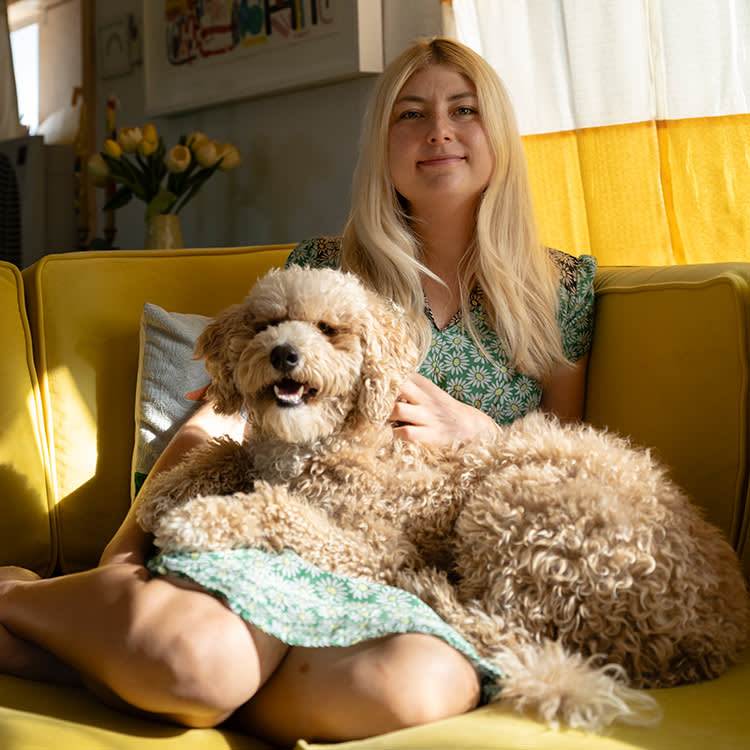
Most people build a pet collection by accident, one soft impulse at a time. Artist Lorien Stern built hers under a constraint most animal lovers would treat as a dealbreaker: her partner, fellow artist Dave McPeters, is seriously allergic. What she ended up with, on a ranch in the Mojave Desert, is a household of ducks, a cat, a doodle, and an ancient tortoise, assembled less by chance than by strategy. It is a small master class in loving animals when your body, or your person’s body, says no.
Stern is best known for whimsical ceramics and installations, plus a line of home goods and clothing, all populated by a bestiary of sharks, ladybugs, frogs, cats, and dogs. Animals, she says, are the biggest influence on everything she and McPeters make. The house they made together on her family’s old desert property, a onetime construction-supply junkyard the family had held since 1990, is now a colorful haven, and the animals are the reason it feels alive.
The gateway pet was a duck
Before the cat, before the dog, there was a duck. About a decade ago, Stern and McPeters, who traveled constantly and wanted something low-maintenance, spotted ducklings for sale at their local hardware store and could not resist. The duck, Beaker, moved in, quite literally: she grew up inside the house, trailed Stern everywhere, and could not bear to be left alone for a minute without crying. At night she slept beside the bed, reassured only if she could see a human arm dangling over the edge. Being small, she also fixated on their shoes as stand-ins for the humans themselves, curling up against them for comfort.
Today the flock is Slim and Beaker; a third duck, Ice Cream, died a couple of years ago. And Stern is a genuine convert. Ducks, she insists, are among the sweetest, most affectionate pets going. They go on walks with you. They are easy. And, in her words, they pay their rent in eggs.
The allergy problem, and the workaround
The cat and dog were harder-won, and this is where the allergies come in. During the pandemic, Stern and McPeters decided they wanted a cat, but McPeters is allergic enough that an earlier attempt collapsed; a cat she brought home once left him so miserable that she had to rehome it. This time they did their homework, learned that some cats are lower-allergen, and found a source online that claimed a high success rate for people with sensitivities. They met the seller, took a chance, and came home with Bob, a shy cat who has since become, in Stern’s telling, the whole center of their lives.
The dog followed the same logic. Wanting a companion but boxed in by allergies again, they looked specifically at low-allergen breeds, which meant, frustratingly for someone who cares about adoption, going to a breeder rather than a rescue. The result is Curly, a Goldendoodle who wrestles with Bob every night like a littermate.
Rounding out the household is Myrtle, a tortoise of roughly 25 years who came to them about five years ago after belonging to a family friend who passed away. The ducks and the mammals keep a respectful distance; after Bob once eyed the ducks a beat too long, Stern instituted a permanent fence between them, unwilling to stress the birds even for a cute cross-species photo.
The reality check on “hypoallergenic”
Here is the part worth pinning down, because Stern’s story runs straight into one of the most persistent myths in pet ownership: there is no such thing as a truly hypoallergenic cat or dog. Not one breed is allergen-free.
The main cat allergen is a protein called Fel d 1, produced in a cat’s saliva and skin, not the fur itself, and spread across the coat during grooming. That is why a hairless cat is not a safe bet and a fluffy one is not automatically worse; what matters is how much Fel d 1 the individual animal makes. Some cats, and some breeds such as the Siberian, do produce measurably less of it, which is likely what Stern’s low-allergen source was selecting for, but “less” is not “none.” With dogs, curly-coated poodle crosses like Goldendoodles shed less loose dander around a home, which can genuinely help, yet they still carry dog allergens in saliva and skin, and doodle coats vary so much litter to litter that “hypoallergenic” is closer to marketing than a guarantee.
If you are the allergic one, the honest move is to test your reaction to the specific animal before you commit, not the breed in the abstract, and to talk to an allergist. Spend real time with the individual cat or dog, and lean on the boring but effective tools: air filtration, frequent bathing and grooming, keeping the pet out of the bedroom, and washing your hands after cuddles. Stern’s happy ending is real, but it rests on choosing the right individual animal, not on a magic breed.
Why animals, always
Ask Stern why she keeps filling her life with creatures despite the obstacles and the answer turns personal. She has always connected with animals, sometimes more easily than with people. When her father died, she adopted seven cats at once, and they became her entire world, a source of comfort waiting for her every day after school. That bond, someone who is simply always there and never judges, is what she chases, and what her work keeps circling back to.
The menagerie, in other words, is not in spite of the allergies. It is a testament to how far someone will go to keep animals close, right down to the duck asleep by the shoes.
Leila Torres leads our Living coverage, from home life and travel to the products and rescue stories that come with sharing a life with animals. She edits and writes across the section, with a soft spot for pieces about the bond between people and their pets.
Meet our experts ↗Keep reading
 LivingEverybody Got a Second Dog. Her Order Book Was the First to Know.Jordan Ellis · 6 min
 LivingThis Bright Yellow Bus Is Basically Uber, but Every Passenger Has Four LegsNina Vasquez · 4 min
 Living8 Absurdly Pampered Pets, Ranked by Whether the Money Bought Them AnythingNina Vasquez · 8 min
 LivingThis Romance Bookstore Used to Be a Pet Shop. The Neighborhood Dogs Never Got the Memo.Jordan Ellis · 6 min
 LivingYour Dog Is 'Worth $90,000 a Year.' That Number Is Doing Something Sneaky.Jordan Ellis · 6 min
 LivingThe Weird Little Rituals Pet Parents Refuse to SkipMarcus Webb · 5 min