


Your Dog Isn't Done Becoming Themselves. Age Six Is the Turning Point.
The wild adolescent you're living with now is not the dog you'll have in five years. Research shows a dog's personality keeps shifting well into adulthood, which is bad news for one myth and great news for your training.

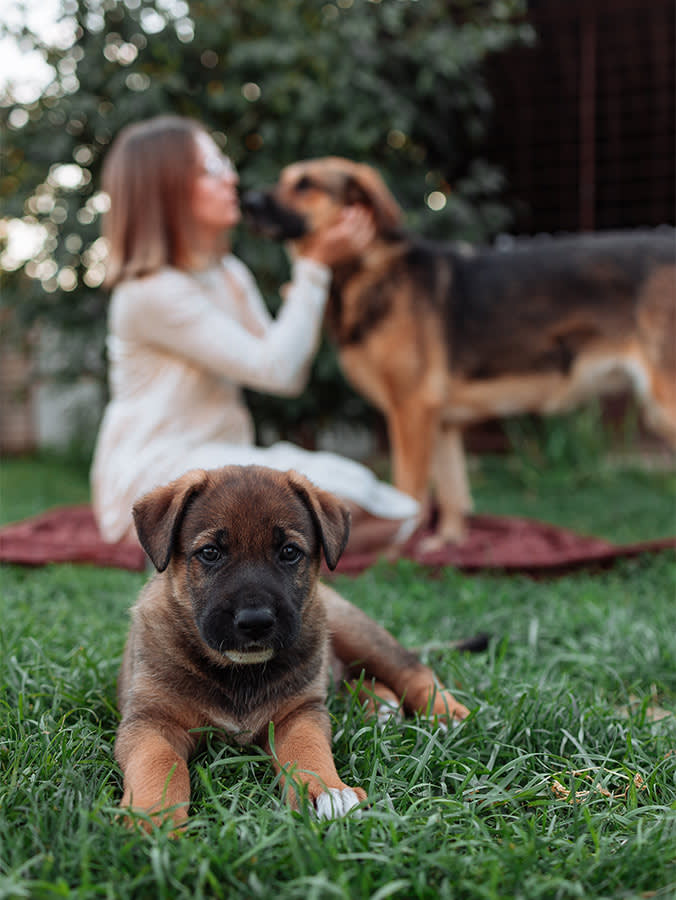
If you are deep in the goofy, boundary-testing, chew-everything teenage phase with your dog right now, you have probably been told to just wait it out. Here is the encouraging news backed by data: you are not waiting out a phase in a fixed personality. You are living with a dog who is still, in a real sense, under construction.
We tend to talk about a dog’s temperament as if it were set at the factory. Sweet dog, anxious dog, wild dog, done. But a large study out of Michigan State University turned that assumption over. The researchers found that dogs’ personalities shift over the course of their lives to a surprisingly large degree, and once you know how that shift moves, it changes how you should be spending these early years.
What the research actually found
Psychologist William Chopik and his team surveyed the owners of more than 1,600 dogs spanning 50 breeds, from puppies just a few weeks old to seniors around 15 and 16 years, with males and females split fairly evenly. Owners rated their dogs’ personalities and behavioral history, and answered a parallel set of questions about themselves.
The team went in expecting dogs to be fairly steady, on the logic that dogs do not go through the big disruptive life changes humans do. Instead, the dogs changed a great deal. Three patterns stood out: personality moves with age, dogs and their people tend to share traits, and a dog’s personality shapes how good the relationship feels to the owner.
That last point is not trivial. A dog’s personality has been linked to how closely bonded they feel to their person, to biting behavior, and even to chronic illness. Temperament is not just charming trivia. It touches health and safety.
The window nobody tells you about
The single most useful finding for a new dog parent is about timing. There is an ideal stretch for drilling obedience into a dog, and it arrives around age six, once a dog has left the frantic, distractible puppy stage behind but before they settle too firmly into their ways.
That reframes the teenage months. The adolescent chaos is not a wall you are stuck behind. It is the front edge of a long, workable stretch of development. And what you do during it matters, because exposure to structured training early was tied to more positive personality traits across a dog’s entire lifespan, not just while the classes were happening. The obedience class you drag yourself to on a Tuesday night is not only teaching a sit. It is nudging the kind of adult your dog becomes.
People hear ‘personality changes’ and assume it means their dog is unpredictable, but it is the opposite. It means you have influence, and the years when that influence is strongest are the ones most people spend just surviving the chewing. Spend them building instead.
The one trait that tends to hold
Not everything is up for grabs. Fear and anxiety are the traits least likely to shift with age. A dog who runs anxious as a young dog often carries that thread through life. That is not a reason to give up on an anxious dog, but it is a reason to treat early fearfulness as a signal to get ahead of, with gentle exposure and, when it is warranted, professional help, rather than something you assume they will simply outgrow the way they outgrow the zoomies.
Why your dog seems a little like you
The study also put hard numbers on an old cliché. Owners and their dogs really do tend to share traits. People who called themselves extroverted tended to describe more excitable, higher-energy dogs. People carrying a lot of negative emotion tended to see their dogs as more fearful, more restless, and tougher to train. Those who described themselves as agreeable generally had dogs they viewed as less fearful and less aggressive toward people and other animals.
It is worth being careful about what that does and does not mean, and it is easy to over-read. Some of it is shared life: a calm household is a calm environment for a dog. Some of it is how we perceive and report on our own dogs. The takeaway is not that your anxiety doomed your dog, but that your dog is developing inside the emotional weather you create, and that weather is one of the levers you actually hold.
Nature, nurture, and the shelter dog
The findings fit the same nature-versus-nurture story we tell about people. Some traits are wired in and stubborn. Others bend to environment. Adopt a dog out of a shelter and drop them into a home where they are loved, walked, and kept busy, and a wary, shut-down dog can genuinely loosen into a more relaxed, more social version of themselves over time. The starting point is not the ending point.
What newer research adds
The Michigan State work, published in the Journal of Research in Personality, remains the anchor study on this question, and its central message has held up as the field has kept probing how stable canine temperament really is: a dog’s personality is a moving target, most malleable earlier in life and most responsive to how the dog is raised and handled.
For a pet owner, the practical version is simple. Do not treat the dog in front of you as the finished product, for better or worse. The anxious puppy is worth investing in early, because that thread is the stubborn one. The wild adolescent is not a lost cause but a work in progress, sitting right inside the window when your training does the most lasting good. The best time to shape who your dog becomes is now, while they are still becoming it.
References
- Chopik, W.J., and Weaver, J.R. “Old Dog, New Tricks: Age Differences in Dog Personality Traits, Associations with Human Personality Traits, and Links to Important Outcomes.” Journal of Research in Personality, vol. 79, 2019, pp. 94–108. doi.org/10.1016/j.jrp.2019.01.005
- Michigan State University. “A Dog’s Personality Can Change Over Time.” msu.edu
Dr. Kohl is a board-certified veterinary dentist with a particular interest in preventive oral care. She reviews all dental health content at The Pet Times and contributes practical guides on home dental routines, professional cleaning, and oral disease prevention.
Meet our experts ↗Keep reading
 TrainingSkip the Doomscroll: 8 Dog Trainers Worth Following on InstagramDr. Mara Chen · 7 min
 TrainingYour Dog Is Listening to Your Tone, Not Your WordsSasha Ford · 6 min
 TrainingEvery Dog Trainer Says They're 'Humane.' Here's How to Read Past ItDr. Amara Solis · 5 min
 TrainingAsking Your Dog for Consent Sounds Ridiculous. It Works Anyway.Dr. Ravi Mehta · 8 min
 TrainingExcited Isn't the Same as Happy. 8 Signs Your Dog Is Over Threshold.Dr. Nina Kohl · 8 min
 TrainingNever Introduce Two Dogs Face-to-FaceDr. Mara Chen · 7 min