


The Law to Stop Puppy Mills Already Exists. This Bill Makes the USDA Use It.
Goldie's Act is named for a Golden Retriever who starved to death in a USDA-licensed puppy mill while inspectors had the power to save her and didn't. The bill doesn't write new rules. It forces the agency to enforce the ones already on the books.

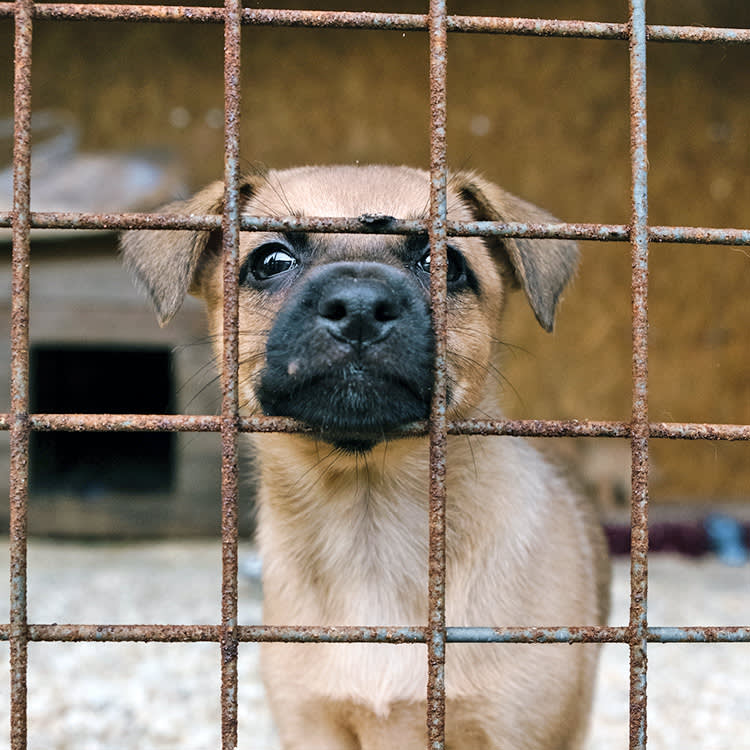
The most infuriating part of Goldie’s story isn’t that she suffered. It’s that people with the authority to stop it watched it happen.
In April 2021, USDA investigators walked into a licensed commercial breeding facility in Iowa housing around a thousand dogs. One of them, a Golden Retriever, had no name, just a number: 142. She was already dangerously thin, but because she was technically under veterinary treatment, the inspectors left her there. Returning months later, they discovered her tucked away in a soiled horse stall, her bones showing through her coat. She was too far gone to save and was later euthanized. The photos from the federal lawsuit that followed are hard to look at. The dog the world came to know as Goldie died of something entirely preventable, inside a system that was supposed to protect her.
That system is the whole problem, and it’s what a bill called Goldie’s Act is trying to fix, not by inventing new protections, but by forcing an agency to use the ones it already has.
What Goldie’s Act actually does
Here’s the key thing to understand: the rules already exist. The federal Animal Welfare Act spells out how commercial breeding operations, puppy mills included, are supposed to treat their animals, and the agency was already handed the power to enforce it. Goldie’s Act simply requires that the power get used, to report violations, penalize breeders who break the law, and act on suffering animals instead of leaving them behind.
Specifically, the bill would direct the USDA to pull animals in urgent need of care out of these operations, to inspect breeding facilities often enough for real oversight, to issue meaningful penalties that actually deter bad behavior, and to loop in law enforcement when violations warrant investigation. As the ASPCA, which has championed the legislation, frames it, the bill doesn’t set a single new standard. It tells the agency to use the power Congress already handed it.
Why the existing system fails
If the USDA already has this authority, why does a dog like Goldie starve on its watch? Because, by the government’s own accounting, enforcement has been toothless for decades.
The USDA’s Office of Inspector General has published report after report criticizing lax oversight. A 2010 audit concluded that penalties issued by the Animal and Plant Health Inspection Service (APHIS) had been slashed so far below the allowable maximum that they’d become, in the audit’s words, essentially meaningless, low enough that breeders treated fines as a routine cost of doing business. And 2010 wasn’t the start of it: that same audit noted that earlier reviews in 1995 and 2005 had flagged the identical problem. This is a failure measured in decades, not years.
The scale is enormous. At any given moment, roughly a quarter of a million dogs live inside operations that the USDA licenses or registers. And a 2023 ASPCA report found that while the USDA documented more than 1,000 Animal Welfare Act violations that year, it took law-enforcement action against just four of the 413 offending facilities. The agency has real tools at its disposal, fines, temporary license suspensions, even removing suffering animals, and it consistently under-uses them. Perhaps most telling, a facility’s history of violations has virtually no bearing on whether its license gets renewed, so chronic offenders stay in business. When the agency’s own program leans primarily on inspections to ensure compliance, weak follow-through all but guarantees that licensees keep breaking the law.
“By the time a dog reaches a rescue or a vet’s table out of one of these operations, we’re often treating the physical record of that neglect, untreated infections, dental disease, matting down to the skin, behavioral shutdown,” says Dr. Ravi Mehta. “The single most powerful thing an ordinary person can do isn’t only to back a bill like this. It’s to never buy a puppy sight unseen from a seller who won’t show you where the animals live. Demand dries these places up faster than any inspection.”
Who’s behind the bill, and who’s fighting it
Goldie’s Act has been a bipartisan effort from the start, and it was reintroduced in Congress in 2025 as H.R. 349. Its House sponsors span both parties, including Representatives Nicole Malliotakis, Raja Krishnamoorthi, Mike Quigley, Brian Fitzpatrick, Chris Smith, and Zach Nunn, and a companion version has been introduced in the Senate by Senators Richard Blumenthal and Rick Scott. More than 170 animal-welfare, law-enforcement, and shelter organizations have endorsed it.
It also has organized opposition. Groups that benefit from the USDA’s loose enforcement, most notably the American Kennel Club, have pushed back against Goldie’s Act and similar measures, which is a large part of why the bill has struggled to advance despite its broad support. Advocates continue to press for its provisions through the regular legislative process, including as a possible addition to the periodic Farm Bill that sets national agriculture policy.
How to help
If you want Goldie’s Act to become law, the most direct step is to contact your own representatives and senators, tell them the bill matters to you, and ask them to support it. The ASPCA’s position, and the argument at the heart of the whole effort, is simple: these animals are already supposed to be protected under the Animal Welfare Act. Goldie’s Act is about making that protection real in practice, not just on paper.
References
- U.S. Department of Justice. United States v. Daniel Gingerich (case filing).
- U.S. Congress. “H.R.349 — Goldie’s Act.” 119th Congress (2025).
- ASPCA. “ASPCA Report on Puppy Mill Cruelty Reveals the USDA’s Continued Failure to Protect Vulnerable Dogs.” 2025.
- USDA Office of Inspector General. “APHIS Animal Care Program Inspection and Enforcement Activities.” Audit Report 33002-4-SF, 2010.
James Okafor covers rescue, adoption, and the causes shaping animal welfare. His work follows the people and organisations working to give more pets a home, and the issues owners and advocates care about most.
Meet our experts ↗Keep reading
 LivingYour Rescue Can Win $1,000 for the Shelter That Saved ThemSara Lim · 4 min
 LivingHe Quit City Life for a Van and a Rescue Puppy. It Grew Into a $200,000 Mission.James Okafor · 5 min
 LivingHundreds of Thousands of Dogs Died Last Year. This Film Blames Us.Marcus Webb · 6 min
 LivingThey Came to Shoot a TV Show. They Left Having Saved 14 Dogs.Sara Lim · 6 min
 LivingThe ADA Has No Breed List. Your Landlord's Insurance Does.Dr. Priya Nair · 6 min
 LivingThis Pit Bull Documentary Isn't Really About DogsJames Okafor · 6 min