


Your Dog Can Smell the Setup. How to Actually Get a Pill Down.
Dogs that eat socks and spiders will somehow detect one tiny pill in a meatball. The trick isn't a better hiding spot — it's never letting the pill feel like medicine in the first place. Vet-approved methods that work.

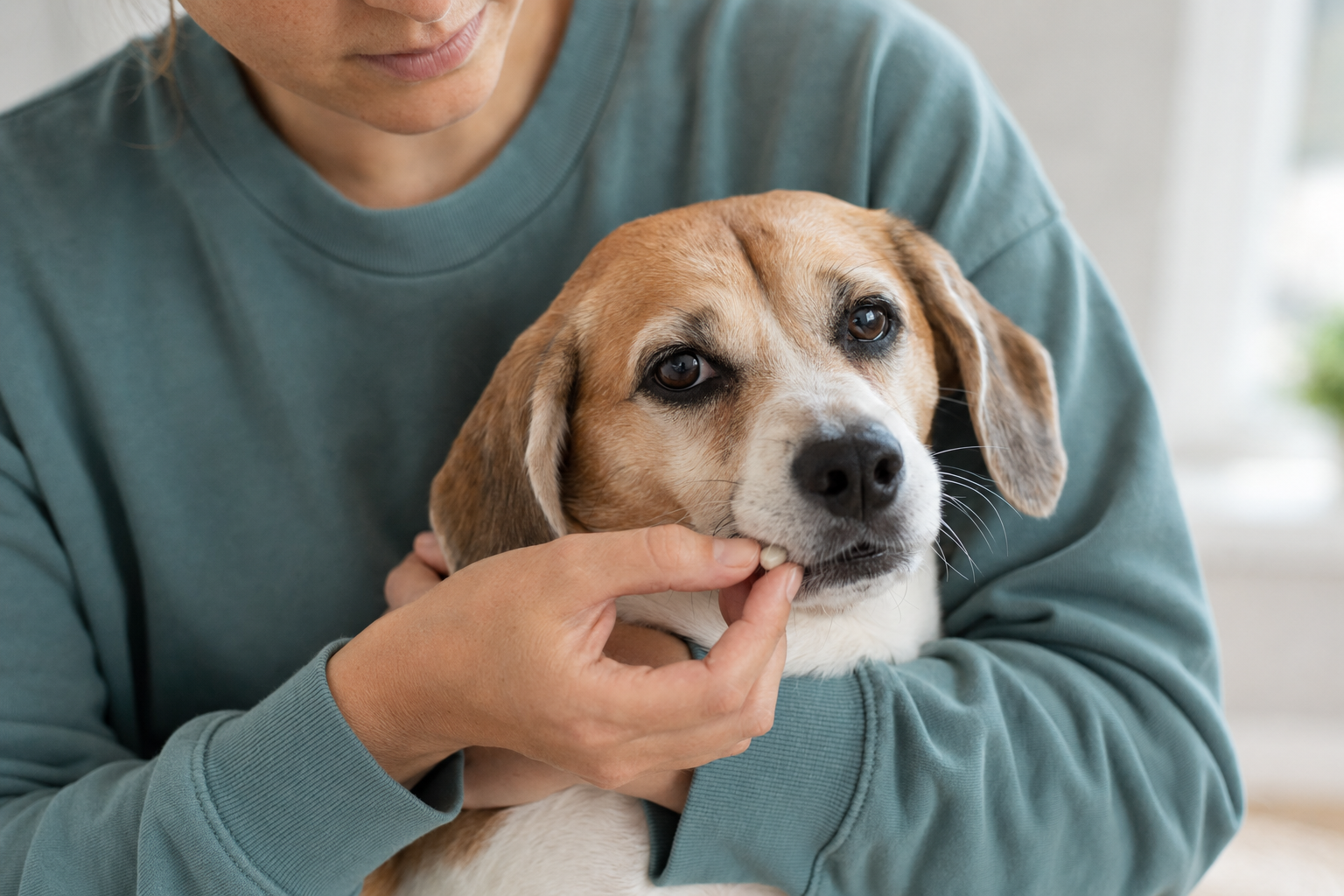
Dogs will eat almost anything. Couch stuffing, socks, the occasional spider, all swallowed without a second thought. And then you wrap a single pill in a bite of cheese and suddenly your dog is a Michelin inspector, delicately eating around the medicine and spitting the tablet onto the floor with visible contempt.
That contrast is the whole puzzle, and it points at the solution. Dogs don’t refuse pills because they can’t get them down. They refuse because they catch the setup, the change in your behavior, the too-careful treat, the faint bad taste from last time. A dog is smart enough to know when something’s up. So the winning strategy isn’t a cleverer hiding spot. It’s making the pill feel like nothing at all, an ordinary, unremarkable moment your dog has no reason to inspect. Here’s how to pull that off, from the easiest methods to the last resort.
Why some dogs are so hard to pill
For an animal that treats the world as a buffet, dogs can be shockingly discerning about medication. Usually it’s memory: a pill once left a bitter taste, or the texture or size was off-putting, and now your dog is suspicious on principle. They also dislike being tricked, so the more obviously you’re pulling a fast one, the harder they dig in. Understanding that changes your job from “force it in” to “don’t tip them off.”
Hide it in food (the right way)
This is the first thing to try, and most of the time it’s all you need, if you do it without ceremony. The idea is a Trojan horse: bury the pill in a bite of something so delicious your dog swallows first and thinks never. A few rules make it work far better.
Use a treat your dog doesn’t normally get, so the novelty overrides the suspicion. Run through a couple of ordinary tricks or cues first and hand it over as if it’s just another reward, no fussing, no hovering. And crucially, pick something your dog will swallow whole rather than chew, because a dog who bites down may hit the pill, taste it, and blow the whole operation. Good vehicles include:
- A ball of plain butter
- A dab of chilled cream cheese rolled into a ball
- A cube of hot dog
- A spoonful of soft-cooked pasta
- Peanut butter, warm or chilled, pressed onto a corner of bread or rolled into a ball
- A folded bite of scrambled egg
- A small piece of chicken or beef
- Melted cheese on a bit of toast
If the medication is a capsule and hiding it whole isn’t working, ask your vet whether you can open it and stir the contents into a spoon of canned food, but check first, because not every capsule can be opened safely (more on that below).
Use a pill pocket
A pill pocket is a squishy treat with a hollow middle built for exactly this job, and it’s brilliant for a lot of dogs. Several brands exist, so find a flavor your dog loves. There are also pill pastes, essentially a heavily flavored spread instead of a solid treat, that you smear around the medication. The soft, moldable format hides both the shape and the smell, which is half the battle.
Try the treat sandwich
If your dog knows treats come after doing a task, use that to your advantage. Some dogs will down the medicated treat just to earn the reward. For the more skeptical, try a “treat sandwich”: a plain treat, then the pill (or medicated treat), then another plain treat as a chaser, so the medicine is bracketed by good things. A variation is the three-pocket roulette, offer three treats or pill pockets in quick succession with the pill in just one, so your dog can’t predict which bite matters and gulps them all.
Time it with hunger
A hungry dog is a less picky dog. Giving the pill right before a meal, with or without a treat, makes it more tempting and can teach your dog that the pill is simply the toll they pay before dinner arrives. Just confirm the medication doesn’t need to be given on a full stomach first.
Ask about a different formulation
Veterinary medicine has caught on to the fact that most pets hate pills, so many common drugs now come in friendlier forms. If your dog simply will not take a tablet, ask your vet about a liquid, a powder, or a flavored chewable. Liquids and powders mix easily into food, chewables can turn dosing into a treat, and a compounding pharmacy can sometimes reformulate a medication into a flavor your dog actually likes. Many everyday dog medications, anti-inflammatories and pain relievers among them, already exist in alternatives.
The hands-on method (when all else fails)
Sometimes the pill just has to go in directly. This is the method most owners are least eager to try, and your dog’s safety comes first, so if you’re uneasy, ask your vet for a hands-on demonstration rather than guessing.
To do it: with one hand over the upper jaw (thumb on one side, fingers on the other), gently pry the lower jaw down with the middle finger of your free hand. Place the pill as far back on the tongue as you can reach, then quickly withdraw your hand, close the mouth, and stroke the throat until you feel a swallow. Follow with praise and affection so the experience ends on a good note. This is essentially what your vet does when a pill absolutely has to get in: open the mouth the same way, drop the pill deep, close, and massage the throat to trigger swallowing.
Two safety notes worth knowing
First, don’t crush or split a pill without checking. Some medications are extended-release or coated for a reason, and crushing them can dump the whole dose at once or wreck how the drug is absorbed. A quick call to your vet or pharmacist tells you whether a given pill can be split, crushed, or opened.
Second, make sure the pill actually goes down. A tablet that lodges partway can irritate the esophagus, so chasing any hand-given pill with a little water or a moist treat is a smart habit, especially for smaller dogs.
The biggest reason owners lose the pill battle is that they turn it into an event. The dog reads your nervous energy and knows the meatball is a trap. Keep it casual, mix medicated treats in with plain ones so the pill isn’t special, and always send it down with a swallow of water. And if you’re truly stuck, tell us, because a missed dose of a real medication matters, and there’s almost always another formulation or trick we can offer.
When to call your vet
If you can’t get your dog to take a needed medication, whether it’s for an upset stomach, diarrhea, or a chronic condition, loop in your vet sooner rather than later. That drug was prescribed for a reason, and a dog who isn’t getting it isn’t getting better. Your vet can suggest a different form, show you the hands-on technique, or adjust the plan.
Bottom line
Most dog owners eventually face a pill their dog wants no part of. The way through is rarely brute force, it’s disguising the pill in a tasty treat, timing it with hunger, switching to a form your dog tolerates, or, when necessary, placing it by hand and chasing it with water. Keep the whole thing low-key, because the calmer and more ordinary you make it, the less your clever dog has to object to.
References
- Plumb’s Veterinary Drugs. “Administering oral medications to dogs.” plumbs.com.
- American Animal Hospital Association. “Giving your dog medication.” aaha.org.
- U.S. Food and Drug Administration, Center for Veterinary Medicine. “Get the Facts about Pain Relievers for Pets.” fda.gov.
Not a substitute for your vet. Our guidance is educational. For urgent symptoms, contact a vet or emergency clinic right away. Editorial standards
Dr. Mehta is a board-certified veterinary nutritionist who evaluates pet food formulations, ingredient quality, and the science behind dietary trends. He writes and reviews all nutrition content at The Pet Times, including our food rankings and feeding guides.
Meet our experts ↗Keep reading
 Health & WellnessYes, Male Dogs Have Nipples. The Part That Actually Matters Is Cancer.Dr. Amara Solis · 7 min
 Health & WellnessThe Dog Longevity Pill Is Almost Real. It Won't Buy You Forever.Dr. Ravi Mehta · 8 min
 Health & WellnessYour Dog Can't Have Down Syndrome. What You're Seeing Is Still Real.Dr. Amara Solis · 8 min
 Health & WellnessYour Dog Becomes an Adult Three Separate TimesDr. Ravi Mehta · 9 min
 Health & WellnessMucus in Your Dog's Poop Is Not the Problem. Its Company Is.Dr. Amara Solis · 8 min
 Health & WellnessYour Dog Doesn't See the World. They Smell It.Dr. Ravi Mehta · 10 min