


To Gary Baseman, the Cat Was Never a Pet. He Was a Co-Author.
The Emmy- and BAFTA-winning artist spent 15 years with a 20-pound black cat named Blackie who became his muse, his comfort, and, in his telling, his collaborator. How grief and a mischievous new kitten keep shaping his work.
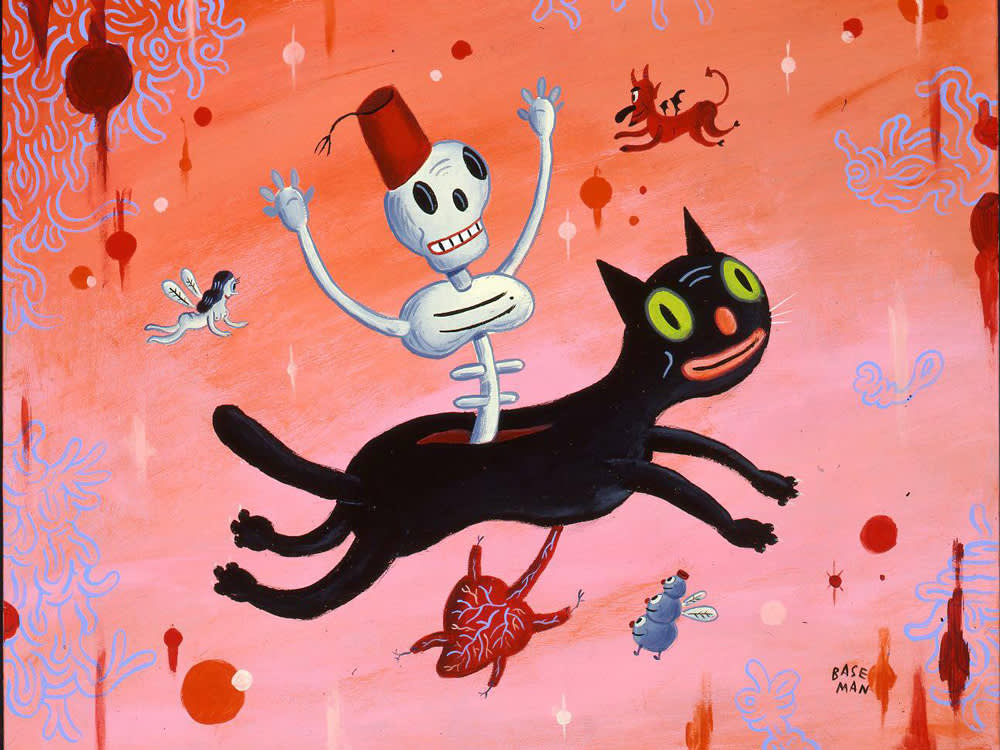
Ask most people about their cat and you’ll hear about a pet. Ask Gary Baseman about his and you’ll hear about a family member, a friend, and, without a trace of irony, a creative partner. The Los Angeles artist, who has an Emmy and a BAFTA to his name and a résumé that runs from The New York Times Book Review to Time to a globe-spanning career in painting and toy design, has been open that he never thought of his cats as animals he owned. He thought of them as souls he lived and worked alongside.
For 15 years, that soul was Blackie: a large, fluffy, roughly 20-pound black cat who quietly became one of the most recurring presences in Baseman’s art.
The muse who moved in during the worst year
Blackie arrived at a low point. Baseman has described being in the middle of a painful divorce, carrying guilt and fear, when the cat, then a neighbor’s, essentially adopted him. Blackie would climb onto his chest and settle there, and Baseman credits him with pulling the anxiety out of the room. It’s a familiar story to anyone who has been rescued by an animal at exactly the moment they needed one, except that in Baseman’s case the rescue turned into a decade and a half of collaboration.
Because Baseman works from home, the two were together constantly, and Blackie seeped into the work. He inspired recurring characters, stood in for the artist himself in some pieces, and starred in Baseman’s own online series devoted to him. The cat’s habits became material, too. For years, Blackie had a strange ritual of knocking small red elephants off a bedside table, a game Baseman assumed was just play. Over time he came to read it as something more deliberate, a private ceremony tied to memory and lineage, and he began folding that meaning into his art alongside his own reckoning with heritage. Both of Baseman’s parents survived the Holocaust, and he has spoken about being the first in his family to make the trip back to his parents’ birthplaces, in a corner of eastern Europe that was Polish territory before the war. The elephants and the searching ran side by side.
Losing him, and the work that came after
Blackie’s death hit Baseman hard, and he hasn’t hidden it. He has talked about the last stretch of the cat’s life, feeding him around the clock, hoping he’d rally, and about how few relationships in his life ever felt as close. He marked the anniversary of the loss with a memorial, and he has channeled the grief into ongoing work, including an exhibition built around mourning and memory.
The most direct tribute keeps appearing on the page. In the years since, Blackie has lived on as a series of drawings Baseman has titled The Nine Lives of Blackie the Cat, including a Día de los Muertos edition that imagines his departed friend in the spirit world. It’s the kind of afterlife an artist can give: not a plaque, but a character who keeps showing up in new pictures.
Enter Bosko, the crazy little brother
Then came Bosko, a black kitten Baseman adopted in early 2021. The adoption almost didn’t happen the way it did. A fan who was fostering a litter sent photos, and one kitten looked so much like a baby Blackie that Baseman felt himself reaching for a replacement. On a later visit he spent time instead with the shy sibling, and that kitten, not the look-alike, became his. He named him Bosko.
Where Blackie was a grave, watchful presence, Bosko is chaos in the best way. He treats Baseman like a jungle gym, scaling his shoulders and leaving his back scratched up. He’s broken things Baseman loved and clawed a few finished pieces, and Baseman shrugs it off as the cat’s way of collaborating; the objects, he’s said, are never more important than the animal. Bosko has even inherited the red-elephant ritual, knocking the little figures down the way Blackie once did, and he’s developed quirks of his own, like dropping his favorite hair bands, which the household calls “halos,” into his water bowl to baptize them.
Baseman draws Bosko constantly, dressing him in specific clothes and props as a way of figuring out who this new cat is and what role he plays in his life. It’s the same instinct that made Blackie a character: the drawing is how the relationship gets understood.
Why he won’t use the word “pet”
The thread running through all of it is that word Baseman keeps refusing. He doesn’t call Blackie or Bosko pets, because to him the label undersells the relationship. They’re family. He’s noted that more people seem to feel this way now, especially after stretches of working from home deepened their bonds with the animals in the house.
You don’t have to be an artist to recognize the sentiment. Anyone who has been kept sane by a cat on the chest at 2 a.m., or entertained by one baptizing hair ties in the water dish, already knows the thing Baseman just happens to paint: the animal in the room is not furniture, and not quite a pet, but a whole other someone you get to spend a life with.
Jordan Ellis is a certified professional dog trainer with a decade of experience working with rescue organisations and private clients. They specialise in anxiety, reactivity, and positive reinforcement methods, and review all training and behaviour content at The Pet Times.
Meet our experts ↗Keep reading
 LivingYour Cat Isn't Watching You Cook. He's Reading the Room.Dr. Mara Chen · 7 min
 LivingThe Three Ways a Cat Lowers Your Anxiety (and the One Thing Research Can't Say)Dr. Priya Nair · 6 min
 LivingA Jewelry Designer's Most Beautiful Object Is the Bengal Cat She Won't DecorateNina Vasquez · 5 min
 LivingHating Cats Doesn't Make You a Narcissist. The Rush to Diagnose Says More.Claire Sutton · 6 min
 LivingThat Backyard Cat Probably Isn't Feral. The Difference Decides What You Can DoDr. Nina Kohl · 7 min
 LivingHe Fostered Six Kittens. Two Died in His Hands. He Kept Fostering.Dr. Amara Solis · 8 min