


Floor Licking Is a Stomach Symptom Until Proven Otherwise
Everyone assumes the dog vacuuming the kitchen tiles is being weird, or hunting crumbs. The best study we have on this behavior found something else entirely, and it means most owners are calling the wrong professional.

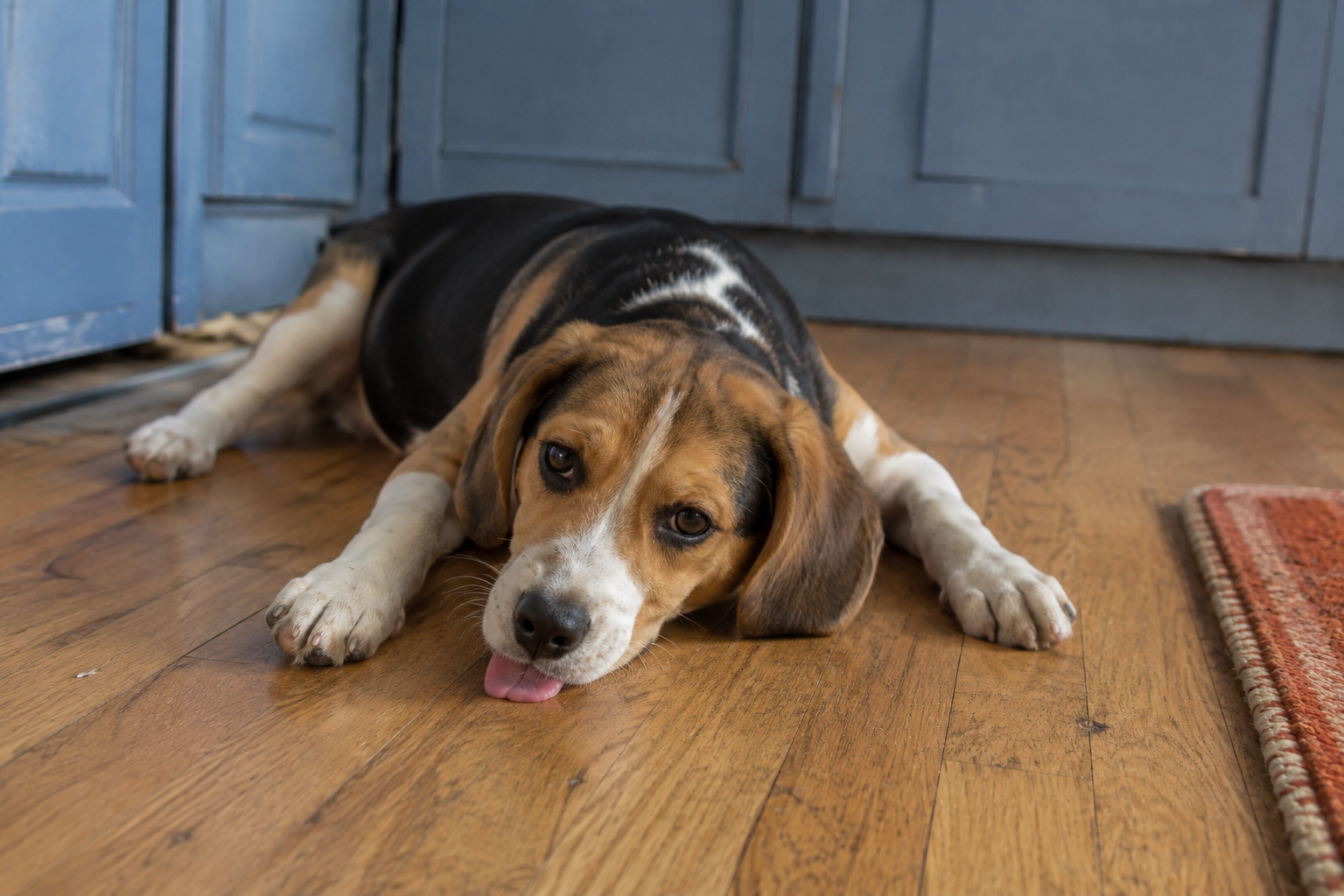
Your dog is standing in the middle of a clean kitchen floor, licking it. Not sniffing, not looking for anything. Just licking, in one place, with a focus that makes you say their name twice before they even look up.
The internet will tell you this is a quirk. It usually is not.
There is a name for it, which is the first sign that this is a real thing and not a personality trait: excessive licking of surfaces, or ELS. It is not a disease. It is a behavior. And the best study anyone has run on it points hard in one direction.
The study that should change how you read this
Researchers at the University of Montreal’s veterinary teaching hospital took nineteen dogs whose owners brought them in for excessive surface licking, compared them to healthy controls, and instead of treating them as behavior cases, ran their guts through a full workup.
Fourteen of the nineteen had a gastrointestinal abnormality.
Not vague findings. Specific ones: eosinophilic and lymphoplasmacytic infiltration of the GI tract, delayed gastric emptying, irritable bowel syndrome, chronic pancreatitis, a gastric foreign body, and giardiasis.
Then came the part that closes the loop. The dogs were treated for what was actually wrong with them. Licking significantly improved in ten of seventeen. It resolved completely in nine.
So the working rule is not “floor licking might be medical.” It is closer to: floor licking is a stomach symptom until proven otherwise, and the proving should be done by a vet, not by you and a search bar.
The dog licking your kitchen tiles is not being odd, they are self-soothing, the same way people do when they feel sick. If we treat that as a training problem, we spend six weeks on enrichment while an inflamed gut goes unexamined.
The full list of what drives it
Nausea and GI disease sit at the top, but they are not alone. Here is the whole field, so you know what your vet is actually sorting between.
Nausea. A nauseated dog licks. Their lips, the air, the floor, the couch. It can come from a diet change, from something they ate that they should not have, from metabolic disease, or from a toxin. If the licking is frantic and comes in episodes, this is the first suspect.
Gastrointestinal disease. The category above, made chronic. Inflammatory bowel disease, pancreatitis, parasites like Giardia, delayed emptying, infiltrative disease in the intestinal wall. This is the one the research keeps landing on.
Oral pain. Periodontal disease, a fractured tooth, an ulcer, a mass, or something wedged between the teeth or across the roof of the mouth. Dogs in oral pain drool and lick. If the licking comes with bad breath, a reluctance to chew on one side, or dropping food, look in the mouth. A dog who licks and coughs may have irritation further back, in the throat or esophagus.
Excessive hunger. There are medical conditions that turn the appetite dial all the way up: diabetes mellitus, Cushing’s disease, exocrine pancreatic insufficiency, and, rarely in dogs, hyperthyroidism. Steroids like prednisone do it too. A dog whose body believes it is starving will lick the floor because that is where food has historically been.
Neurological causes. Partial or focal seizures can present as odd repetitive behavior, including air-biting and surface licking, and the giveaway is that you cannot break through it. Calling the dog’s name does nothing. Brain tumors and inflammatory CNS disease can do it too. In seniors, canine cognitive dysfunction, the dog version of dementia, brings a package of wandering, staring, house-soiling, and excessive licking.
Compulsive disorder. Real, but rarer than the internet suggests, and diagnosed by exclusion. These are behaviors that started as a response to fear, excitement, or attention-seeking and then came untethered from context. The company it keeps: shadow chasing, tail chasing, endless pacing, and grooming that goes on until the dog has damaged their own skin.
Anxiety and boredom. Licking releases endorphins, which makes it a legitimate self-soothing tool during a thunderstorm, a fireworks night, a house move, or a stretch of being left alone too long. And some dogs lick the floor for the extremely simple reason that nothing else is happening.
Actual crumbs. Worth keeping on the list. Dogs know exactly which member of the household eats standing over the sink, and their nose has a much lower bar than your eyes do for whether a spill got properly wiped. If the licking is targeted, brief, and then over, it is crumbs. Use a pet-safe cleaner on spills, so the residue is not both the reward and a mild toxin.
The signs that mean stop reading and call
Occasional floor licking is nothing. Get your dog examined if you see:
- Licking that interferes with normal life
- Licking you cannot interrupt by calling their name
- Other compulsive behaviors: tail chasing, shadow chasing, over-grooming
- A foul smell from the mouth
- Signs of pain
- Vomiting or diarrhea
- Poor appetite, or a sudden ravenous one
- Excessive thirst and urination
That last pair matters more than people realize. Drinking and peeing a lot, alongside a bottomless appetite, is a classic endocrine picture, and it deserves bloodwork.
What the vet visit actually looks like
No good vet will let anyone call this behavioral until the medical causes have been cleared, which is the correct order and the opposite of what most owners do.
Expect a history and a physical exam first. If there is any suspicion of a gastrointestinal or metabolic issue, expect some combination of bloodwork, urinalysis, a fecal exam, and imaging, meaning radiographs or ultrasound. If a neurological cause is in play, that may mean a referral to a veterinary neurologist, and a workup that can include imaging of the brain and a sample of spinal fluid.
Only once that is clean does the conversation shift to the environment and the behavior.
Reducing the risk in the first place
You cannot prevent all of it, but you can shrink the pile of conditions that trigger it:
- Stay current on preventive care, including parasite prevention
- Brush the teeth at home, and do the professional cleanings your vet recommends
- Feed a complete, balanced diet, and do not let treats crowd it out
- Give real physical exercise and real mental work, every day
- Keep the stress down: predictable routines, safe spaces, a plan for storms and fireworks
What newer research adds
The most useful development since that Montreal study is that the veterinary field has largely absorbed its lesson. Compulsive licking now routinely triggers a gastrointestinal investigation in behavior practice rather than a behavior plan, and that reordering is the difference between a dog who gets better in a month and a dog who licks for a year.
The reframe worth carrying home is broader than floor licking. Repetitive behaviors in animals who cannot say “my stomach hurts” are, disproportionately, the sound of a body trying to tell you something. Before you decide your dog is being strange, check whether they are being sick.
The bottom line
If your dog licks the spot where you dropped the toast, that is a dog. If your dog licks a clean floor, at length, and barely hears you, that is a symptom.
Do not train it away. Find out what is underneath it.
References
- Bécuwe-Bonnet, V., et al. “Gastrointestinal Disorders in Dogs With Excessive Licking of Surfaces.” Journal of Veterinary Behavior, vol. 7, no. 4, 2012, pp. 194–204. sciencedirect.com
- “Excessive Surface Licking = Potential GI Pathology.” Clinician’s Brief. cliniciansbrief.com
- “Compulsive Disorders: Have You Considered GI Involvement?” dvm360. dvm360.com
- MSPCA-Angell. “Underlying Gastrointestinal Disease May Manifest as Neurologic Signs in Canine Patients.” mspca.org
Common questions
Is my dog just looking for crumbs?
Sometimes, yes. A dog who licks the spot where the toast landed and then walks away is doing exactly what it looks like. What is not crumbs is licking clean floors, licking the same surface over and over, or licking so intently they are hard to interrupt.
Why does my dog frantically lick the floor and then vomit?
That sequence is close to a textbook nausea pattern. Many dogs lick their lips, lick the air, and lick surfaces as nausea builds. If it repeats, it is worth a vet visit and worth mentioning that the licking came first, because it is a useful clue.
When is floor licking an emergency?
Get seen urgently if the licking comes with repeated vomiting, a swollen or painful belly, retching without producing anything, collapse, or if you think your dog swallowed something they should not have. Get seen soon, not urgently, if it is persistent but your dog is otherwise well.
Not a substitute for your vet. Our guidance is educational. For urgent symptoms, contact a vet or emergency clinic right away. Editorial standards
Dr. Chen is a small-animal veterinarian who leads health and safety coverage at The Pet Times. She writes and reviews the bulk of our illness, condition, and safety content, translating clinical guidance into clear, practical advice owners can act on at home.
Meet our experts ↗Keep reading
 Health & WellnessYour Old Dog Staring at the Wall Is Veterinary Medicine's Most Missed DiagnosisDr. Nina Kohl · 8 min
 Health & WellnessYour Dog's Sleep-Twitching Is Almost Always a Dream. Here's When It Isn't.Dr. Ravi Mehta · 6 min
 Health & WellnessPaw Chewing Is a Loop, Not a Habit. Breaking It Takes Two Moves.Dr. Amara Solis · 8 min
 Health & WellnessYour Dog's Squint Isn't a Smile. Count the Eyes.Dr. Mara Chen · 7 min
 Health & WellnessNo, Your Dog Isn't Schizophrenic. But What They Have Is Real.Dr. Lena Park · 7 min
 TrainingYour Female Dog Humps. It's Normal, and It's Usually Not About SexDr. Lena Park · 7 min