


The 'Fattest Dog States' Ranking Went Viral. It Measures the Wrong Thing.
A survey named the states with the most overweight dogs, and the map missed the real problem: most owners can no longer tell when their own dog is heavy. The fix is your hands, not a headline.

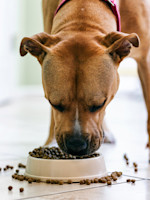
A survey made the rounds recently ranking the U.S. states with the most overweight dogs, Pennsylvania at the top, followed by Virginia, Wisconsin, and Georgia, each with dogs averaging a startling number of pounds over their ideal. It is a great headline. It is also a good example of measuring the wrong thing, and the gap between what the map counts and what actually matters is the whole story.
Because here is the real problem with canine obesity, and it is not regional: most owners can no longer recognize it. A dog’s weight in pounds tells you almost nothing without knowing that dog’s frame, and the scale-based ranking that went viral papers right over the tool that does matter, the one attached to your own wrists.
What the ranking actually said
To be fair to the data, the underlying survey was real. A 2021 survey of roughly 2,430 pet owners across 42 states compared owners’ reports of their dogs’ weight, sex, and breed against American Kennel Club standards to estimate how many pounds each dog was over ideal. The top ten, by average pounds overweight, ran: Pennsylvania (18.25), Virginia (16.67), Wisconsin (16.38), Georgia (16.18), West Virginia (15.66), Connecticut (15.54), New Hampshire (14.23), New York (14.03), Nebraska (13.73), and Tennessee (13.33).
The researchers even offered a plausible explanation for the northeastern clustering: small “indoor” breeds like Pomeranians, Yorkies, Bulldogs, and Chihuahuas were the most-reported overweight dogs, and they concentrate in apartment-dense metro areas where sedentary living is easy and dedicated exercise time is scarce.
Why pounds are the wrong yardstick
Now the critique, which the more careful voices in the survey itself raised. Ranking dogs by raw pounds overweight has a fatal flaw: it ignores how a dog is built and how they carry weight.
“Two dogs of the same breed and the same weight can be in completely different shape, one lean and muscular, one carrying real fat,” says Dr. Amara Solis. “It’s the same reason a bathroom scale is a lousy health tool for people. Pounds don’t distinguish muscle from fat, and they don’t account for frame. When I assess a dog, the number on the scale is almost the least useful thing I look at.”
This is not nitpicking. A ranking built on pounds can flag a stocky, muscular dog as “overweight” while missing a small dog whose few extra ounces are, proportionally, a serious problem. The map is precise about the wrong quantity.
The tool that actually works: your hands
What veterinarians use instead is Body Condition Scoring, a 1-to-9 scale (spanning thin, ideal, overweight, and obese) that relies on touch and sight rather than the scale. The best part is that you can do a rough version at home, and it takes about thirty seconds.
Run your hands over your dog. On a dog at a healthy weight, you can easily feel the ribs, spine, and hip bones without digging for them, the way you’d feel the back of your own hand through a thin glove. Then look down from above: there should be a visible waist behind the ribs. And look from the side: the belly should tuck up slightly rather than hang level or sag. Lose the ribs under a layer of padding, or lose the waist, and your dog has moved up the scale.
Learn that check and you will never again need a state ranking to know how your own dog is doing.
The perception problem is the real epidemic
Here is the part that should worry us more than any map. As overweight dogs have become the norm, our collective eye for a healthy dog has drifted. People with dogs in genuinely good condition now sometimes get told their pet looks too skinny, simply because a lean, waisted dog looks unfamiliar next to all the heavier ones around them.
The numbers back this up. Older data from the Association for Pet Obesity Prevention found that around 56 percent of dogs were overweight or obese, while more than a third of owners of those very dogs rated their body condition as “normal.” The obesity is common. The blindness to it is nearly as common.
That matters because the health stakes are real: excess weight is linked to diabetes, orthopedic problems, and a shorter life. And prevention is far easier than treatment. The core levers are unglamorous and effective: roughly 20 to 30 minutes of aerobic activity a day for most dogs, treats capped at about 10 percent of daily calories, and portions reassessed at every life stage, since a senior dog, a puppy, and a post-surgery dog all need different amounts. When weight does need to come off, do it with your vet, because conditions like thyroid disease can hide underneath, and crash-cutting food can trigger begging and worse.
What newer data adds
The most recent numbers sharpen the picture rather than soften it. The Association for Pet Obesity Prevention’s 2024 survey found that a large majority of dogs, on the order of 59 percent, fall into the overweight-to-obese range by body condition score, with roughly a fifth clinically obese. Just as telling, the survey tracked the perception gap directly: in 2024, about half of dog owners still classified their pet’s body condition as ideal, a sign that awareness is improving but slowly, and that many heavy dogs are still going unrecognized at home.
The throughline connects right back to the viral ranking. We do not have a data problem when it comes to dog obesity; we have a seeing problem. A map of the “fattest states” gives owners someone else to think about. A thirty-second hands-on check gives them the only thing that changes an outcome: an honest read on the dog in front of them.
References
Common questions
How much of my dog's diet can be treats?
Treats should make up no more than about 10 percent of your dog's daily calories. For a small dog, that's a tiny amount, a couple of baby carrots and one biscuit can already be a lot for a Chihuahua-sized pet.
Why does my vet say my dog is overweight when they look normal to me?
Because overweight has become so common that many people's sense of 'normal' has drifted heavier. Owners of dogs in genuinely good condition are sometimes told their pet looks too thin. Trust your vet's body condition assessment over the crowd.
Not a substitute for your vet. Our guidance is educational. For urgent symptoms, contact a vet or emergency clinic right away. Editorial standards
Dr. Park is a board-certified emergency and critical care specialist. She reviews our health and safety content for clinical accuracy and contributes guides on recognising urgent conditions. Her focus is helping owners act quickly and correctly when it matters most.
Meet our experts ↗Keep reading
 FoodCan Dogs Eat Bacon? Why the Salty Strip Is a SkipDr. Lena Park · 5 min
 FoodHome-Cooked Dog Food Can Run $3 a Day. The Real Price Is Your Sundays.Dr. Amara Solis · 9 min
 Health & WellnessYou Can't Eyeball a Healthy Dog. Owners Get the Most Important Sign Wrong.Dr. Mara Chen · 9 min
 FoodHoneydew Is Mostly Sugar Water. That's the Catch for DogsDr. Priya Nair · 5 min
 FoodYour Lab Isn't Greedy. It's Genetic.Dr. Mara Chen · 5 min
 FoodYou're Counting Dog Treats WrongDr. Ravi Mehta · 6 min