


"Stubborn" Is a Diagnosis With No Cure. Here's What Your Dog Is Really Saying
Calling a dog stubborn is a conversation-ender that hands you nothing to work with. Swap it for the four real reasons dogs don't comply, and a dead end becomes a to-do list.

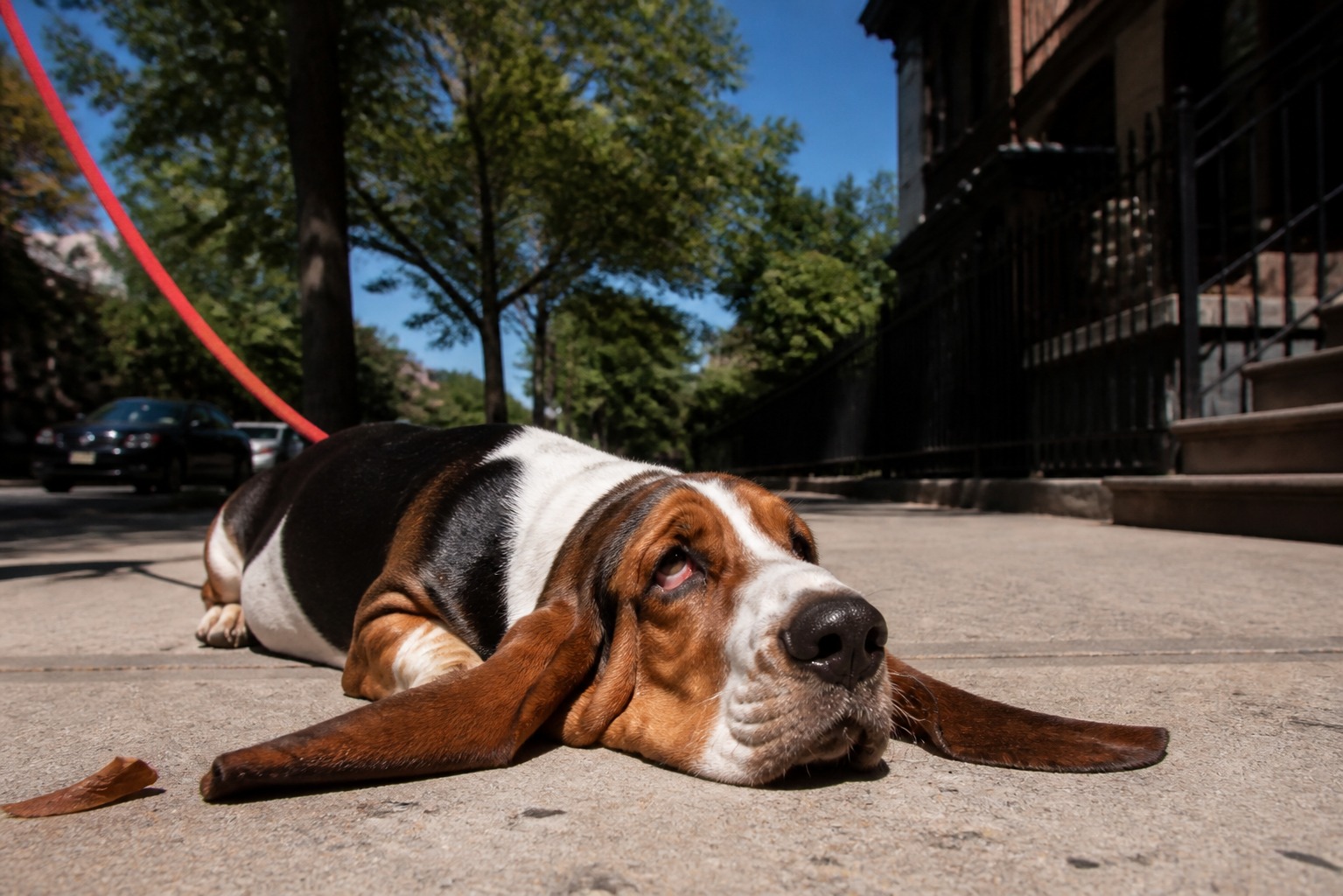
“Come on,” my friend Tim pleads with Brisket, his 11-year-old Pekingese, who has planted himself on the sidewalk and will not be moved. “Brisket, please! Daddy doesn’t have time for this. Ugh!”
“Do you have any treats?” I ask.
“No,” Tim says. “He’s just like this. He’s stubborn, that’s all.”
And there it is, the word that ends every productive thought about why a dog does what it does. Stubborn. It feels like an explanation, but it is a door slammed shut. Once Brisket is “stubborn,” there is nothing left to investigate and nothing to try. Stubborn is a diagnosis with no treatment.
I want to make the case for retiring the word entirely, not because dogs are perfect, but because “stubborn” is the single least useful thing you can call one. The instant you replace it with the actual reasons a dog stops cooperating, an impossible standoff turns into a short list of things you can fix. That is the whole difference between standing on a sidewalk saying “please” and getting your dog moving.
The four things “stubborn” is hiding
Whenever a dog does not do what we ask, or takes its sweet time, we reach for “stubborn.” But behavior experts who actually fix these standoffs tend to point to a small set of real causes underneath the label.
“‘Stubborn’ is just the word we slap on a dog when they don’t respond the way we expected or fast enough,” says Dr. Nina Kohl, a veterinary behaviorist who works with The Pet Times. “But when I look closely, the behavior almost always traces back to one of four things: the dog is afraid, the dog is confused about what I’m asking, the dog isn’t motivated to do it, or the dog has a need I haven’t noticed. None of those are character flaws. All of them are workable.”
Hold Brisket up against that list and the mystery thins out fast. Maybe he did not like the direction we were steering him. Maybe he caught a scent he wanted to investigate. Maybe he expected the usual route and got confused when we turned. Maybe, as I unhelpfully suggested, he just needed a reason, a treat during the walk, to want to keep going. Every one of those is a fixable cause. “Stubborn” is none of them.
The deeper point is that nothing a dog does is premeditated. Dogs do not sit on a plan, and they do not hold grudges. “Dogs live in the moment and react to whatever is happening around them right then,” says Sara Lim, a certified trainer who consults for The Pet Times. “What you’re seeing is an instinctive response to the situation, not a decision to defy you. Calling that ‘stubborn’ is the human projecting their own frustration onto an animal who isn’t capable of the thing they’re being accused of.”
Why the label is so tempting (and what it protects)
Naming the four real causes raises an uncomfortable possibility, which is part of why “stubborn” is so popular: most of those causes point back at us.
When I mentioned I was writing this, my friend Fern said her dog, Gollum, was “definitely stubborn.”
“Has anyone actually taught him what you’re asking for?” I asked.
“Oh no,” she laughed. “He’s trained us.”
“Except dogs don’t actually train people,” I said. “If Gollum has habits you don’t like, it’s because they’ve been reinforced, not because he’s willful.”
“So it’s my fault?” she said, instantly defensive. “Now you’re making me feel bad.”
That was not my intent, but the reflex is telling. Almost no one likes being told they could be doing more for their dog. “Stubborn” is a convenient escape hatch: it relocates the problem from the relationship, which I might have to work on, to the dog, who is simply built this way. The label does not help the dog. It protects the human from a slightly uncomfortable truth.
“Labeling a dog stubborn is an easy way to shift the blame from the relationship to the animal,” says Dr. Nina Kohl. “But when a dog doesn’t comply, it’s far more often a breakdown in communication. A dog may treat a cue as optional simply because the training around it has been inconsistent, so the cue means different things on different days.”
The science the label ignores: dogs are situational learners
Here is the piece that reframes the most maddening version of “stubbornness,” the dog who “knows” a cue at home and “ignores” it everywhere else. That dog is usually not ignoring you. They genuinely do not recognize the cue in the new setting.
People are contextual learners. Learn to read in a classroom and you can read at the beach, in bed, on a bus. Dogs do not transfer skills that way. Dogs are situational learners, which means “sit” in your quiet kitchen is, to the dog, a different request from “sit” at a loud park with squirrels everywhere. Each location, each distraction level, is effectively a new lesson.
“This is the source of an enormous amount of so-called stubbornness,” says Dr. Nina Kohl. “The owner thinks the dog is being defiant, when really the dog has only ever practiced the cue in easy conditions and has never been taught it where it’s hard. The dog isn’t refusing. They’re lost.”
Understanding this single fact does more than any amount of frustration. It tells you the fix is not to demand harder, but to re-teach the cue in each new context, building up from easy to difficult.
A field diagnosis: what is the “stubbornness” masking?
Next time you hit a standoff, run through this instead of reaching for the label:
- Could it be pain or fear? A dog refusing stairs, a jump, or a particular route may be hurting or frightened, not obstinate. Rule this out first, and see a vet if a previously willing dog suddenly “won’t.” Sudden refusal is a medical red flag, not a personality change.
- Do they actually understand the cue here? Have you ever practiced it in this place, at this distraction level? If not, the dog is not ignoring you, they have not learned it in this context yet.
- Is there any reason to comply? If coming when called only ever ends the fun, or means getting yelled at, the dog has learned that obeying is a bad deal. Check whether the payoff is worth it from the dog’s point of view.
- Is a need going unmet? Hunger, a full bladder, an overwhelming smell, exhaustion, overstimulation. A dog with a louder competing need is not being difficult.
Four questions, four levers. None of them exist if the answer is just “stubborn.”
Why punishment backfires, and what works instead
A common driver of apparent stubbornness is too much negative reinforcement. If every “come” precedes a scolding or the end of something good, the dog learns to dread the cue. Imagine a boss who only ever summons you to criticize your work; you would come to fear “can I see you in my office?” You are an adult who would go anyway. A dog is not, and will simply opt out.
The fix is to make compliance pay. “Put a party in your voice,” as a character in one well-known dog-park play advises. When your dog comes, reward the coming, never punish whatever they were doing beforehand. Punishment mostly teaches a dog that you are someone to avoid, and it is more about venting your frustration than changing behavior.
“If you feel yourself getting frustrated, that’s your cue to change something, not to push harder,” says Dr. Nina Kohl. “Make the cue fun. Pair it with treats, praise, play, whatever your dog actually loves.” She offers a concrete example: “If your dog adores being outside but you only ever call him to bring him in, of course he looks ‘stubborn’ about recall, coming to you ends the best part of his day. So flip it. Call him from a short distance, reward him, and release him to keep playing. Now coming to you predicts good things, and recall improves on its own.”
Changing a dog’s behavior is absolutely possible, but it asks you to change too, and that is the real reason “stubborn” is so seductive: it lets us off the hook. Drop it, do the slightly harder work of figuring out the actual cause, and you get more than a more cooperative dog. You get a clearer, warmer line of communication between the two of you. If you think you are close to your dog now, wait until you are actually understanding each other.
The bottom line
“Stubborn” feels like an answer, but it is the end of the conversation, a label that explains nothing and hands you no way forward. Underneath it sit four real, fixable causes: fear, confusion, low motivation, and unmet needs, plus the crucial fact that dogs learn situationally and have to be taught cues anew in each new context. Diagnose which one you are facing, rule out pain, make complying worth your dog’s while, and stay consistent. Do that, and the “stubborn” dog reliably turns out to be a dog who was simply waiting for the request to make sense.
References
- Hiby, E. F., N. J. Rooney, and J. W. S. Bradshaw. “Dog Training Methods: Their Use, Effectiveness and Interaction with Behaviour and Welfare.” Animal Welfare, vol. 13, no. 1, 2004, pp. 63-69. https://www.cambridge.org/core/journals/animal-welfare/article/abs/dog-training-methods-their-use-effectiveness-and-interaction-with-behaviour-and-welfare/.
- Ziv, Gal. “The Effects of Using Aversive Training Methods in Dogs: A Review.” Journal of Veterinary Behavior, vol. 19, 2017, pp. 50-60. https://www.sciencedirect.com/science/article/abs/pii/S1558787816301216.
- “Positive Reinforcement Training.” American Veterinary Society of Animal Behavior (AVSAB). https://avsab.org/resources/position-statements/.
- “How Dogs Learn.” American Kennel Club. https://www.akc.org/expert-advice/training/how-dogs-learn/.
Common questions
Are dogs actually stubborn?
Not in the way the word implies. Dogs do not weigh their options and decide to defy you out of willfulness, and they do not act from spite. What we call stubbornness is almost always one of four things: fear, confusion about what is being asked, lack of motivation, or an unmet need. Each has a fix; 'stubborn' does not.
Why does my dog ignore commands they clearly know?
Usually because the cue has not generalized. Dogs are situational learners, so a 'sit' learned in your kitchen is not automatically a 'sit' at the busy park. What looks like ignoring you is often a dog who genuinely does not recognize the same cue in a new, distracting place and has to be taught it there too.
Is my dog being stubborn or is it my fault?
It is rarely about fault and almost always about communication. Inconsistent cues, accidental reinforcement of the wrong behavior, and overuse of punishment all produce a dog who seems uncooperative. The good news is that these are things you can change, which is exactly why the 'stubborn' label is worth dropping.
How do I get a stubborn dog to listen?
Diagnose the real reason first. Rule out pain or fear, make sure the dog actually understands the cue in that exact context, raise the value of the reward, and stay consistent. Positive reinforcement that makes complying genuinely worthwhile turns most apparent stubbornness around.
Marcus Webb writes about the gear, gadgets, and everyday choices that make life with a pet easier. His coverage runs from product picks to training and the causes worth paying attention to, always with an eye on what actually earns a place in your home.
Meet our experts ↗Keep reading
 TrainingYour New TV Is Half the Reason Your Dog Won't Stop Barking at ItDr. Nina Kohl · 8 min
 TrainingYour Dog Isn't Being Stubborn About the Snow. They're Confused.Dr. Amara Solis · 7 min
 TrainingDog Anxiety Isn't One Thing. That's Why Treating It Like One FailsDr. Nina Kohl · 8 min
 LivingAmerica's Cutest Rescue Dog Can't Handle a LeashDr. Nina Kohl · 5 min
 TrainingThe Puddle on Your Bed Has a Size. That's Half the Diagnosis.Dr. Lena Park · 8 min
 TrainingThe 'Invisible Fence' Isn't a Fence. That's the Whole Problem.Dr. Amara Solis · 7 min