


Your Dog Learned a Toy's Name Once. Two Years Later, They Still Knew It.
A handful of word-savvy dogs memorized 12 toy names, then didn't touch the toys for two years. Most still passed the test cold. What that says about canine memory is stranger than the trick itself.

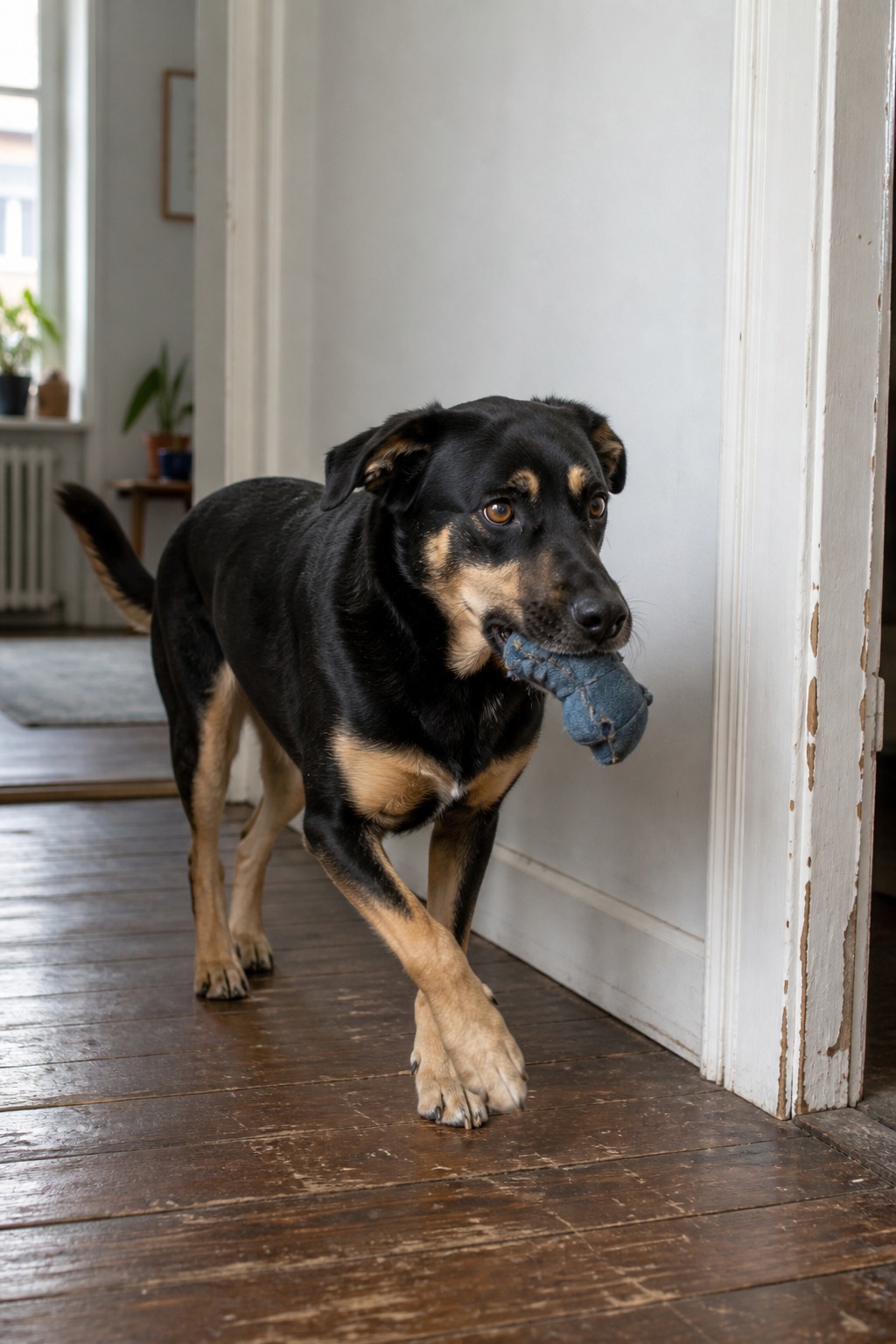
We spend a lot of time staring into our dogs’ eyes trying to guess what’s happening in there, and usually coming up empty. Here’s a rare, clean answer. A study published in Biology Letters set out to measure how long a dog can hold onto a word once it’s learned, and the result rewrites a common assumption about animal memory. Some dogs can recall the names of toys they last saw two full years earlier, with no practice in between.
The eye-catching version of this is “dogs remember stuff.” The more interesting version, and the one worth your attention, is how they remember it: not by constant refreshing, but by filing the word away in long-term storage and leaving it there, intact, untouched, and still retrievable years later.
The setup
The study worked with five “gifted word learners,” an unusual class of dog that can pick up the individual names of objects. These are not typical dogs. A gifted word learner can accumulate more than 100 labels, and the famous outlier, a border collie named Chaser, learned over 1,000 words, which makes her the exception even among the exceptional.
Each of the five dogs learned the names of 12 toys across a single week. Then the researchers did the crucial thing: they took the toys away and kept them boxed and untouched for two full years. The day before testing, all the old toys came back out at once and each dog got to sniff around and reacquaint themselves. On test day, six of the learned toys were laid on the floor mixed in with eight other toys from the dog’s regular collection, and the owners asked their dog to fetch specific ones by the names they’d learned two years before. Each name was requested twice.
Four of the five dogs pulled it off, correctly retrieving somewhere between three and nine of the named toys. That’s not a fluke rate. That’s memory.
The part that should surprise you
Plenty of people assume a dog only “knows” a word because we keep drilling it, so the knowledge is really just a fresh habit propped up by repetition. This study cuts against that. The dogs weren’t rehearsing. The toys sat in a box for two years. Whatever the dogs retrieved on test day had to have been consolidated into durable, long-term memory and held there on its own.
Lead author Shany Dror described the result as the dogs maintaining their word-to-object mappings across a two-year gap after the initial learning settled in, without any further practice. In plain terms: they learned it, filed it, and it stayed filed. The researchers even suspect the dogs would have scored higher if they’d been taught fewer names to begin with, with more time to cement each one, which is a hint about how canine learning consolidates rather than a knock on the dogs.
We tend to picture dog memory as short and in-the-moment, and for a lot of things it is. But this shows a dog can lay down a specific, arbitrary label and keep it for years with zero maintenance. That’s not repetition holding it up, that’s genuine long-term storage, and it’s more like how we remember a childhood phone number than most people expect from a dog.
Why it matters beyond the party trick
Dror’s team is chasing something bigger than a clever retrieval game. In people, strong verbal memory tends to travel with other cognitive strengths, from visual-spatial memory to executive function, and the researchers want to learn whether an unusually good canine word-memory lines up with other mental abilities too. Studying how a dog stores and recalls language may even sharpen our understanding of our own memory and how we acquire words in the first place. As Dror framed the deeper question, if language is uniquely human, we can only understand why by mapping which pieces of it show up in other animals and which don’t.
There’s an important limit stamped on all of this. Gifted word learners are rare, so what these five dogs did doesn’t automatically describe the sleeping mutt at your feet. But one finding does generalize into a nice piece of advice. Across the study, the dogs with the sharpest recall were the ones whose owners had put in the most time practicing the original names. Dror’s takeaway was blunt and warm at once: the more you pour into your dog, the more the relationship gives back. Your dog may never label a dozen toys. But the effort you spend teaching, playing, and paying attention is the exact input this research keeps rewarding.
References
Dr. Chen is a small-animal veterinarian who leads health and safety coverage at The Pet Times. She writes and reviews the bulk of our illness, condition, and safety content, translating clinical guidance into clear, practical advice owners can act on at home.
Meet our experts ↗Keep reading
 TrainingThat Big Dramatic Sigh Isn't Sadness. It's Punctuation.Dr. Lena Park · 6 min
 TrainingYou Think You Can Read Your Dog's Face. A New Study Says You're Guessing.Dr. Nina Kohl · 5 min
 LivingThe Shelter Dog Everyone Called 'Aggressive' Just Needed a PlaygroundDr. Mara Chen · 8 min
 TrainingYour Dog Isn't Shy at Your Party. Six Signs They Want Out.Dr. Lena Park · 8 min
 LivingA Wolfdog Is Not a Fluffier Husky. Nobody Can Tell You What You Actually Own.Dr. Ravi Mehta · 8 min
 TrainingYour Husky Isn't Arguing With You. It's Doing the Job It Was Bred For.Dr. Ravi Mehta · 6 min