


Your Dog's Paw Licking Is a Symptom. Investigate It in This Order
Excessive paw licking almost always traces to one of four buckets: skin, pain, parasites, or stress. A vet-backed framework for finding the cause and knowing when to worry.

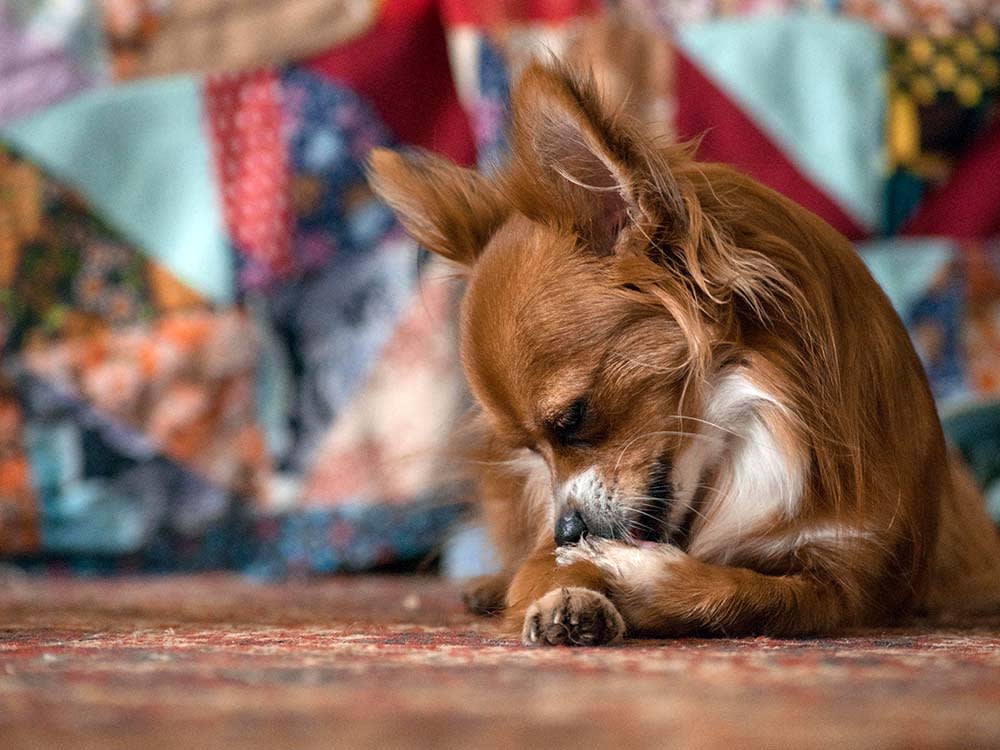
Most advice about paw licking hands you a long list of possible causes and leaves you to guess which one applies to your dog. That gets the problem backward. Paw licking is not a behavior to decode; it is a symptom to investigate, and almost every case traces back to one of four buckets: something irritating the skin, something hurting underneath it, something living on it, or something stressing the dog who owns it. Work through those four in the right order and you go from “my dog won’t stop licking” to “here is what to actually do about it.”
That order matters because the buckets are not equally likely, and because chasing the wrong one wastes weeks while a dog quietly does real damage to their own feet.
First, confirm it’s actually a problem
Every dog licks their paws sometimes. A quick clean-up when they come inside, a few licks while settling down for a nap — that is ordinary grooming, and it needs no fixing. The fact that dog paws famously smell like corn chips only makes the temptation worse.
The line to watch for is intensity and focus. Licking that is near-constant, fixated on a single foot, or accompanied by visible changes to the skin is the kind that means something. One tell is easy to miss in the moment but hard to miss afterward: a rusty, reddish-brown stain on the fur between the toes. That color comes from porphyrin, a pigment in saliva, and it is the most reliable evidence that licking has been going on long enough to matter even if you have never actually caught your dog at it. If you see that stain, you are past “is this normal” and into “what is driving it.”
And the licking itself can create a second problem on top of the first. All that moisture trapped between the toes is an open invitation to bacterial and yeast infections, which then itch and drive even more licking. Breaking that loop is part of why getting to the cause quickly is worth it.
Bucket one: the skin (the most common answer by far)
If you only investigate one category, make it this one. The single most common driver of excessive paw licking is allergic skin disease.
When a dog can’t leave their feet alone, atopic dermatitis — environmental allergy — tops my differential list every time. Feet are ground zero: every walk coats them in dust, pollen, and mold spores, and the itch usually starts right where the exposure is. A quick paw wash when you get home clears that residue before it has a chance to stir up the skin.
Within the skin bucket there are a few distinct culprits, and telling them apart shapes the fix:
Environmental allergies (atopic dermatitis). Triggered by grass and tree pollens, mold spores, and dust mites. The classic pattern is a dog who comes in from a walk and immediately works at their feet, often with itchy ears and watery eyes alongside.
Flea allergy dermatitis. Some dogs are allergic to flea saliva itself, so a single bite sets off itching well beyond the bite site. Look for licking and scratching focused on the paws and rear end, plus fur loss, thickened skin, redness, and hot spots.
Food allergies. Less common than people assume, and worth keeping in proportion. “True food allergy exists, but I diagnose it far less often than owners expect — and when it’s there, it announces itself as itchy skin. Dogs rarely get the puffy-face reaction we associate with allergies in humans,” Dr. Nair says. The usual suspects are beef, dairy, wheat, egg, and chicken. Diagnosing one means a proper elimination diet, not just switching bags.
Dry skin. Over-bathing strips natural oils, and low winter humidity does the rest. The signs are general itchiness, flaking, and redness across the coat, not just the paws.
The good news in this bucket: it is also where treatment has improved most. Beyond longstanding options like Apoquel and the injectable antibody therapy Cytopoint, the FDA approved a newer once-daily oral medication, Zenrelia (ilunocitinib), in late 2024. It works on the same itch-signaling pathway and gives vets another lever when the older medications underperform. (One practical note to raise with your vet: the label guidance on coordinating Zenrelia with routine vaccines has shifted since approval, so ask how they want to handle timing.) None of these are something to start on your own, but it is worth knowing the toolbox is bigger than it was a few years ago.
Bucket two: pain underneath the paw
This is the bucket people forget, and it is the reason a “skin treatment” sometimes does nothing. Dogs lick where it hurts, and sometimes the hurt is not in the skin at all.
A dog’s foot and lower leg pack in an extraordinary number of small bones and joints — nearly 20 in each front foot, around 15 in each rear, plus the wrist and ankle. As those joints become arthritic, the inflammation and ache can prompt a dog to lick at the limb the way a person rubs a sore knee. Stiffness, reluctance to walk, or licking that centers on a wrist or ankle rather than the pad points here.
There are also acute injuries. “Summer brings me a steady stream of torn-up pads — a long game of fetch on sun-baked pavement can peel the surface layer right off,” Dr. Nair says. “Winter has its own culprit: de-icing salt stings the skin between the toes, and the licking starts the moment they’re back inside.” Less often, persistent chewing of one spot signals something more serious underneath: a deep tissue infection, a toe fracture, nail bed disease, or in rare cases a tumor. A dog who fixates on a single toe or foot and won’t be redirected deserves a closer look, not reassurance.
Bucket three: something living on the foot
Parasites and foreign objects are the most fixable causes, and the easiest to catch with your own eyes.
Beyond fleas, the mites, ticks, and lice that cause skin irritation can all send a dog after their paws. Hair loss, sores, redness, or licking in several places at once helps separate a parasite from a localized problem.
Then there are the simple mechanical irritants. Paw pads are tough, but thistle stickers, grass seeds, thorns, and splinters slip into the soft webbing between toes and lodge under pads. A dog licks at a foreign object trying to dislodge it. This is the one cause you can often find and fix yourself: part the toes in good light and look for a red spot, swelling, or a visible wound. Grass awns in particular are notorious for burrowing in and causing trouble far out of proportion to their size.
Bucket four: stress (only after the rest are ruled out)
Behavioral causes belong last, not first, and that ordering is the whole point.
“The mistake is jumping to anxiety because it is the easiest explanation,” Dr. Nair says. “Rule out the medical causes first. A dog in pain or fighting an allergy will look anxious, because they are uncomfortable, and you will spend months on the wrong problem if you skip the physical exam.”
Once medical causes are genuinely off the table, stress and compulsion can drive licking as a form of self-soothing. Ask what has changed: new noises, a shifted routine, a new pet, visitors, a move. Some dogs develop canine compulsive disorder, an OCD-like pattern in which paw licking, flank sucking, and tail chasing become entrenched. Boredom plays a role too, especially in working breeds — German Shepherds, Pointers, Labradors, Golden Retrievers, and the like — who invent their own jobs when they don’t have one. Here the fix is environmental and behavioral: more exercise, more enrichment, redirection, and sometimes professional behavioral support.
When to stop investigating and call the vet
A dog who licks now and then is fine. Get a professional involved when:
- The licking is near-constant or you catch your dog at it many times a day
- It’s focused on one foot or one toe and won’t redirect
- The skin is red, swollen, stained brown, raw, or oozing
- There’s a limp, stiffness, or reluctance to bear weight
- You find a wound or suspect something is lodged in the foot
- Nothing you’ve tried at home has changed it within a week or two
“Give a dog one raw spot and by morning they’ve chewed it into twice the problem,” Dr. Nair cautions. “Until your appointment, a gentle wash and a careful towel-off between the toes keeps things tolerable. And block access to the foot — an e-collar, or a basket muzzle if your dog hates the cone. It looks unkind, but it saves the skin.” At the visit, your vet will want the timeline: when it started, what triggers it, what you’ve tried. Expect a close exam and possibly skin samples, bloodwork, or X-rays depending on which bucket the evidence points toward.
Safe first steps at home
While you sort out the cause, a few things help and none of them hurt: rinse the paws in lukewarm water and dry thoroughly between the toes, check the pads and webbing for foreign objects, keep the nails trimmed so they don’t catch and break, and trim long fur between the toes so debris and moisture don’t pack in. What to skip: over-the-counter ointments and home remedies applied to skin your dog will promptly lick off, and any attempt to “wait out” licking that has already broken the skin.
FAQs
When does paw licking become a problem?
Occasional licking after a walk or before a nap is normal grooming. It becomes a problem when it’s near-constant, focused on one foot, or has left the skin red, stained brown, swollen, or raw.
Why is the fur between my dog’s toes turning rusty brown?
That staining is from porphyrin, a pigment in saliva. It’s the clearest visible sign that licking has been going on long enough to matter, even if you’ve never caught your dog doing it.
Can I treat paw licking at home?
You can rinse and dry the paws and check for foreign objects, but don’t apply ointments without veterinary guidance, and don’t let a dog lick an open sore. Persistent licking or damaged skin needs a diagnosis.
What’s the newest treatment for allergy-driven paw licking?
Beyond Apoquel and Cytopoint, the FDA approved a once-daily oral option, Zenrelia (ilunocitinib), in late 2024. Your vet can advise whether it fits your dog.
References
- Olivry, Thierry, et al. “Treatment of Canine Atopic Dermatitis: 2015 Updated Guidelines from the International Committee on Allergic Diseases of Animals (ICADA).” BMC Veterinary Research, vol. 11, no. 210, 2015, doi:10.1186/s12917-015-0514-6.
- “Freedom of Information Summary: Zenrelia (ilunocitinib tablets).” U.S. Food and Drug Administration, 2024, www.fda.gov/animal-veterinary.
- “Canine Skin Autoimmune Diseases.” Cornell University College of Veterinary Medicine, Riney Canine Health Center, 2024, www.vet.cornell.edu/departments-centers-and-institutes/riney-canine-health-center.
- “Atopic Dermatitis in Dogs.” Merck Veterinary Manual, www.merckvetmanual.com/integumentary-system/atopic-dermatitis/atopic-dermatitis-in-dogs.
Not a substitute for your vet. Our guidance is educational. For urgent symptoms, contact a vet or emergency clinic right away. Editorial standards
Dr. Nair is a veterinarian focused on diet and feeding. She covers everyday nutrition, treats, and the many "can they eat this?" questions owners ask, grounding each answer in what is actually safe and sensible for dogs and cats.
Meet our experts ↗Keep reading
 Health & WellnessThere's No 'Best' Food for Dog Allergies. Here's How to Actually Find YoursDr. Nina Kohl · 13 min
 Health & WellnessYour Dog's Itch Is a Symptom, Not a Diagnosis. 13 Culprits, Sorted 4 WaysDr. Priya Nair · 7 min
 Health & WellnessYour Dog's Skin Is Turning Gray or Black. It's Trying to Tell You Something.Dr. Priya Nair · 7 min
 Health & WellnessThat Crusty Nose Isn't the Problem. It's the ReceiptDr. Amara Solis · 8 min
 Health & WellnessMost Lumps on Your Dog's Back Are Fat. You Cannot Tell Which by Touching.Dr. Amara Solis · 7 min
 Health & WellnessThe Vet Specialty Nobody Mentions, Until Your Dog Won't Stop ScratchingDr. Amara Solis · 6 min