


Dogs Aren't Eager to Please You—And That's Great for Training
Your dog's behavior isn't driven by a desire to make you happy. They're motivated by what they actually want. Here's why that matters for training.

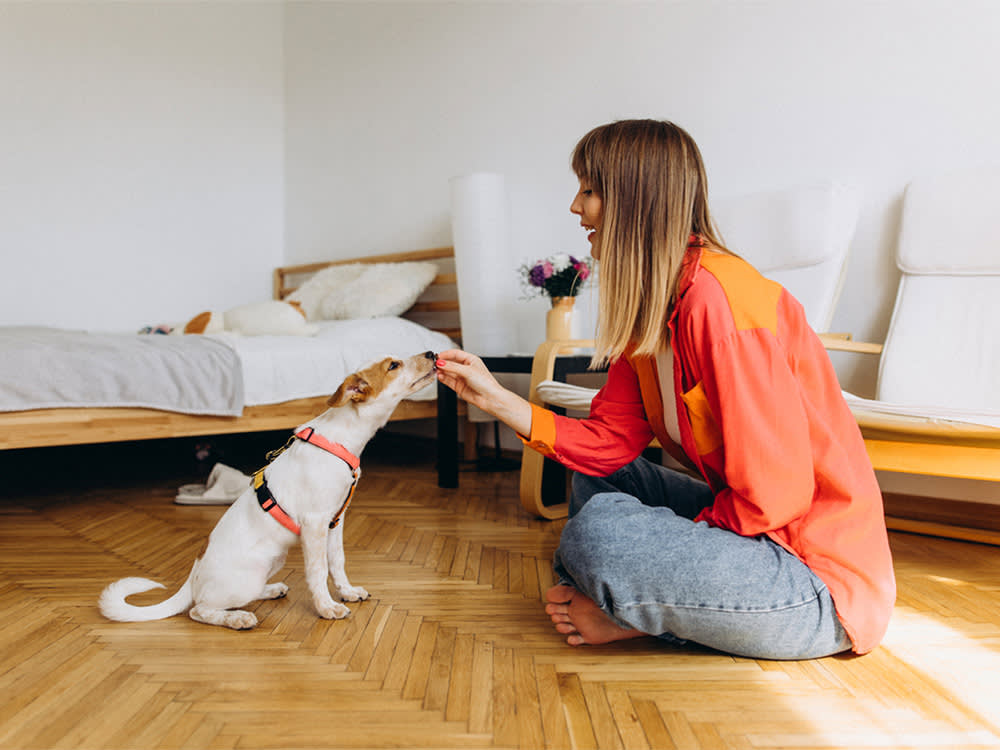
Your dog follows you from room to room, brings you their favorite toy, and gives you that irresistible happy stare when you come home. It feels like proof: my dog loves me so much they just want me to be happy. But that’s probably not what’s actually happening in their head. And if you build your training around that assumption, you might be making things harder than they need to be.
The truth is simpler and more useful: dogs aren’t natural people-pleasers. They’re motivated by what they want—food, play, attention, comfort. Your dog will do what works to get those things. When training clicks, it’s not because your pup has suddenly developed a burning desire to obey you out of love. It’s because you’ve made it worth their while.
This shift in thinking can change everything about how you train and bond with your dog.
The “People Pleaser” Myth Comes from Domestication—Maybe
For thousands of years, dogs have lived alongside humans. That long partnership makes it tempting to assume dogs evolved a special instinct to make us happy. After all, humans reward them, provide for them, and build their whole lives around them. Wouldn’t that create a desire to please?
The science doesn’t quite back it up. Marc Bekoff, author and professor emeritus of ecology and evolutionary biology at the University of Colorado Boulder, explains the reality: “Because of the close relationship that dogs have had with humans for so long, they maybe do have some predisposition to cooperate with us. But then when you consider that around 75 percent of all dogs on the planet are feral, living without any human contact at all—I’ve met lots of feral dogs who don’t really care about me. They want to avoid me.”
Dogs aren’t inherently programmed to want your approval. What they are programmed to do is notice what works. If your dog sits when you say “sit” and gets a treat, they’re not thinking I want to make my human happy. They’re thinking that action gets me something good.
You’re Reading Your Dog’s Mind—Probably Wrong
Dog parents have a powerful tendency to project human emotions onto their dogs. We see a guilty look and assume remorse. We see tail wags and assume joy. We see them follow us around and assume devotion to our happiness.
Alexandra Horowitz, a canine cognition researcher at Barnard College at Columbia University, ran a clever experiment to test the “guilty look” idea. She had owners tell their dogs to leave a treat alone, then left the room. When owners returned, Horowitz’s team would tell them whether or not their dog ate the treat—sometimes truthfully, sometimes not.
The result? The “guilty” behavior—averted eyes, tucked tail, ears back—showed up whether the dog actually broke the rule or not. It appeared when owners scolded their dogs, not when dogs actually felt guilty about something they’d done. The dogs were responding to the owner’s angry tone and body language, not reporting on their own emotional state.
Says Horowitz: “This misattribution could be harmful to dogs if owners have expectations that dogs understand rules and either willfully or negligently violate them. Dogs don’t operate that way.”
Why This Misconception Leads to Bad Training
When you believe your dog wants to obey you and should respect your authority, you’re more likely to reach for punishment-based methods. The logic seems sound: My dog knows what I want but isn’t doing it because he doesn’t respect me, so I need to show him who’s boss.
This thinking has kept punishment-based training methods alive for decades. Some trainers still recommend electronic shock collars, physical corrections, or pressure-based techniques. The justification? Food rewards are just “bribes,” and your dog should listen because they respect you, not because they’re getting something they like.
Jean Donaldson, founder of the Academy for Dog Trainers and longtime advocate against the “desire to please” framing, puts it bluntly: “Trainers who make claims about dogs working ‘to please’ or strictly for praise seem oblivious to the main motivator they employ: pain.”
Here’s the thing: positive reinforcement with food works—and not because you’re “bribing” your dog. You’re just giving them a reason to listen.
What Actually Motivates Your Dog
Nicky Wilke learned this the hard way. Her 90-pound Husky mix, Charlie, had severe leash reactivity—he’d pull her to the ground when other dogs appeared. Multiple trainers recommended aversive methods: shock collars, pressure points, painful corrections.
Desperate, she found Renée Erdman, a positive-reinforcement trainer. Erdman’s approach was simple: use really good treats to make Charlie’s focus on Wilke more rewarding than lunging at other dogs.
“Once I switched to high-value treats, Charlie suddenly cared about what I had to say,” Wilke says. “The difference was night and day. He went from pulling me down the street to actually checking in with me. That’s when I realized he didn’t have a behavior problem—I just hadn’t given him a reason to listen.”
This isn’t manipulation. This is alignment. Charlie isn’t learning to please Wilke—he’s learning that paying attention to her produces something he likes. That creates a dog who actually wants to work with you.
Marc Bekoff emphasizes the point: “To play that dichotomy of food versus true love is ridiculous. It’s just not supported by any research at all. Rewarding what you want to see more of is how learning works in all animals.”
Dogs Have Their Own Agendas—And That’s Okay
Your nervous dog isn’t going to overcome their fear of strangers just to make you happy. A fearful dog who hides during thunderstorms isn’t being stubborn—they’re genuinely scared. A dog who pulls on the leash isn’t disrespecting you; they’re following their instinct to investigate.
The sooner you stop assuming your dog is trying to do what you want, the sooner you can start training based on what actually works. That means:
Identify what your dog actually wants. Is it food? Toys? Sniffing time? Access to other dogs? Once you know what genuinely motivates your individual dog, you have a training tool.
Use that motivation strategically. Reward the behaviors you want to see more of. A nervous dog who approaches a stranger gets rewarded. A dog who walks past another dog without lunging gets rewarded. You’re not bribing them; you’re teaching them that your way of handling situations produces good things.
Stop assuming your dog understands rules. They don’t. Your dog doesn’t know they’re “supposed” to sit at the door before going outside. They just know that sitting produces something good—or doesn’t. Training is about setting up clear cause and effect, not enforcing morality.
Accept that your dog has preferences. Your dog doesn’t want to walk past the dog park if they’d rather go play. Your dog doesn’t want to visit the vet. Some dogs don’t enjoy being petted, even if you love petting them. Meeting your dog halfway—even if it’s not what you want—builds trust.
What’s new since this was written
Recent research in canine cognition continues to reinforce these findings. Studies on dog learning show that food rewards aren’t just effective—they’re more reliable than praise or affection alone. Dogs trained with positive reinforcement show lower stress markers and faster learning curves than dogs trained with aversive methods. If anything, the evidence has gotten stronger that understanding dogs as motivated by what they want (rather than a desire to please) leads to better training outcomes and more confident, less stressed dogs.
The shift away from dominance-based training—the idea that you need to establish yourself as “pack leader”—has accelerated as well. Modern dog training emphasizes cooperation and mutual reward, not authority and respect. Your dog doesn’t need to respect you; they just need to understand that being with you is worth their time.
References
- Bekoff, M. (2019). The Emotional Lives of Animals: A Leading Scientist Explores Animal Joy, Sorrow, and Empathy—and Why They Matter. Novato, CA: New World Library.
- Donaldson, J. (2002). Culture Clash: A Revolutionary New Way of Understanding the Relationship Between Humans and Domestic Dogs. James & Kenneth Publishers.
- Horowitz, A. (2009). Disambiguating the “guilty look”: Salient interpretations of a suspect’s behavior. Behavioral Processes, 81(3), 447-452.
- Horowitz, A., & Hecht, J. (2016). “Examining social desirability bias in dog-human interaction research.” Domestic Dog Cognition and Behavior: The Scientific Study of Canis familiaris. Springer Publishing.
- Sackman, J. (2023). “Positive Reinforcement in Veterinary Medicine.” Journal of the American Veterinary Medical Association, 262(8), 1031-1038.
Dr. Park is a board-certified emergency and critical care specialist. She reviews our health and safety content for clinical accuracy and contributes guides on recognising urgent conditions. Her focus is helping owners act quickly and correctly when it matters most.
Meet our experts ↗Keep reading
 TrainingYour Dog Poops Facing North. That's Not a Coincidence.Dr. Priya Nair · 6 min
 TrainingYour Dog Poops on Hills for a Reason (and It Isn't the View)Dr. Nina Kohl · 6 min
 TrainingNever Introduce Two Dogs Face-to-FaceDr. Mara Chen · 7 min
 TrainingTreats Teach the Trick. Meaning the 'Good Boy' Is What Makes It Stick.Dr. Ravi Mehta · 4 min
 TrainingA Shelter Dog Predicted a Stranger's Seizure With No Training. How?Dr. Lena Park · 6 min
 TrainingYour Dog Isn't Being Difficult. They Might Be Wired Differently.Dr. Nina Kohl · 8 min