


Your Dog's Swimming Ability Won't Save Them From This
Water intoxication isn't about whether your dog can swim. It's about how much water they swallow while playing, and it can turn deadly in under 30 minutes. Here's the emergency picture, the mechanism, and the one habit that prevents it.

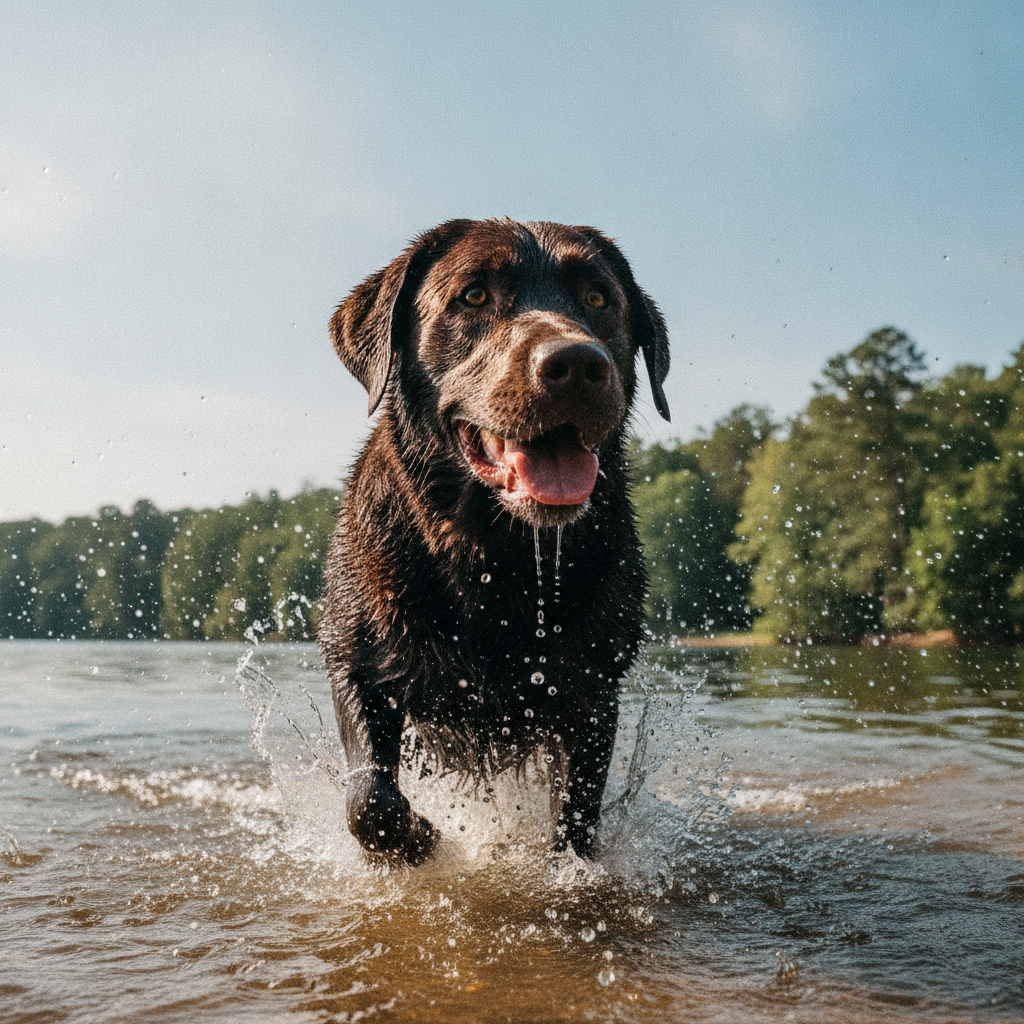
Here is the assumption that gets dogs into trouble: that a confident swimmer is a safe swimmer. Water intoxication does not care whether your dog can swim. It is caused entirely by how much water they swallow, and a strong, enthusiastic swimmer usually swallows more, not less. This is one of the few summer hazards where being good at the activity raises the risk.
Because it is uncommon, most people have never heard of it until it happens to a dog they know. And because it moves fast, the time to understand it is before you are standing at the edge of a lake watching your dog stagger. So we are going to start with the part that matters most in the moment, then explain why it works the way it does.
Know the emergency signs first
If your dog has been swimming, fetching in water, or biting at a hose and then shows any of these, treat it as an emergency and get to a vet immediately.
Early signs:
- Loss of coordination or a drunk, staggering walk
- Lethargy and a glazed, faraway look in the eyes
- Nausea, bloating, and drooling
- Vomiting (often clear liquid)
- Dilated pupils and pale gums
Advanced signs (call ahead and drive now):
- Difficulty breathing
- Collapse or loss of consciousness
- Seizures
The reason speed matters this much is the timeline. Signs can appear in under 30 minutes, and untreated water intoxication can be fatal within 24 to 72 hours. It progresses faster in small dogs, whose smaller bodies are overwhelmed by far less water than a Labrador could shrug off. When you catch it early, the outlook is good: mild cases treated promptly can resolve within a few hours.
What surprises people is that swimming ability is irrelevant here. I’ve seen it in dogs who are wonderful in the water. The common thread is a wide-open mouth during play. A dog having the time of their life will never pace themselves, so pacing them is your job.
What is actually going wrong inside
When a dog takes in a large volume of water in a short window, and is not urinating or vomiting it back out fast enough, it dilutes the sodium in their blood. That condition has a name, hyponatremia, and sodium is not optional: the body needs it to run muscles, nerves, and blood pressure. As sodium drops, water shifts into the body’s cells to balance things out, and those cells swell. In the brain, swelling is catastrophic, which is why the outward signs are neurological: the stumbling, the glazed eyes, the seizures. Left unchecked, it can cause brain damage and heart failure.
Treatment is a hospital job. A vet confirms it with bloodwork showing low electrolytes, then carefully restores balance, sometimes with a diuretic to draw off excess water, sometimes with more aggressive measures like hypertonic saline in severe cases. This is not something to manage at home.
The scenarios that cause it
Naming the specific setups is more useful than a vague “watch the water,” because the risk clusters around a few predictable patterns:
- Open-mouth fetch. A dog repeatedly diving for a ball or bumper with their mouth open swallows a mouthful on every pass. This is the classic cause.
- Hose and sprinkler biting. Dogs who love to snap at a stream of water can down a shocking amount in a few minutes of yard play. No lake required.
- Chugging after hard exercise. A hot, thirsty dog who drinks an enormous volume all at once, then keeps going.
- Flat, shallow water. A dog running through shallow water, mouth low, can scoop water constantly without meaning to.
The fresh-water vs. salt-water twist
Here is a wrinkle that trips people up. Fresh water and salt water are both dangerous, just from opposite directions. Gulping lake or pool water dilutes sodium and causes the hyponatremia described above. But drinking ocean water, or heavily salted pool water, does the reverse: it floods the body with sodium faster than the dog can process it, a condition called salt toxicity that causes vomiting, tremors, and the same disorientation. The practical takeaway is identical either way. The body of water changes the chemistry, but the fix does not: limit how much your dog swallows, whichever kind it is.
The one habit that prevents almost all of it
You do not have to keep your dog out of the water. You have to interrupt the swallowing. Build mandatory breaks into every water session, every ten to fifteen minutes of hard fetch or hose play, and pull your dog out to rest whether they want to or not. Watch specifically for that open-mouthed, ball-chasing pattern and shorten the sessions when you see it. Bring clean drinking water to the shore so your dog is not tempted to drink where they swim. And with small dogs, be stricter, because their margin is thinner. Water play stays one of the best things about summer with a dog. It just needs a referee.
References
- ASPCA Animal Poison Control. “Treating Acute Water Intoxication in Pets.” https://www.aspcapro.org/resource/treating-acute-water-intoxication-pets
- American Kennel Club. “Can Dogs Drink Too Much Water? The Dangers of Water Intoxication.” https://www.akc.org/expert-advice/health/can-dogs-drink-much-water-dangers-water-intoxication/
- Today’s Veterinary Practice. “Evaluation and Management of the Hyponatremic Patient.” https://todaysveterinarypractice.com/internal-medicine/evaluation-and-management-of-the-hyponatremic-patient/
Common questions
Can a strong swimmer still get water intoxication?
Yes. Swimming skill has nothing to do with it. The danger is swallowing water, usually while fetching with an open mouth or biting at a hose or sprinkler, not how well a dog stays afloat.
Is salt water safer than fresh water?
No, it's dangerous in the opposite direction. Gulping fresh water dilutes sodium (hyponatremia); drinking ocean or heavily salted pool water floods the body with sodium (salt toxicity). Both wreck the same electrolyte balance, so limit how much your dog swallows either way.
Not a substitute for your vet. Our guidance is educational. For urgent symptoms, contact a vet or emergency clinic right away. Editorial standards
Dr. Solis is a board-certified veterinary dermatologist with over twelve years of clinical experience. She advises on skin conditions, allergies, and grooming practices that affect coat and skin health. All dermatology and allergy content at The Pet Times is reviewed by her team before publication.
Meet our experts ↗Keep reading
 Health & WellnessWhen Your Dog Chokes, Your First Instinct Is the Wrong OneDr. Ravi Mehta · 6 min
 Health & WellnessA Bee Sting Won't Wait for You to Look It Up: A Vet's Triage Guide for DogsDr. Lena Park · 9 min
 Health & WellnessYour Dog Ate Chocolate. The Word 'Toxic' Won't Tell You What to Do. The Math Will.Dr. Ravi Mehta · 8 min
 Health & WellnessThe Old Advice Was to Starve the Pancreas. The Evidence Says Feed It.Dr. Ravi Mehta · 7 min
 Health & WellnessPut Down the Neosporin. Your Dog Is Just Going to Eat It.Dr. Ravi Mehta · 7 min
 Health & WellnessYour Dog's Penis Won't Retract? Start the 20-Minute Clock.Dr. Priya Nair · 6 min