


A Bee Sting Won't Wait for You to Look It Up: A Vet's Triage Guide for Dogs
You probably won't see your dog get stung. What you will see is a swollen face, and the real skill is telling a harmless reaction from anaphylaxis fast. Here is how.

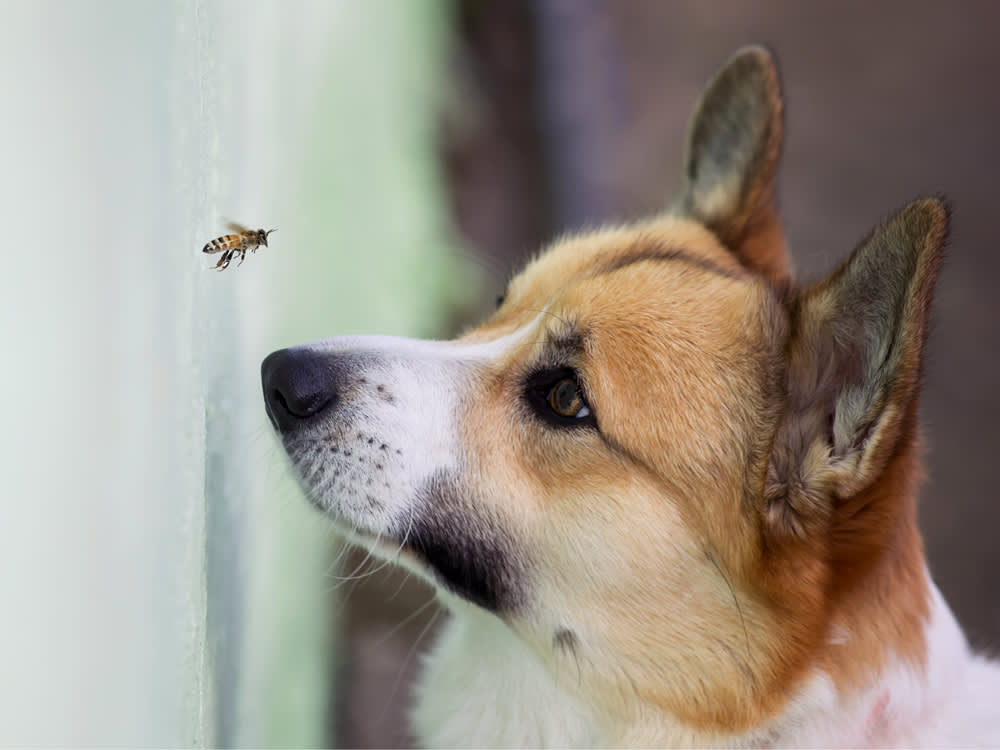
Most pet parents never see the sting. They see the aftermath: a dog who was happily nosing through the garden a minute ago now standing in the kitchen with a muzzle swelling like a water balloon, one eye puffing shut, looking faintly embarrassed. The first reaction is usually a jolt of panic and a scramble for the phone. And the honest truth is that by the time you are reading a how-to, the most important decision has already passed you by.
That decision is triage. A bee sting in a dog can be a forgettable nuisance or a true emergency, and they start out looking almost identical. The single most useful skill you can have is not stinger-removal technique or a Benadryl dose. It is the ability to look at your dog in the first minute and sort “swollen and annoyed” from “going into shock,” because those two paths call for completely different responses. So this guide starts there, with the fork in the road, and works outward.
The fork in the road: mild reaction vs. anaphylaxis
Almost every sting produces a local reaction, the body’s normal response to venom. The question that determines everything is whether it is staying local or going systemic.
A mild, local reaction looks alarming but behaves itself. You will see some mix of:
- A swollen or puffy face, often the muzzle, lips, or around one eye
- Pain or tenderness at the spot
- Redness, hives, or raised lumps on the skin
- Head shaking and itchiness
Crucially, a dog having a mild reaction is still breathing normally, has pink gums, and is alert. They are uncomfortable, not in danger, in this moment.
Anaphylaxis is the systemic version, and it is the one that kills. It comes on within minutes and involves the whole body, not just the sting site. Warning signs include:
- Vomiting (often a single dramatic vomit), then collapse
- Weakness, staggering, or sudden disorientation
- Pale or white gums
- Difficulty breathing, or breathing that looks like effort
- Severe, full-body hives and itching
- Diarrhea
- Swelling of the throat or larynx, sometimes with a change in the sound of the breath
In my years in emergency practice, the most common pattern I see for canine anaphylaxis is heartbreakingly consistent: the dog vomits once, then collapses, and on exam has pale gums and a weak, thready pulse, the signature of distributive shock. If you see that sequence, you are not removing a stinger or making a baking-soda paste. You are getting in the car.
The reason triage has to come first is timing. A local reaction gives you hours of margin to call your vet and watch. Anaphylaxis gives you minutes, and epinephrine given by a vet is what reverses it. Spending those minutes on Google or a home remedy is the mistake that turns a survivable reaction into a fatal one.
Why you usually can’t see the sting
Dogs investigate the world with their faces and mouths, so stings cluster on the muzzle, lips, gums, tongue, and paws. A dog who tries to snap at a buzzing bee can get stung inside the mouth or even swallow it, and those locations carry extra risk: swelling in the throat can narrow the airway in a way a swollen muzzle never will. If your dog was play-hunting an insect and then starts drooling, gagging, pawing at the mouth, or breathing hard, treat it as urgent regardless of how the rest of them looks.
And there often is no visible stinger to find. Only honeybees leave one behind; wasps, hornets, yellow jackets, and bumblebees keep theirs and can sting repeatedly. So “I can’t find a stinger” tells you nothing reassuring, it may simply mean the culprit wasn’t a honeybee, or the stinger already fell out.
If it’s mild: the three steps, in the right order
Once you have decided the reaction is local and your dog is breathing fine, you have time to help, and to call your vet while you do. The classic memory aid still works, but one piece of it needs updating.
Get the stinger out, fast, by any method. Here is the correction worth internalizing, because the old advice was wrong. For decades the rule was “scrape it out with a credit card, never pinch, because pinching squeezes the venom sac.” A systematic review of stinger-removal methods found that this dogma doesn’t hold up. The detached stinger’s venom sac keeps contracting and pumping venom into the flesh for a minute or more on its own, so the total dose depends mostly on how fast you remove it, not on whether you scraped or pinched. A quick pinch that gets it out in two seconds delivers less venom than a careful, fumbling scrape that takes half a minute. If you can see a stinger, the instruction is simply: remove it now, however you can. If you genuinely can’t manage it, leave it for your vet rather than digging.
Neutralize and cool. Dab a paste of baking soda and water on the site to counter the acidic venom, then hold a cool compress on the area. The cold eases pain and swelling and constricts local blood vessels, which slows the venom’s spread.
Call your vet, even for mild signs. A swollen face is your cue to phone the clinic, describe what you see, and follow their direction. Keep watching your dog for the first 30 to 60 minutes, because a reaction that started mild can climb, and you want to catch that turn early.
A word on Benadryl
Benadryl (diphenhydramine) is generally considered safe for dogs and can help a mild reaction. But it is not anaphylaxis treatment, and reaching for it instead of calling your vet is exactly the delay that gets dogs in trouble. The rule: if there is facial swelling, contact your vet before giving anything, and let them tell you the dose.
The real exception is the backcountry. If you hike far from any clinic, ask your vet in advance for a weight-based Benadryl dose to carry, and in some cases a dog who has survived prior anaphylaxis can be prescribed an epinephrine auto-injector (the canine version of an EpiPen) to keep in the pack. Neither replaces veterinary care; both exist to buy time on the trail while you get to it.
The hard truth about prevention
There is no test that tells you whether your dog will react badly to a sting, and a dog who shrugged off last summer’s sting can have a severe reaction to the next one. Sensitization is unpredictable. So prevention is mostly about reducing exposure: steer your dog away from foraging bees on flowering plants, from swarms, and from the underside of porches, decks, and shrubs where nests hide. Be extra wary of ground-nesting yellow jackets and wasp nests, which can deliver dozens of stings at once, and remember that multiple stings, or even one in a sensitized dog, can cause damage well beyond the local swelling, including documented cases of kidney injury, blood-cell destruction, and lung injury after heavy envenomation.
A single bee is a small thing. The reason to take it seriously is that you cannot know in advance which sting is the small thing and which is the emergency, so you treat every one as if it could be the second, watch closely, and keep your vet’s number close during bee season.
References
- Methods of Honey Bee Stinger Removal: A Systematic Review of the Literature — Wilderness & Environmental Medicine, 2020
- Bee Sting Removal — University of California, Riverside
- Cunha, E., et al. “Pathological Findings in Dogs After Multiple Africanized Bee Stings.” Toxicon
- Nakamura, R.K., et al. “Kidney Injury in a Dog Following Bee Sting-Associated Anaphylaxis.” Journal of the American Animal Hospital Association
- Walker, T., et al. “Imaging Diagnosis: Acute Lung Injury Following Massive Bee Envenomation in a Dog.” Veterinary Radiology & Ultrasound
Common questions
Should I scrape the stinger out or can I pull it?
Just get it out fast, by whatever method is quickest. The old advice to only scrape and never pinch has been overturned by research. What matters is speed, because the detached venom sac keeps pumping venom for a minute or more. A pinch that removes it in two seconds beats a careful scrape that takes thirty.
Can I give my dog Benadryl for a bee sting?
Only after talking to your vet, and never as a substitute for a visit when there is facial swelling. Benadryl (diphenhydramine) can ease a mild reaction, but it does not treat anaphylaxis and giving it can delay real care. Call your vet first.
Is a bee sting on a dog an emergency?
It can be. There is no way to predict whether a given sting will be a minor nuisance or a life-threatening reaction, and a dog with no reaction to one sting can have a severe one to the next. Treat every sting as a potential emergency and watch closely for the first 30 to 60 minutes.
How do I know if my dog was stung in the mouth?
A dog stung inside the mouth or who swallowed a bee may show swelling, drooling, coughing, gagging, rapid breathing, vomiting, or diarrhea. Mouth and throat stings are higher risk because swelling there can block the airway. Seek immediate veterinary care.
Not a substitute for your vet. Our guidance is educational. For urgent symptoms, contact a vet or emergency clinic right away. Editorial standards
Dr. Park is a board-certified emergency and critical care specialist. She reviews our health and safety content for clinical accuracy and contributes guides on recognising urgent conditions. Her focus is helping owners act quickly and correctly when it matters most.
Meet our experts ↗Keep reading
 Health & WellnessCooked Salmon Is a Gift. Raw Fish From a Lake Can Kill Your Dog.Dr. Priya Nair · 5 min
 Health & WellnessYour Dog's Penis Won't Retract? Start the 20-Minute Clock.Dr. Priya Nair · 6 min
 Health & WellnessThe Skin-Pinch Test for Dehydration Fails on the Dogs Who Need It MostDr. Amara Solis · 8 min
 Health & WellnessThe Deadliest Thing in Your Garden Is Flavored Like DessertDr. Lena Park · 6 min
 Health & WellnessYour Dog Ate Chocolate: The Weight-and-Type Math That Tells You What to DoDr. Ravi Mehta · 7 min
 Health & WellnessYour Dog Is Not a Carbon Monoxide Detector. Don't Treat Them Like One.Dr. Priya Nair · 6 min