


That Red, Squinty Eye Isn't Nothing. It Could Be Uveitis.
A dog's inflamed eye can go from painful to sight-threatening fast. Here's how to spot uveitis, what actually causes it, and why the next generation of treatment may finally come without the side effects.

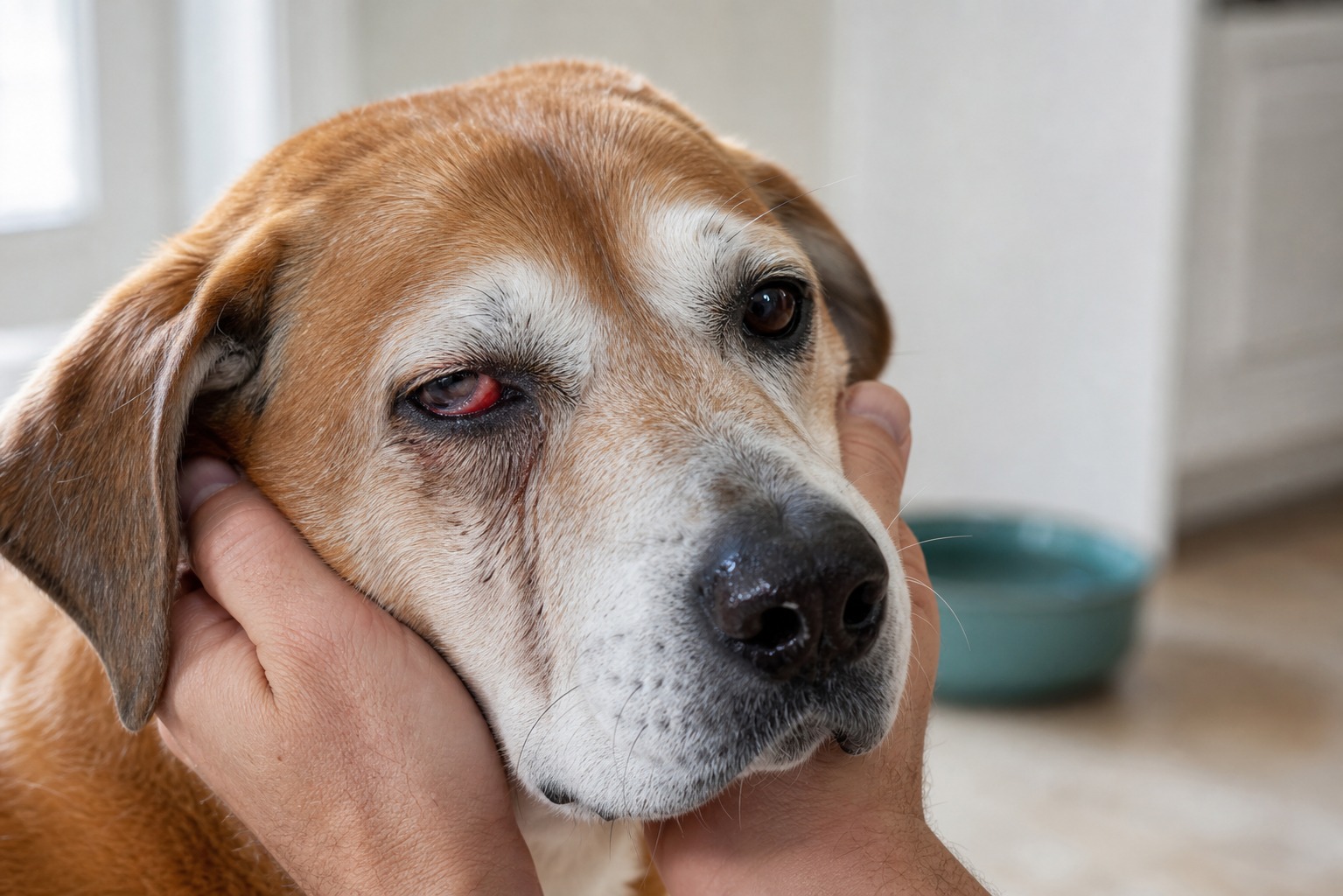
Your dog keeps one eye pinched shut. It looks a little red, maybe a little cloudy, and they flinch away from the window. It is tempting to tell yourself it is dust, or a scratch that will heal by morning. With eyes, that instinct is the dangerous one.
A painful, inflamed eye can be uveitis, and uveitis is not a wait-and-see condition. It is inflammation inside the eye itself, it hurts, and depending on what is driving it, it can threaten your dog’s vision if it is left to smolder. The good news is that it is treatable, and the treatments are getting gentler. The catch is that it rewards owners who move quickly.
What uveitis actually is
The uvea is the vascular, pigmented middle layer of the eye. When it becomes inflamed, that is uveitis. Think of it less as a single disease and more as the eye’s version of a fever: a sign that something is irritating, infecting, or attacking the tissue, and the eye is reacting.
That is the part owners tend to miss. Uveitis is frequently a symptom of a larger problem rather than a stand-alone eye issue. It can develop secondary to infectious diseases, to cancer, and to autoimmune conditions where the body turns on its own tissue. It also shows up around cataracts: a longstanding cataract can inflame the eye, and inflammation inside the eye is one of the most common complications after cataract surgery, which makes controlling it a genuine challenge in both veterinary and human eye medicine.
When I see a red, painful eye, I am not just treating the eye, I am asking what the rest of the body is doing. Uveitis can be the first hint of something systemic, so the eye exam is really the start of a bigger conversation.
The signs worth acting on
Uveitis tends to announce itself through discomfort. Watch for:
- Pain in or around the eye
- Redness of the eye
- Heavy squinting, or holding the eye shut
- Shying away from bright light
- A cloudy or hazy look to the eye
- Excessive tearing or watering
A dog who keeps the affected eye clamped shut, ducks away from light, and has a cloudy or weepy eye is telling you something is wrong. None of these signs earn a night of waiting. If you are seeing them, the eye deserves a vet’s attention that day.
How it is treated now
Standard treatment leans on anti-inflammatory medication, given both as drops on the surface of the eye and, when needed, as a systemic drug the dog takes by mouth or injection. These are usually steroids or non-steroidal anti-inflammatory drugs (NSAIDs), and they work.
The trade-off is side effects. The same drugs that calm the eye can unsettle the rest of the dog: vomiting, diarrhea, and stomach ulcers, strain on the kidneys and liver, and rising blood sugar in dogs who are diabetic. For a pet who needs inflammation controlled for weeks, those risks add up, and vets end up balancing the eye against the gut and the organs. It is effective medicine that asks the body to pay a tax.
What newer research adds
This is where the story gets genuinely hopeful, and it involves a spice.
Curcumin, the compound that gives turmeric its yellow color, is a natural anti-inflammatory. Its problem has always been absorption: swallow it and very little reaches your bloodstream, which is why eating curry does nothing for an inflamed eye. Researchers at the Texas A&M College of Veterinary Medicine and Biomedical Sciences, led by veterinary ophthalmologist Dr. Erin Scott, tackled that problem directly. In work published in the journal Science Advances, they built a “double-headed” nanoparticle that latches onto the transferrin receptor, a protein the body uses to ferry iron across barriers, and hitches curcumin a ride to where it is needed. In their canine model, the reformulated curcumin calmed inflammation inside the eye, and it did so with no known side effects, the exact weakness of today’s steroids and NSAIDs.
The idea has kept moving. A 2024 study in the Journal of Nanobiotechnology paired curcumin with hyaluronic acid in a nanoparticle designed to switch on the body’s own antioxidant defenses, and reported that it slowed the progression of experimental autoimmune uveitis. Different lab, same direction of travel: get curcumin where it needs to go, and it starts to look like a real anti-inflammatory tool rather than a health-store rumor.
Two honest caveats. This is not something you can buy or make at home, and the spice in your cabinet will not do the job. And these formulations are still being tested, not sitting on a pharmacy shelf. But the trajectory matters, because a treatment that controls eye inflammation without taxing the kidneys, liver, and stomach would be a real gift to dogs who need it for weeks at a time.
The bottom line
If your dog’s eye is red, painful, cloudy, or held shut, call your vet the same day and let them find what is driving it. Today’s treatments work, even if they come with side effects to manage. Tomorrow’s may be kinder. Either way, the eye is not the place to gamble on time.
A note: eye problems can escalate quickly, so this article is not a substitute for a hands-on exam. When in doubt, your vet is the right call.
References
- Scott, E. M., et al. “Systemic anti-inflammatory therapy aided by double-headed nanoparticles in a canine model of acute intraocular inflammation.” Science Advances, 2020. https://www.science.org/doi/10.1126/sciadv.abc9227
- “Preventing the progression of experimental autoimmune uveitis with hyaluronic acid-curcumin nanoparticles through the Keap1/Nrf2/HO-1 signaling pathway.” Journal of Nanobiotechnology, 2024. https://jnanobiotechnology.biomedcentral.com/articles/10.1186/s12951-024-03082-3
- American College of Veterinary Ophthalmologists. “Uveitis.” https://www.acvo.org/
- Texas A&M College of Veterinary Medicine & Biomedical Sciences. “Researchers Develop Uveitis Treatment From Turmeric.” https://vetmed.tamu.edu/news/press-releases/texas-am-researchers-develop-uveitis-treatment-from-turmeric/
Common questions
What causes uveitis in dogs?
Lots of things. It can follow infections, cancer, and autoimmune disease, and it commonly shows up alongside longstanding cataracts or after cataract surgery. Because the trigger can be a bigger body-wide problem, your vet will often look beyond the eye itself.
Can I treat my dog's eye inflammation at home with turmeric?
No. The turmeric research making headlines uses a specialized nanoparticle form of curcumin that your body can actually absorb, and it is not the same as sprinkling spice on dinner. Uveitis needs a real diagnosis and prescription treatment. Ask your vet before giving any supplement.
Not a substitute for your vet. Our guidance is educational. For urgent symptoms, contact a vet or emergency clinic right away. Editorial standards
Dr. Chen is a small-animal veterinarian who leads health and safety coverage at The Pet Times. She writes and reviews the bulk of our illness, condition, and safety content, translating clinical guidance into clear, practical advice owners can act on at home.
Meet our experts ↗Keep reading
 Health & WellnessTylenol Is the 'Gentle' Painkiller That Quietly Wrecks a Dog's LiverDr. Amara Solis · 8 min
 Health & WellnessMost Dog Stretches Are Nothing. One Is a Race to the VetDr. Lena Park · 7 min
 Health & WellnessThe CBD-for-Seizures Pitch Is Way Ahead of the ScienceDr. Ravi Mehta · 7 min
 Health & WellnessYour Dog's Squint Isn't a Smile. Count the Eyes.Dr. Mara Chen · 7 min
 Health & WellnessYour Dog Is Panting at 3 a.m. Here's How to Know If It's Nothing.Dr. Mara Chen · 7 min
 Health & WellnessCircling, Head Tilts, Stumbling: When a Dog's 'Off' Day Is Actually Their BrainDr. Ravi Mehta · 9 min