


Dog Saliva Isn't Dirty. It's Just Brutal on Your Face.
Everyone argues about the bacteria. For most people that's the wrong worry entirely. The thing wrecking your skin is the wet-dry-friction cycle, and it's fixable without cutting your dog off.

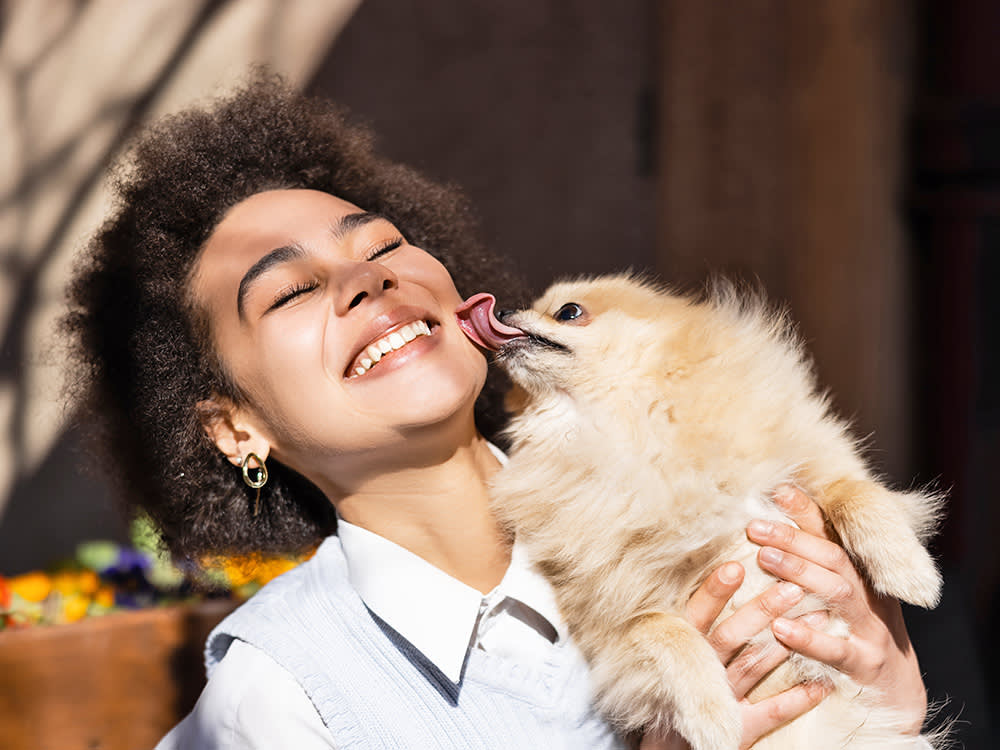
The argument about dog kisses always gets stuck in the same place: is dog saliva full of bacteria, yes or no.
It is the wrong question, and it makes people worry about the wrong risk. Yes, dog saliva contains hundreds of species of bacteria, and so does yours. For a healthy adult with unbroken skin, the odds of that biology hurting you are very low. Meanwhile, something else is quietly happening to your face every morning, and almost nobody names it.
Your dog is not infecting your skin. Your dog is exfoliating it, with a wet, warm, textured tool, at a pH your skin barrier did not sign up for, several times a day. That is the actual mechanism, and once you see it that way, the fix is obvious and does not involve rejecting your dog.
The mechanism nobody explains
Three things happen when a dog licks you repeatedly, and they compound.
1. The wet-dry cycle. Saliva goes on, then air-dries. Every evaporation cycle pulls moisture out of the top layer of skin with it. Do that four times before breakfast and you have a dehydrated stratum corneum.
2. The friction. A dog’s tongue is not smooth. It is a physical abrasive, applied repeatedly to the same patch, usually the same cheek.
3. The pH mismatch. Human skin sits slightly acidic. That acid mantle is part of what keeps the barrier working. Dog saliva has a higher pH, so frequent exposure can temporarily disrupt it.
“Think of it as a slow sanding, not a contamination,” says Dr. Lena Park. “Wet, dry, scrape, repeat, on the same square inch of cheek, several times a day. A tough barrier shrugs that off. A barrier that is already struggling gives way, and then the proteins in the saliva have somewhere to land.”
On resilient skin, this is a nothing-burger. The barrier holds, and the worst you get is a slightly dry patch. If you have acne, eczema, or rosacea, this is a very different story, and the reason it flares is not that your dog is dirty. It is that your skin overreacts to compounds that are entirely natural.
Add the enzymes to the picture, amylase and peroxidases among them, and you have a mild chemical peel administered by an animal who loves you.
Now the infection question, answered properly
Here is where the panic articles are both right and useless, because they never tell you who is actually at risk.
The bacteria worth knowing by name are Capnocytophaga canimorsus and Pasteurella canis. Both live normally in dog mouths. Both can cause serious infection if they get into you, through a cut, a popped pimple, or a mucous membrane like the eyes or the mouth. Saliva on intact skin is a very different event from saliva in a wound.
The numbers are what make this concrete. Per the CDC, people usually get Capnocytophaga infections from bites, but scratches and licks can transmit it too, and the risk is concentrated in specific bodies. People who have had their spleen removed make up roughly 60% of C. canimorsus cases. Other established risk factors include heavy alcohol use, liver cirrhosis, and cancer.
That is the real answer to “is it safe.” It is not one answer. It is two:
- If you are healthy with intact skin: the risk is low enough that the barrier damage is a bigger practical problem than the bacteria.
- If you have no spleen, a significantly weakened immune system, cirrhosis, or you are undergoing cancer treatment: do not let a dog lick your face, your hands, or any broken skin, and treat every scratch seriously. This is the group where a lick is genuinely dangerous, and the group most articles forget to warn.
One honest caveat, because the literature has moved: up to 40% of reported C. canimorsus infections occur in people with no known immune compromise at all. These infections are rare. They are not impossible. That is why “any lick into an open lesion or into the mouth” is where the line sits, for everyone.
Dogs can also carry ringworm and giardia, especially if they have recently licked something they should not have. Same principle applies: the route in matters more than the presence of the organism.
Go to urgent care, not Google, if you get spreading redness, swelling, warmth, a fever, or a wound that looks worse at 24 hours than it did at 6.
The fix, in the order it actually matters
You do not have to cut your dog off. You have to change the sequence.
1. Let your skincare absorb before the kissing starts
This is the highest-leverage change and it costs nothing. Dogs are drawn to sweet, fatty, and protein-like scents: vanilla, caramel, honey, coconut oil, shea butter, and essential oils like peppermint and lavender. If you moisturize and immediately present your face, you have essentially seasoned yourself.
It also protects the dog. Some of what is on your face should not be in a dog. Zinc oxide in mineral sunscreens, retinoids, essential oils, and xylitol are the ones to be strict about, and oils and fragrances can cause stomach upset on their own. Let it all sink in first.
2. Redirect the target, not the behavior
Licking is one of the first social behaviors a puppy ever runs, aimed at mom and at siblings, and it never really gets uninstalled. Trying to delete it wholesale is a losing fight over a behavior that is not doing any harm.
Move it instead. Offer the chin or the cheek. Keep it away from the lips, the eyes, and any broken skin. If you have an eczema patch, that patch is off-limits, permanently.
3. Cleanse and rebuild after, not obsessively
Wash with something mild and pH-balanced, then put a barrier moisturizer back on top. That is the whole protocol: reset the acid mantle, replace the lipids. Scrubbing your face raw after every kiss does more damage than the dog managed.
4. If you want fewer licks, stop paying for them
Attention is the reward, and negative attention is still attention. Redirect to a chew toy, a puzzle toy, or a lick mat when they start. Reward the stop, or a cue like “sit” or “down,” with something better than your face. Teach a consistent “no lick” if you want a clear boundary. Consistency matters more than the specific cue.
If it has tipped into compulsive, constant, and escalating, stop thinking about training and start thinking about why. Obsessive licking is usually a dog with an unmet need, most often boredom or anxiety.
5. Clean up the mouth doing the licking
If the kisses have gotten genuinely funky, that is a dental signal. Brushing reduces plaque and bacterial load, improves gum health, and, incidentally, makes your dog considerably more pleasant to be near.
Look for products carrying the Veterinary Oral Health Council (VOHC) seal, which is an actual efficacy standard rather than a marketing claim. Enzymatic toothpaste, chlorhexidine rinses, and VOHC-accepted dental chews all have evidence behind them. Brands like C.E.T. and Greenies show up on that list.
What newer research adds
The clinical literature on Capnocytophaga has grown noticeably over the last couple of years, with a steady stream of case reports, including severe sepsis in an otherwise healthy adult with only saliva exposure and no bite. That sounds alarming and it is worth keeping in proportion: these are case reports precisely because they are unusual. Millions of people are licked by dogs every day and nothing happens.
What the newer cases do change is the framing. It is no longer accurate to say “only immunocompromised people get this.” The better summary is that the infection is rare, the consequences when it happens are severe, and the risk climbs steeply with a missing spleen, cirrhosis, heavy drinking, or cancer treatment, and with any break in the skin.
So the practical advice has not changed, but the confidence behind it has. Keep saliva out of open skin, out of your eyes and mouth, and off anyone in a high-risk group. Everything else is a moisturizer problem.
The answer nobody gives you
No. And the frame that you might is exactly what makes people either paranoid or reckless.
Keep the kisses. Put your serum on ten minutes earlier. Aim her at your chin. Keep a gentle cleanser and a decent moisturizer nearby. Brush her teeth this week, which you were supposed to be doing anyway.
That is a small tax on a very large amount of joy.
References
- “About Capnocytophaga.” Centers for Disease Control and Prevention.
- “Capnocytophaga canimorsus from Dog Saliva Exposure Causing Severe Sepsis in a Healthy Adult: A Case Report.” American Journal of Case Reports, 2025.
- Veterinary Oral Health Council: Accepted Products.
Common questions
Why does my dog lick my face so much?
Partly affection and social ritual, carried over from puppyhood. Partly your skin. Skincare, makeup, sweat, and shower-fresh skin all smell and taste interesting to dogs, especially sweet, fatty, and protein-like scents like vanilla, caramel, honey, coconut oil, shea butter, and essential oils. Licking can also be driven by anxiety, boredom, or the fact that you reacted to it once and taught them it works.
Can dog licking make eczema or acne worse?
Yes, for reactive skin. The repeated cycle of saliva exposure, air-drying, and tongue friction can compromise the skin barrier. Dog saliva also has a higher pH than human skin, which can temporarily disrupt the acid mantle, and it contains enzymes and proteins that some people react to.
What skincare ingredients are dangerous for my dog to lick off?
Zinc oxide in sunscreens, retinoids, essential oils, and xylitol are the most concerning. Oils and fragrances can also cause stomach upset. Let products fully absorb before any face-licking session.
Not a substitute for your vet. Our guidance is educational. For urgent symptoms, contact a vet or emergency clinic right away. Editorial standards
Dr. Kohl is a board-certified veterinary dentist with a particular interest in preventive oral care. She reviews all dental health content at The Pet Times and contributes practical guides on home dental routines, professional cleaning, and oral disease prevention.
Meet our experts ↗Keep reading
 Health & WellnessYour Kid's Lice Can't Move Into Your Dog. Here's the Biology.Dr. Amara Solis · 5 min
 Health & WellnessYour Dog's Ear Infection Keeps Coming Back for One Reason Most Owners MissDr. Priya Nair · 6 min
 Health & WellnessYour Dog's Skin Is Turning Gray or Black. It's Trying to Tell You Something.Dr. Priya Nair · 7 min
 FoodCamelina Oil for Dogs: A Real Coat Booster That Can't Replace Fish OilDr. Mara Chen · 5 min
 Health & WellnessYour Dog's Paws Smell Like Fritos. Here's the Bug Behind It.Dr. Lena Park · 6 min
 Health & WellnessYour Itchy Dog Doesn't Need a Perfect Cure. They Need a Livable Itch.Dr. Priya Nair · 6 min