


Why the Circle Wag Is the Only Tail Signal You Can Trust at a Glance
Most tail wags are ambiguous, and science now shows even the direction of a wag carries meaning. The circle wag is the rare exception that reads clearly as joy. Here's why.

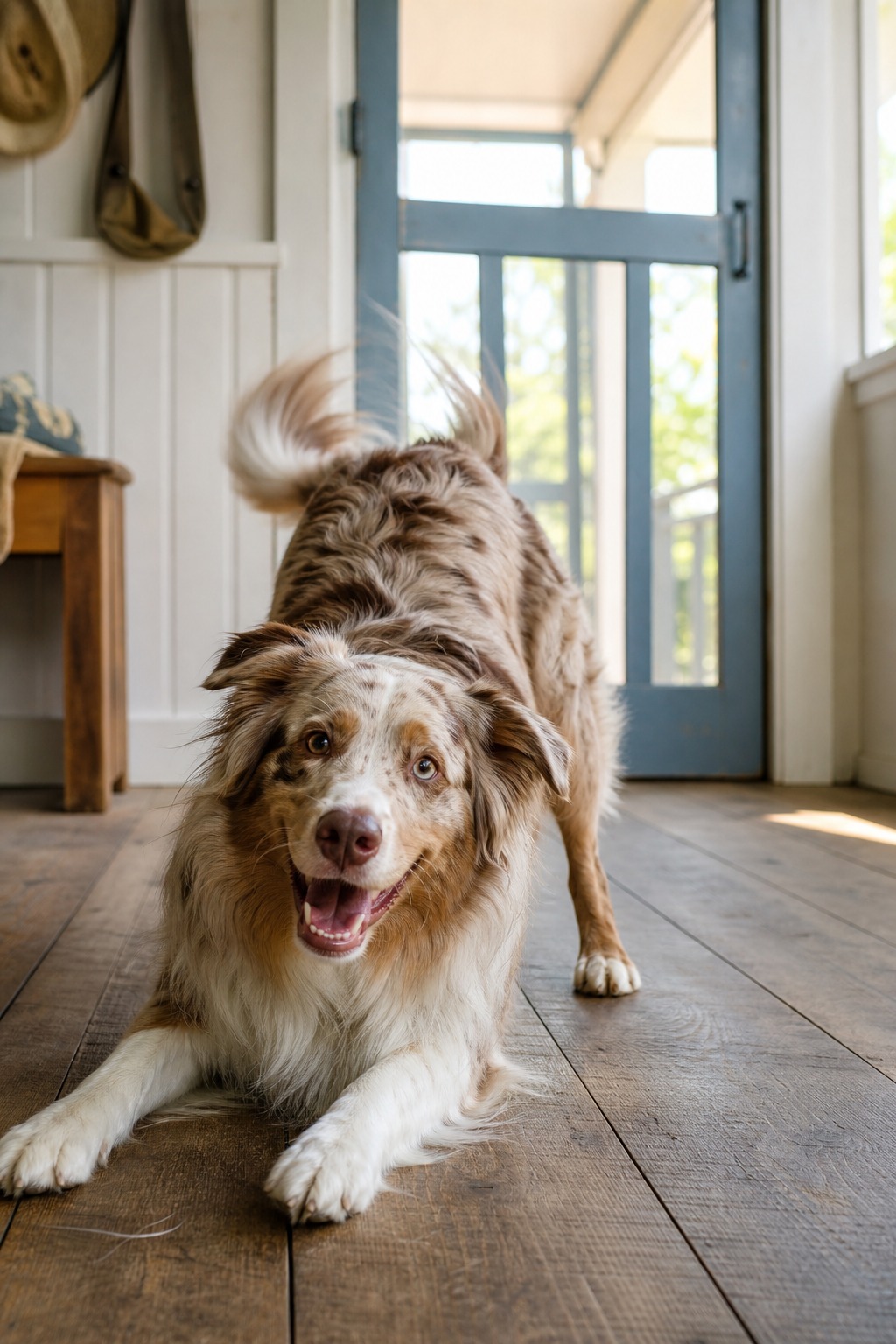
Almost everything you think you know about tail wagging is a little bit wrong. A wag is not a smile. It’s closer to a word that changes meaning depending on speed, height, stiffness, and even which direction it leans, which is why “the dog is wagging, so it’s happy” gets people bitten. But there is one wag that is the genuine exception, the one that actually means what everyone assumes all wags mean. It’s the circle wag, and understanding why it’s trustworthy when other wags aren’t tells you more about reading dogs than any single cue could.
Most tail wags pose a question rather than settle one. The circle wag is a rare exception that hands you a definite answer, and that answer is almost always joy. It’s trustworthy precisely because a dog can’t fake the whole-body looseness that produces it.
What the circle wag actually is
The circle wag, also called the propeller wag or helicopter tail, is exactly what it sounds like: the tail rotates at the base so the tip traces a broad circle in the air rather than sweeping side to side. You see it most often when a dog is overjoyed to greet someone special, especially after a real absence. Those viral videos of dogs losing their minds when a service member comes home are full of circle wags. Some dogs bring that propeller to every reunion no matter how brief the separation; for them it’s just how they say hello.
Why it’s reliable when a normal wag isn’t
Here’s the mechanism that makes the circle wag trustworthy. Friendliness in dogs isn’t expressed by the tail alone, it’s expressed by how much of the body joins in. The classic friendly greeting is a full-body affair that ripples from the shoulders, through the belly and hips, and out into the tail. The more the whole body is recruited into loose, rolling motion, the friendlier the intent. The circle wag is the most extreme version of that whole-body looseness: to spin the tail in a full circle, a dog essentially has to be relaxed and wiggly from the core outward. A tense, conflicted, or fearful dog holds tension somewhere, and that tension breaks the circle. So the shape of the motion is doing the work. A stiff high wag or a fast narrow one can accompany all sorts of emotional states, but a true, loose propeller almost never coexists with a bad mood, which is why you can read it at a glance.
Even the direction of a wag has a meaning now
If you needed proof that a plain wag is more complicated than it looks, science has supplied it. Researchers measuring the direction of tail wags found that dogs wag with a rightward bias when they encounter something positive, like their owner, and a leftward bias when they see something they want to withdraw from, like an unfamiliar, assertive dog. The asymmetry reflects which side of the brain is doing the processing. A follow-up study went further and showed that dogs themselves notice: when they watched other dogs wag with a left bias, they showed higher heart rates and more anxious behavior than when they watched a right-biased wag. In other words, dogs are reading a layer of tail information most humans never even see. Against that backdrop, the circle wag’s value becomes obvious, it’s the one signal loud and unambiguous enough that you don’t need to measure angles to interpret it.
The exception to the exception
Even a signal this reliable isn’t absolute, and honesty demands the caveat. Consider a dog I’ll describe from behavior casework: sociable and playful off leash, but a committed resource guarder around toys and food, prone to barking and lunging at other dogs while leashed, and fearful in many situations. When another dog came onto his property, he would charge with a full circle wag while barking and stiffening the rest of his body, none of which says “friendly,” and yet once he arrived, a tense greeting would dissolve into real play. It was one of the only times a circle wag showed up in a dog who wasn’t in an obviously happy state. The best read is that he was ambivalent, genuinely anticipating fun while nervous about the encounter at the same moment. The lesson isn’t that the circle wag is unreliable. It’s the same lesson the direction research teaches: always read the tail in the context of the whole body. When the circle wag comes with a loose, wiggly body, it’s joy. When it comes with a stiff one, the tail is telling you one thing and the body another, and the body wins.
When your own dog does it
Some dogs circle-wag constantly, seemingly at any good thing at all. Others save it for specific moments: greeting a favorite dog friend, welcoming their person home after a long day, or realizing it’s finally walk time. Learning your own dog’s particular triggers is part of the fun, and a good reminder that even the clearest body-language cue is personal. The more you watch for the whole-body version, the more fluent you’ll get at telling a real propeller of joy from a wag that only looks like one.
References
- Quaranta, A., Siniscalchi, M., Vallortigara, G. Asymmetric Tail-Wagging Responses by Dogs to Different Emotive Stimuli. Current Biology, 2007.
- Siniscalchi, M., et al. Seeing Left- or Right-Asymmetric Tail Wagging Produces Different Emotional Responses in Dogs. Current Biology, 2013.
Dr. Kohl is a board-certified veterinary dentist with a particular interest in preventive oral care. She reviews all dental health content at The Pet Times and contributes practical guides on home dental routines, professional cleaning, and oral disease prevention.
Meet our experts ↗Keep reading
 TrainingYour Dog Is Running on Your Nervous SystemDr. Nina Kohl · 6 min
 TrainingThat Big Dramatic Sigh Isn't Sadness. It's Punctuation.Dr. Lena Park · 6 min
 TrainingThe Most Dangerous Dog Isn't a Breed. It's the One Nobody's Reading.Dr. Mara Chen · 7 min
 TrainingRead the Human First: How to Greet a Dog You've Never MetMarcus Webb · 9 min
 TrainingThat Creepy 'Shark Tank' Doll Won't Cure Your Dog's Separation AnxietyDr. Amara Solis · 5 min
 Training'Stubborn' Isn't a Personality. It's a Failed Diagnosis.Dr. Mara Chen · 8 min