


Your Dog Broke a Nail: The 30-Second Triage for Home vs. Vet
Most broken-nail advice buries the one thing that matters: which of three injuries you're looking at. Get that right and you'll know instantly whether to treat at home, wait for morning, or go now.

Affiliate disclosure. This article contains affiliate links. We may earn a small commission if you buy through a link, at no extra cost to you. How we handle recommendations.
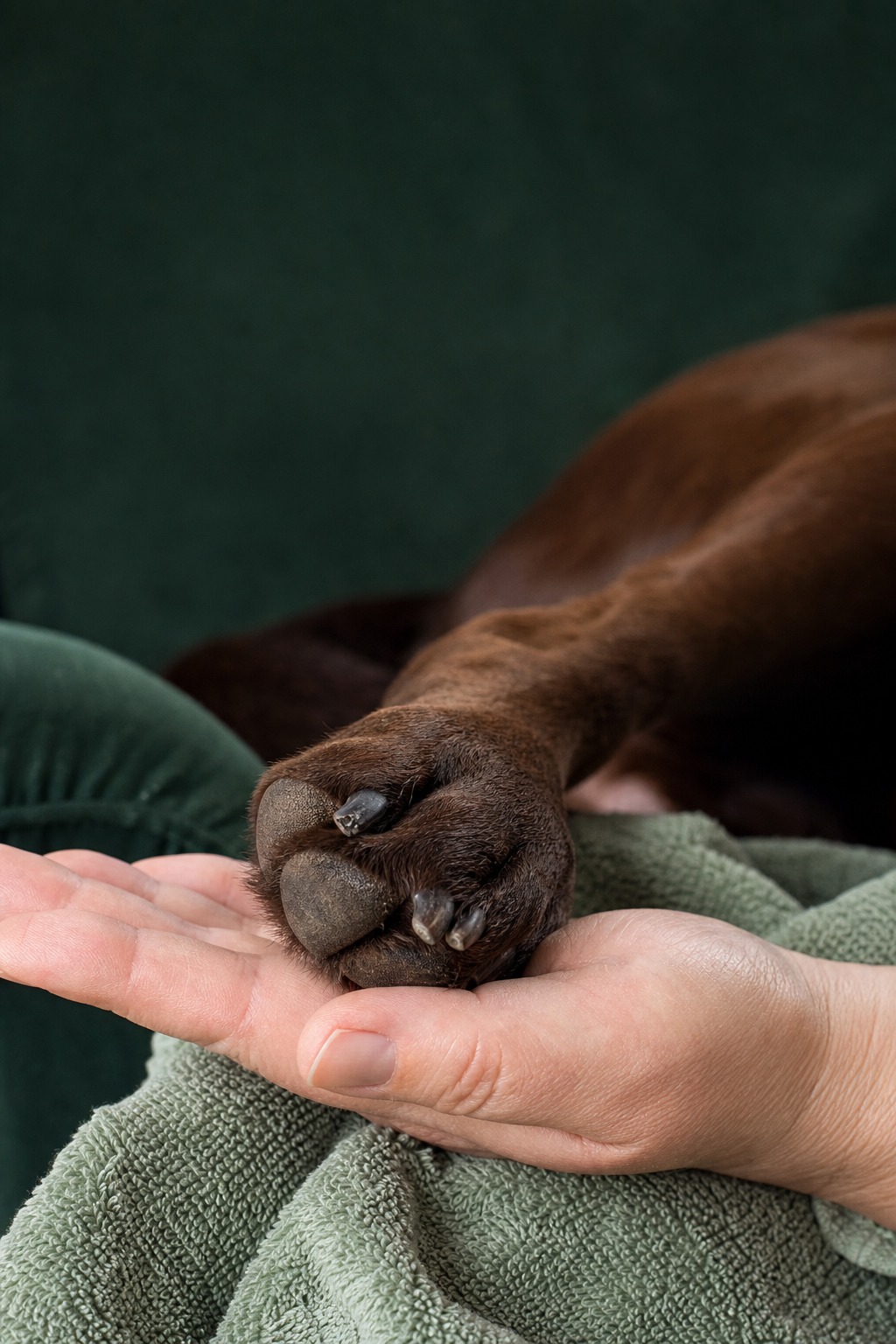
Almost every broken-nail guide gives you the same list of home remedies, and almost all of them bury the one decision that actually changes what you should do. Before you reach for gauze or styptic powder, you need to answer a single question: which of three injuries are you looking at? Two of them you can often handle at home. One of them you must not touch. Sort that in the first thirty seconds and the rest of this becomes simple. Get it wrong and you can turn a manageable injury into a bleeding, painful mess. So this starts with the triage, and everything else follows from it.
First, confirm it’s the nail at all
You’ll usually notice a sudden limp on one leg. Before you assume it’s the nail, get a good look at the whole paw, including between the toes and the webbing. A cut, a foxtail, an insect stinger, or another foreign object can all cause the same limp. Look closely at the nail bed too, because cracks and injuries often hide underneath the fur line right where the base of the nail meets the toe. Once you’ve confirmed it’s a nail, run the triage.
The three-way triage (memorize this part)
Every dog nail injury falls into one of three buckets, and the bucket tells you the plan.
Type 1: Completely broken off, some bleeding. This is the best-case scenario and almost always a home job.
Type 2: Cracked and loose, dangling. Home job only if it’s genuinely loose, think wiggly baby tooth ready to fall out.
Type 3: Cracked but still firmly attached, often with the quick exposed. This is the one you don’t touch. It needs a vet.
The single most common mistake pet parents make is treating a Type 3 like a Type 2, grabbing and pulling a nail that is still firmly rooted. That nail has a live blood vessel and nerve running through the thick part you’d be tearing, which is why professional removal is done under sedation. Pulling it at home means severe pain and heavy bleeding. When in doubt about loose versus attached, treat it as attached and Type 3.
Type 1: treating a clean break-off at home
When a nail has broken off with mild bleeding, you usually only need to stop the bleed. Apply steady pressure with gauze or a clean cloth and hold it for a full five to ten minutes without lifting to check, since peeking early disrupts the forming clot. Keep your dog calm while you do it, because excitement raises blood pressure and works against clotting.
If bleeding continues, pack styptic powder such as Kwik Stop around the nail and resume pressure for another five minutes. No styptic on hand? Flour or cornstarch can substitute in a pinch; their fine texture packs around the nail and helps a clot set. If the bleeding still won’t stop after all that, head to the ER. A nail should not bleed heavily for long.
Type 2: removing a truly loose nail
If the cracked nail is genuinely loose and dangling, you can remove it. Have someone gently and safely restrain your dog while you take it off with one quick, decisive pull. Only attempt this if the nail is truly ready to come off. Be careful, because even a loose nail can send a sharp jolt of pain, and a surprised dog may nip or snap. If there’s bleeding afterward, settle it with gauze, light pressure, and styptic powder as above.
Type 3: why this one is hands-off
A nail that’s cracked, painful, maybe bleeding, and still firmly attached needs professional care, especially if the quick is exposed. Treatment typically involves sedation plus pain medication, then cutting the damaged nail off just above the crack. Sedation isn’t optional pampering here; it’s because cutting through the live part of the nail is genuinely painful. Afterward the vet usually applies styptic powder and a bandage that stays on about 24 hours, buying a day of rest so a solid clot forms and the wound doesn’t reopen if it gets bumped.
These injuries need a professional, but they can usually wait until the next day if you can’t get an immediate appointment, unless your dog seems to be in extreme pain. In that case, don’t wait.
Preventing infection while you wait
Any time a toenail breaks, infection becomes a real concern. A dog’s feet are constantly on the ground, and the exposed quick is open to contamination. Nail-bed infections are intensely painful and can leave a toe hugely swollen and inflamed; because the nail bed sits against bone, a deep infection can reach the bone, which is serious and harder to treat. That’s the stakes behind keeping the wound clean.
If you can’t get to a vet right away, you can take these steps at home:
- If long hair covers the nail, gently trim it back with clippers, not scissors. Some dogs won’t tolerate this if their feet are sore.
- Rinse the foot with clean, lukewarm water and remove visible dirt or debris.
- Use a povidone iodine soak. In a bowl, add a little povidone iodine to lukewarm water until it’s the color of weak tea (it doesn’t take much), and have your dog stand with the foot in it for five to ten minutes. This may temporarily stain light fur.
- Pat the area dry.
- If there’s bleeding, apply gentle pressure plus styptic powder, flour, or cornstarch.
Keep your dog in a clean environment and limit outdoor time until the nail heals. Skip at-home bandaging, because it’s easy to wrap too tightly and cut off blood flow to the foot. Use an e-collar to stop constant licking, and repeat the iodine soaks twice daily until you can see your vet.
How long healing takes
Once the initial trauma settles, the exposed tissue usually becomes less sensitive within a few days to a couple of weeks. Much like smashing your own fingernail in a door, the sensitivity fades faster than the nail regrows. A dog’s toenails grow at roughly 0.7 to 2.1 mm per week, with the pace depending on age, environment, and overall health, so expect six to ten weeks for the nail to reach a normal length.
Cracked nails can bring complications. A weakened nail sometimes keeps splintering as it regrows and the dog bears weight on it; if a crack is worsening rather than healing, have your vet address it, since chronically broken nails become a source of pain and infection. Rarely, the nail bed itself is damaged, which can make the nail regrow in an odd shape or direction, or not at all. Check the injured nail at least weekly to confirm it’s regrowing steadily and looking normal.
When it isn’t just a broken nail: the pattern to watch for
Here’s the piece most first-aid guides leave out, and it matters. A single broken nail is an injury. But repeated breaks across several toes or multiple paws, nails that split, crumble, slough off, and grow back deformed, are not bad luck. That pattern points to a nail disease, most commonly symmetric lupoid onychodystrophy (SLO, also called SNMOD or idiopathic onychomadesis), an uncommon, likely immune-mediated condition in which the dog’s own immune system attacks the growth area of the nails.
The distinction is worth knowing because the two situations call for opposite responses. A one-off break is a wound you clean and protect. SLO is a chronic disease that no styptic powder, iodine soak, or bandage will resolve. It’s diagnosed by your vet based on the multi-nail pattern and history, and it’s typically managed long-term, often with omega-3 fatty-acid supplementation and, in more stubborn cases, immune-modulating medication. Response is slow because nails grow slowly, and treatment is frequently lifelong. So if your dog is a “serial nail-breaker,” the most useful first aid isn’t at the paw at all. It’s a vet visit to rule out a disease masquerading as clumsiness.
Preventing everyday nail injuries
For ordinary breaks, the best prevention is keeping nails trimmed, since short nails are far less likely to catch and tear. Trim at home if you’re comfortable, or have it done at the vet or groomer, keeping nails as short as possible without hitting the quick. And because a calm dog is a dog whose nails actually get trimmed, cooperative-care training pays off here: desensitize your dog to having their paws handled, pair trims with treats, and go one nail at a time. A dog who tolerates a trim is a dog whose nails stay short, and short nails are the single best protection against the cracks and tears covered here.
References
- VCA Animal Hospitals. “First Aid for Broken Nails in Dogs.” vcahospitals.com
- VCA Animal Hospitals. “Symmetric Lupoid Onychodystrophy in Dogs.” vcahospitals.com
- PetMD. “First Aid for a Dog’s Broken Nail.” petmd.com
- Edwards, Petra T., et al. “Puppy Pedicures: Exploring the Experiences of Australian Dogs to Nail Trims.” Applied Animal Behaviour Science, vol. 255, 2022, p. 105730. doi.org/10.1016/j.applanim.2022.105730
Common questions
Will my dog need pain relief?
It depends on how bad the break is. A clean break-off with mild bleeding usually doesn't. A cracked nail still attached at the quick often does, and your vet may prescribe a few days of pain medication so it can heal without your dog worrying at it.
Should I pull or trim the broken nail myself?
Only if the nail is completely broken off, or dangling by a thread like a loose baby tooth. A nail that is cracked but still firmly rooted should never be pulled or cut at home. That one needs sedation and a vet.
My dog keeps breaking nails on multiple paws. Is that normal?
No. Repeated breaks across several toes or paws can signal an underlying nail disease like symmetric lupoid onychodystrophy, not bad luck. That pattern is a reason to see your vet, because no amount of first aid fixes it.
Not a substitute for your vet. Our guidance is educational. For urgent symptoms, contact a vet or emergency clinic right away. Editorial standards
Dr. Nair is a veterinarian focused on diet and feeding. She covers everyday nutrition, treats, and the many "can they eat this?" questions owners ask, grounding each answer in what is actually safe and sensible for dogs and cats.
Meet our experts ↗Keep reading
 Health & WellnessIf You Can Hear Your Dog's Nails on the Floor, You're Already LateDr. Priya Nair · 9 min
 Health & WellnessYour Dog Isn't Being Dramatic About Their PawsDr. Amara Solis · 6 min
 Health & Wellness'Natural' Dog Shampoo Isn't a Safety Claim. Nobody Is Checking.Dr. Priya Nair · 7 min
 Health & WellnessBath Day Wrecks Your Back Because You're Doing It in the Wrong RoomLeila Torres · 6 min
 Health & WellnessYou'll Never Stop the Shedding. You Can Stop Finding the Hair.Sasha Ford · 7 min
 Health & WellnessThose Clicking Nails Aren't Cosmetic. They're Changing How Your Dog Walks.Dr. Amara Solis · 9 min