


Dog Eye Problems: The One Skill That Protects Your Dog's Sight
The difference between saving and losing a dog's vision is often hours. Here's how to triage an eye change fast, which breeds are pre-loaded for trouble, and what each condition means.
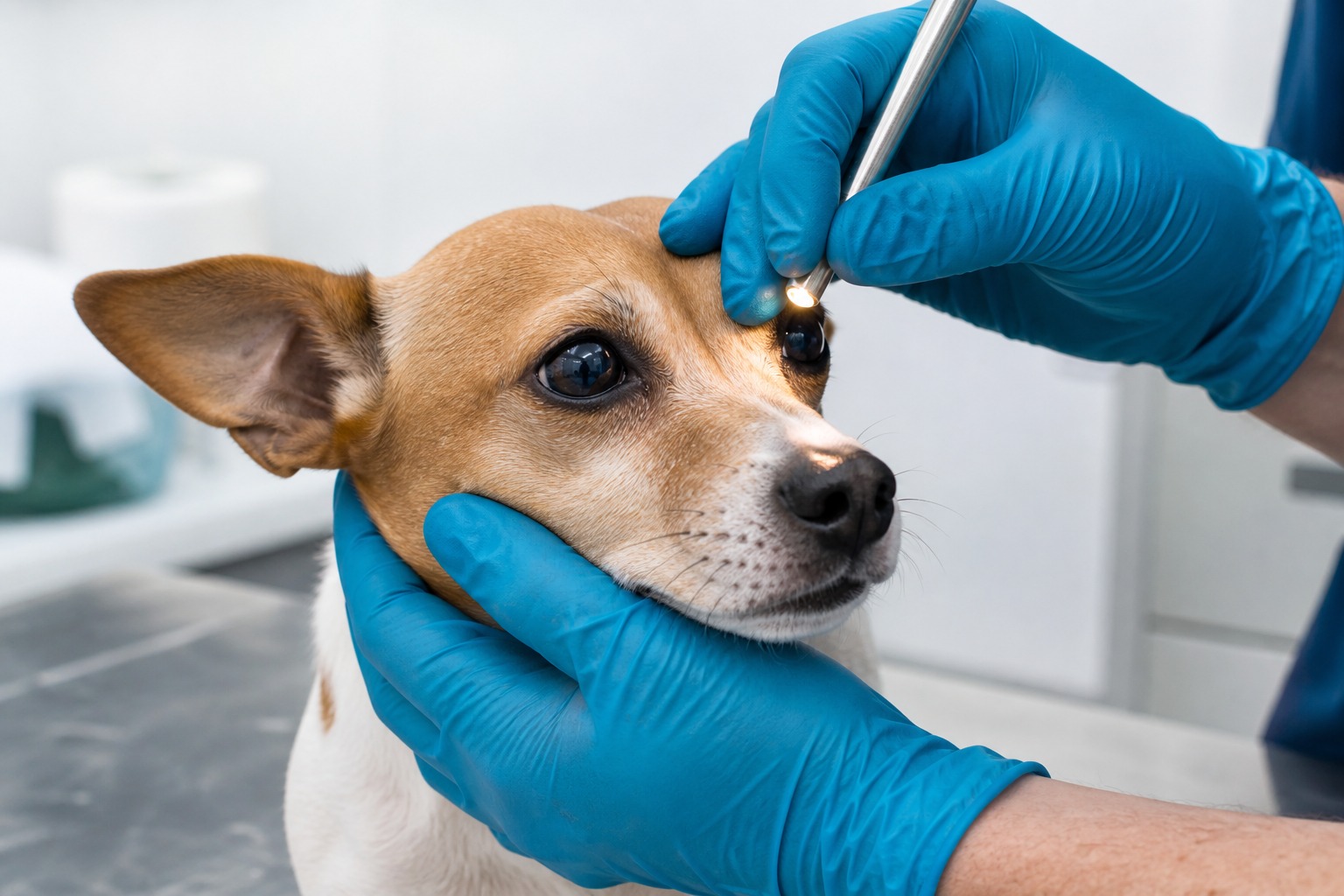
If you take one thing from this guide, make it this: with a dog’s eye, the clock is usually the enemy, and the skill that protects your dog’s sight is knowing how fast to move. A cloudy eye that appeared overnight, an eye that suddenly bulges, a dog that won’t open one eye, these are not “watch it for a few days” situations. Many canine eye conditions are highly treatable caught early and sight-ending caught late, and the window can be hours. So we’re going to start with triage, not anatomy. Learn the red flags first, learn which dogs are built for eye trouble second, and use the condition-by-condition section as reference when you need it.
Any sudden change in how a dog’s eye looks or how well they’re seeing deserves same-day veterinary attention, and some changes are true emergencies. Flat-faced breeds carry extra risk for many eye problems. When in doubt, it’s always safer to be seen than to wait.
Triage first: go-now versus call-today
Not every eye issue is a 2 a.m. crisis, but some are. Use these two lists to decide how fast to move.
Get to a vet or emergency clinic immediately if you see:
- A sudden bulging or displaced eye (this can be proptosis, an emergency)
- Sudden vision loss (bumping into things, freezing, new fear of moving)
- A cloudy, hazy, or bluish eye that appeared quickly
- Intense squinting, holding the eye shut, or obvious pain
- A pupil that’s suddenly much larger or smaller than the other, or won’t respond to light
- Any obvious injury or object in the eye
Call your vet the same or next day for:
- Yellow or green discharge, or heavy crusting
- Persistent redness
- Pawing or rubbing at the eye
- Excessive tearing with signs of irritation
- The third eyelid creeping across the eye
When you’re unsure which list you’re in, treat it as the more urgent one. The downside of an unnecessary vet visit is small; the downside of waiting on a corneal ulcer or glaucoma is your dog’s sight.
Which dogs are pre-loaded for eye trouble
Any dog can develop an eye problem, but brachycephalic (flat-faced) breeds are built for it. Pugs, French Bulldogs, English Bulldogs, Boston Terriers, Lhasa Apsos, and Bullmastiffs all carry the risk. The same skull shape that crowds their airways also gives them shallow eye sockets and eyes that don’t fully close, producing a cluster of problems grouped as brachycephalic ocular syndrome: eyes that can pop out of the socket after even minor trauma (proptosis), a tendency toward dry eye and corneal ulcers, and inward-rolling eyelids or stray facial hairs that scrape the cornea. If you own a flat-faced dog, your triage threshold should be lower, because their eyes have less margin for error. Beyond the brachycephalics, specific breeds carry specific risks (inherited cataracts, glaucoma, and PRA lists appear in the sections below), so knowing your breed’s weak spots is part of prevention.
How a dog’s eye works (and why they see the way they do)
A quick foundation makes the conditions below make sense. A dog’s eye works like a camera: light enters the clear cornea, passes the pupil (sized by the iris), and is focused by the lens onto the retina, a layer of color-sensing cones and motion-and-light-sensing rods that convert light into signals the optic nerve carries to the brain. Dogs differ from us in ways that matter clinically. They have only two cone types to our three, so they see fewer colors. They have a third eyelid (nictitating membrane) that protects and lubricates, and a reflective tapetum lucidum behind the retina that makes their eyes glow and boosts night vision. Their rod-heavy retinas make them excellent at detecting motion in dim light but less sharp overall than human eyes, and near vision is genuinely blurry in long-nosed breeds. The upshot: a dog can lose a surprising amount of vision before an owner notices, which is one more reason to act on the physical signs above rather than waiting for the dog to seem “blind.”
The conditions, grouped by what you’ll actually notice
When the eye looks red or irritated
Conjunctivitis is inflammation of the eyelid lining and the white of the eye, triggered by infection, a foreign object, allergies, dry eye, a scratch, or even smoke and dust. Treatment targets the inflammation and any infection. Eye infections (usually viral or bacterial, rarely fungal) show up as yellow-green discharge, crusting, redness, and discomfort, and are treated with medicated drops, sometimes plus oral medication. Uveitis, inflammation inside the eye, is more serious: it’s painful, makes the eye look red or cloudy, and usually develops secondary to trauma, infection, tick-borne disease, or autoimmune or metabolic disease, so treatment means calming the inflammation and hunting the underlying cause.
When the eye waters or tears constantly
Watery eyes (epiphora) happen for one of two reasons: too many tears from irritation, or poor drainage. Irritation comes from allergies, trauma, or infection; drainage fails when the nasolacrimal duct is blocked, so tears spill down the face and can stain fur. Clear tears with a comfortable eye usually aren’t a medical problem, but tearing alongside irritation should be checked.
When the eye looks cloudy
Cataracts, a clouding of the lens, are the most common cause of blindness in dogs. Most are inherited (a long breed list includes the American Cocker Spaniel, Boston Terrier, German Shepherd, Golden Retriever, Labrador Retriever, Miniature Schnauzer, Siberian Husky, Standard Poodle, and West Highland White Terrier), but diabetes, injury, poor nutrition, and aging also cause them. Surgery works: the clouded lens is removed and usually replaced with a plastic one.
The cataract surgery itself isn’t too stressful for most patients. What’s demanding is the recovery, the first few weeks are intensive, with an Elizabethan collar around the clock and several medications to stay on top of. Owners who go in prepared for that do really well.
Cloudiness can also signal glaucoma (below), which is why a newly hazy eye belongs on the go-now list rather than being written off as “just aging.”
When pressure builds: glaucoma
Glaucoma is elevated pressure inside the eye, caused when fluid drains more slowly than it’s produced, and it damages the retina and optic nerve while being genuinely painful. Primary (inherited) glaucoma affects both eyes over time and shows up in breeds like the American Cocker Spaniel, Basset Hound, Beagle, Boston Terrier, Chow Chow, Great Dane, and Siberian Husky. Secondary glaucoma is triggered by a dislocated lens, injury, or tumor and may hit one eye. Treatment ranges from drops and oral medication to surgery or, in severe cases, removal of the eye. Glaucoma remains one of the harder conditions to manage well, which is exactly why catching the early pressure signs fast matters so much.
When the surface is injured: corneal ulcers
Corneal ulcers are slow-healing, inflamed sores on the surface of the cornea, usually from injury, treated with antibiotics and close monitoring. Small, short-nosed breeds with large, exposed eyes, Boston Terriers, Pekingese, and Shih Tzus, are especially prone. An ulcer can worsen fast, so squinting and pain in these breeds is a same-day call.
When the eyelids don’t sit right
Entropion (the eyelid rolls inward, letting lashes scrape the cornea) shows up most in young, large-breed dogs like Bullmastiffs, Chow Chows, Labrador Retrievers, and Shar-Peis, and usually needs surgery. Ectropion (the lid turns outward or sags) is the classic droopy-eyed look of Saint Bernards, Bloodhounds, and Great Danes; because the lid can’t spread tears properly, the eye dries and inflames, and treatment ranges from lubricating drops to surgery. Cherry eye is the tear gland of the third eyelid popping forward as a smooth pink lump in the inner corner; brachycephalic breeds are at higher risk, and repositioning surgery is often the better fix over medical management.
When tear production fails: dry eye
Dry eye (keratoconjunctivitis sicca) develops when the eye doesn’t make enough tears, from inherited tendency (American Cocker Spaniel, English Bulldog, Pug, Lhasa Apso, Shih Tzu, and West Highland White Terrier are prone), an immune reaction, injury, or a drug side effect. It’s not to be ignored, because dry eyes easily progress to conjunctivitis or ulcers. Treatment includes artificial tears, diligent hygiene, anti-inflammatories, and cyclosporine ointment (Optimmune) to stimulate tear production.
When the eyes bulge or point wrong
A dog’s eyes should be equal in size and sit comfortably in their sockets. Bulging from displacement (proptosis) or enlargement (buphthalmos, often from glaucoma) is a medical emergency, get seen immediately. Lazy eye (strabismus), eyes that don’t point the same direction, is usually harmless when it’s congenital, but a sudden change in eye position can mean a tumor, neurological problem, or trauma and must be evaluated right away.
When the retina is the problem
Progressive retinal atrophy (PRA) is a group of inherited disorders in which the retina’s rods and cones die off; there’s no treatment, and onset and speed vary by breed (early in the Cardigan Welsh Corgi, Collie, and Irish Setter; adult-onset in the American Cocker Spaniel, Labrador Retriever, and Miniature Poodle). Retinal detachment can come from infection, injury, or high blood pressure, and small toy breeds that shake toys hard, Boston Terriers, Jack Russell Terriers, and Shih Tzus, can literally tear a retina loose that way, going from seeing to blind in a moment.
How eye problems are treated, and why speed decides the outcome
The single best thing you can do for your dog’s vision is catch problems early, when they’re most treatable. Many issues can be handled in general practice; when they can’t, your vet refers you to a veterinary ophthalmologist. Be aware there are only about 300 board-certified veterinary ophthalmologists in the United States, so a referral may mean travel and, sometimes, a wait, which is one more reason not to sit on early signs while the appointment window fills. An eye issue is never a “watch and wait at home” situation.
Can you prevent dog eye problems?
You can’t prevent inherited disease, but you can lower risk. Keep your dog away from animals that don’t want to play nice and clear of smoke and aerosol sprays that irritate eyes. Stay current on vaccines and parasite prevention to head off infections and tick-borne disease. Feed a good diet with plenty of exercise to ward off diabetes, a common route to cataracts. Good general care and good eye care overlap more than owners expect.
Two advances worth knowing about
First, at-home genetic testing for PRA and other inherited eye diseases has expanded to cover far more breeds than it once did. A simple cheek-swab DNA panel can flag risk before any symptom appears, giving you and your vet a head start on monitoring, valuable if you have a purebred or are considering breeding. Second, cataract surgery keeps refining: modern phacoemulsification, the same ultrasound-based technique used in human cataract surgery, is now widely available at veterinary ophthalmology referral centers, with success rates often reported around 90 percent in well-selected patients. The catch hasn’t changed, the earlier the cataract is caught and the healthier the rest of the eye, the better the result, which loops right back to this guide’s core message: don’t wait on a cloudy eye.
Frequently asked questions
Can I use over-the-counter human eye drops on my dog?
No. Human eye products can contain ingredients that worsen a dog’s condition. Always check with your vet first.
Is there a home remedy for dog eye problems?
Only gentle cleaning of mild crusting or clear discharge with a warm, damp cloth. The underlying cause still needs a veterinary diagnosis.
When is a dog eye problem an emergency?
Sudden vision loss, a bulging or displaced eye, a rapidly cloudy eye, intense pain or squinting, or a sudden change in pupil size are all emergencies. Get seen immediately.
References
- Nagasawa, M., et al. Oxytocin-Gaze Positive Loop and the Coevolution of Human–Dog Bonds. Science, 2015.
- Costa, D., et al. Clinical Signs of Brachycephalic Ocular Syndrome in 93 Dogs. Irish Veterinary Journal, 2021.
- Gelatt, K. N., MacKay, E. O. Prevalence of the Breed-Related Glaucomas in Pure-Bred Dogs in North America. Veterinary Ophthalmology, 2004.
- American College of Veterinary Ophthalmologists: Inherited Eye Disease and Genetic Testing
Not a substitute for your vet. Our guidance is educational. For urgent symptoms, contact a vet or emergency clinic right away. Editorial standards
Dr. Park is a board-certified emergency and critical care specialist. She reviews our health and safety content for clinical accuracy and contributes guides on recognising urgent conditions. Her focus is helping owners act quickly and correctly when it matters most.
Meet our experts ↗Keep reading
 Health & WellnessLeptospirosis Used to Be a Country-Dog Problem. Now It's Hunting City Dogs.Dr. Ravi Mehta · 8 min
 Health & WellnessYour Dog Can Take the Anti-Aging Pill Today. Read the Fine Print First.Dr. Ravi Mehta · 7 min
 Health & WellnessThe Dog Longevity Pill Is Almost Real. It Won't Buy You Forever.Dr. Ravi Mehta · 8 min
 Health & WellnessYour Straining Dog Might Not Be Constipated at AllDr. Lena Park · 6 min
 Health & WellnessA Dog Who Won't Drink Water Is a Clock, Not a QuirkDr. Lena Park · 7 min
 Health & WellnessMud Won't Hurt Your Dog. What's Living In It Might.Dr. Priya Nair · 6 min