


Cats vs. Dogs: Who Actually Has the Bigger Brain?
"Which is smarter, cats or dogs?" is the wrong question. Score it honestly across neurons, training, and problem-solving and you get three different winners, which is the real answer.

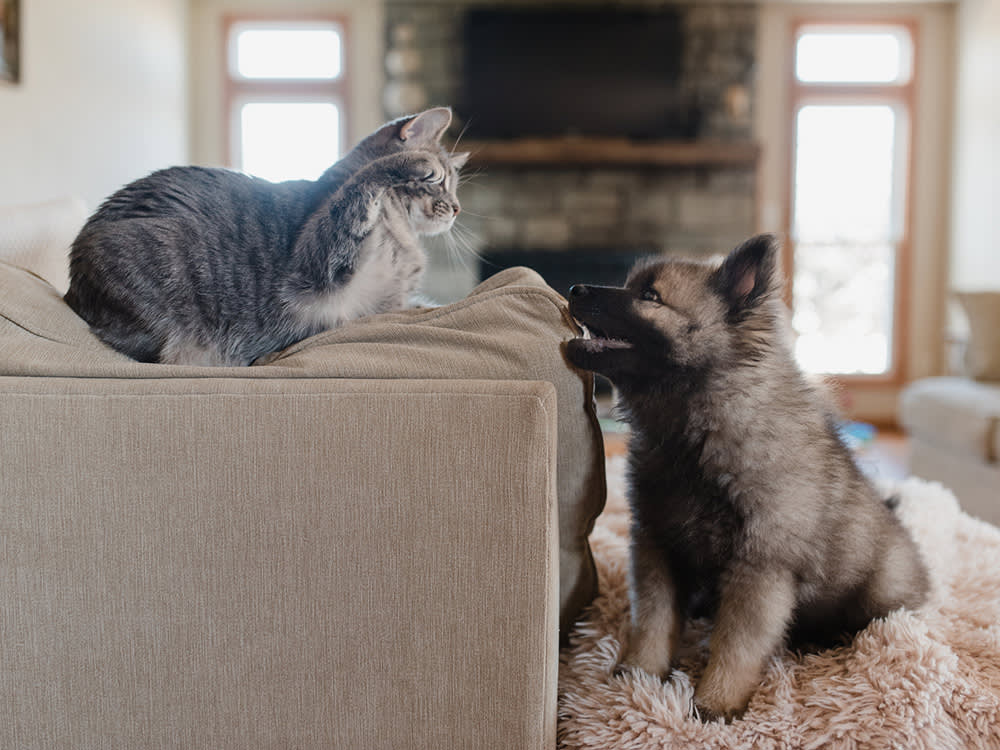
Ask “which is smarter, my cat or my dog,” and you have already made a mistake, just not the one you think. The mistake is assuming the question has an answer. It does not, and the reason it does not is the genuinely interesting part.
Intelligence is not one dial that runs from dim to brilliant. It is a bundle of separate abilities (memory, problem-solving, trainability, social reading, spatial navigation) and cats and dogs are built to be good at different ones. Score them honestly and you do not get a winner. You get a scoreboard where cats take some categories, dogs take others, and the final tally tells you more about your own definition of “smart” than about either animal.
Brian Hare, who founded Duke University’s Canine Cognition Center, framed it more cleanly than anyone:
“Asking which species is smarter is like asking if a hammer is a better tool than a screwdriver. Each tool is designed for a specific problem, so of course it depends on the problem we are trying to solve.”
So let’s stop looking for a champion and do the thing the usual version of this article skips. Let’s actually run the scoreboard, category by category, and see who wins each round and why.
Round one: raw brainpower, counted properly
The instinct is to reach for brain size, and the instinct is wrong. Brain size mostly tracks body size. A cow has a bigger brain than a cat and nobody is nominating cattle for the dean’s list. What researchers actually care about is the number of neurons in the cerebral cortex, the wrinkled outer layer where the heavy cognitive lifting happens.
In 2017, neuroscientist Suzana Herculano-Houzel and her team did exactly this count, using a technique she pioneered: dissolve the cortex into what she has cheerfully described as a “brain soup,” then count the free-floating neuron nuclei. The headline numbers settled a piece of the debate that brain size never could.
Dogs carry roughly 530 million cortical neurons. Cats carry about 250 million. A single Golden Retriever in the study topped out at 627 million, the most of any carnivore the team measured.
“The absolute number of neurons an animal has, especially in the cerebral cortex, determines the richness of their internal mental state and their ability to predict what is about to happen in their environment based on past experience,” Dr. Sasha Ford, a Pet Times contributor who studies comparative cognition, notes. “By that specific yardstick, the dog simply has more processing hardware than the cat.”
Here is the wrinkle that almost never makes it into the cat-versus-dog version of this story, and it is the most useful thing in this section. The same study counted a raccoon’s cortex at roughly 438 million neurons, packed into a brain the size of a cat’s. Neuron-for-gram, the raccoon is one of the densest brains measured. The lesson is not “raccoons are geniuses.” It is that the relationship between size, neurons, and intelligence is loose enough that you should be suspicious of anyone who settles the whole question with one number, including this one.
Round one goes to dogs, on cortical neurons. But hold that result loosely, because hardware is not the same as how the animal uses it.
Round two: trainability, and why it flatters dogs
Dogs are famously trainable, and they earned the reputation honestly. Canine researcher Stanley Coren’s work puts the average dog’s working vocabulary at about 165 words, signals, and gestures, roughly the language range of a human two-year-old, with the top 20 percent of dogs learning around 250. Border Collies, Poodles, and German Shepherds sit at the top of that distribution.
But trainability measures something narrower than intelligence: it measures how badly an animal wants to do what you ask. Dogs were shaped by domestication to work alongside humans and to find human approval rewarding. That motivation is doing a lot of the work we credit to “smarts.”
Cats were never bred for biddability, so a cat that ignores your “sit” cue is not failing an intelligence test. It is declining to take it. Give a cat a clear reward it actually values and a clicker to mark the behavior, and cats reliably learn to sit, target, high-five, and come when called. The gap is in motivation, not capacity.
Round two goes to dogs, with an asterisk the size of a cat: this category rewards the animal that cares about pleasing you, which is a real cognitive trait but not the only one that counts.
Round three: solving a problem alone
Now flip the lens, and watch the scoreboard flip with it. Hand a cat and a dog the same sealed puzzle with food inside, and a revealing difference shows up. The dog often works at it briefly, then turns to look at the nearest human, essentially asking for help. The cat keeps working.
That persistence is why cats have a reputation as the better independent problem-solvers, and the evidence backs it. Cats have been documented opening doors, working latches, and manipulating levers to reach food. Their independence, the same trait that tanks their trainability score, makes them more likely to brute-force a solution rather than outsource it.
The catch is that the dog’s “give up and ask” is not really giving up. It is a sophisticated social strategy: when you have a cooperative partner, recruiting them is often smarter than struggling solo. So the exact same puzzle scores a point for feline problem-solving and a point for canine social intelligence at the same time. Which is the whole thesis in miniature.
Round three goes to cats, on independent problem-solving.
Round four: reading the room
Dogs are exceptional at reading humans. They track our gaze, follow a pointed finger (a skill even chimpanzees struggle with), and pick up on emotional cues with startling sensitivity. A 2017 University of Arizona study found dogs’ cooperative-communication skills landed in the same range as two-year-old children’s and outperformed chimpanzees’. Tens of thousands of years of living in our houses selected hard for dogs that could understand us.
Cats read humans too, more than their aloof reputation suggests. They recognize their owner’s voice and respond to human emotional cues. They are also strong at social learning, picking up behaviors by watching, which is itself a marker of advanced cognition. But their social cognition is tuned to a smaller, less human-centric world than the dog’s.
Round four goes to dogs, on social and emotional intelligence.
Round five: the senses behind the scores
One reason these animals “think” so differently is that they live in different sensory worlds, and any fair scoreboard has to note it. A cat’s cortex devotes more real estate to vision and movement, which feeds their stealth and hunting precision, and their hippocampus, the brain’s spatial-memory hub, is highly developed for navigation. A dog’s cortex leans more toward the regions tied to social processing and communication.
In other words, the cat’s brain is partly optimized to ambush prey in three dimensions, and the dog’s is partly optimized to cooperate with a pack, including the strange two-legged members of it. Neither is “smarter.” Each is a different specialist, which is exactly what evolution produces when two species solve different survival problems.
Round five is a draw, because it is the round that explains why a single winner was never coming.
The final tally
Add it up and the scoreboard reads dogs three, cats one, one draw, which looks decisive until you remember that you chose those five categories. Weight problem-solving and long-term memory more heavily and the cat closes the gap fast. Weight trainability and human-reading and the dog runs away with it. The “answer” was hiding in your scoring rubric the entire time.
So the honest verdict is the one Brian Hare gave us at the start: hammer versus screwdriver. Your dog is brilliant at the things dogs were built for, and your cat is brilliant at the things cats were built for, and the only species in this comparison capable of being smug about the result is the one reading the article.
The genuinely practical takeaway has nothing to do with who won. Both species have more cognitive capacity than most homes ever ask them to use, and a bored brain of either kind tends to invent its own entertainment, usually at your expense. Food puzzles, scent games, trick training, and novel toys give that hardware a job. Whichever animal you live with, the smartest thing you can do is give that mind something to chew on.
References
- Jardim-Messeder, Débora, et al. “Dogs Have the Most Neurons, Though Not the Largest Brain: Trade-Off between Body Mass and Number of Neurons in the Cerebral Cortex of Large Carnivoran Species.” Frontiers in Neuroanatomy, vol. 11, 2017. https://www.frontiersin.org/journals/neuroanatomy/articles/10.3389/fnana.2017.00118/full
- “Which Are Smarter, Cats or Dogs? We Asked a Scientist.” PBS NewsHour, 2017. https://www.pbs.org/newshour/science/which-are-smarter-cats-or-dogs-we-asked-a-scientist
- Coren, Stanley. “Dogs’ Intelligence On Par With Two-Year-Old Human, Canine Researcher Says.” American Psychological Association, 2009. https://www.apa.org/news/press/releases/2009/08/dogs-think
- MacLean, Evan L., et al. “Individual Differences in Cooperative Communicative Skills Are More Similar Between Dogs and Humans Than Chimpanzees.” Animal Behaviour, 2017. https://news.arizona.edu/news/dogs-toddlers-show-similarities-social-intelligence
- Bradshaw, John. “Cat Sense: How the New Feline Science Can Make You a Better Friend to Your Pet.” Basic Books, 2013.
Common questions
Is a cat smarter than a dog?
There is no single answer, because there is no single test. When researchers counted cortical neurons, dogs came out ahead (about 530 million to a cat's 250 million). When researchers measure independent problem-solving, cats often win. When they measure trainability and social cognition, dogs win. Each species is optimized for a different job, so 'smarter' depends entirely on which job you are scoring.
How many words can a dog understand?
The average dog learns about 165 words, signals, and gestures, putting them roughly on par with a human two-year-old's vocabulary, according to canine researcher Stanley Coren. Dogs in the top 20 percent of intelligence can learn around 250 words. Border Collies sit at the top of that range.
Can cats be trained like dogs?
Yes. Cats respond well to clicker training and a high-value food reward, and they can learn sit, high-five, targeting, and recall. They are simply less motivated to perform for human approval than dogs are, so training a cat is about finding the right incentive rather than overcoming any lack of ability.
Do cats or dogs solve problems better?
Cats tend to be quicker at solving a problem on their own, because their independence pushes them to keep working a puzzle that a dog would abandon to ask a human for help. That help-seeking is itself a sign of dogs' social intelligence, so the same behavior reads as a strength for both species depending on what you value.
Does a bigger brain mean a smarter animal?
Not by itself. Raw brain size tracks body size more than intelligence. Researchers care more about the number of neurons in the cerebral cortex, the brain's processing layer. By that measure dogs outscore cats, but a brown bear has a huge brain and far fewer cortical neurons than a dog, which shows why size alone is a poor guide.
Dr. Park is a board-certified emergency and critical care specialist. She reviews our health and safety content for clinical accuracy and contributes guides on recognising urgent conditions. Her focus is helping owners act quickly and correctly when it matters most.
Meet our experts ↗Keep reading
 TrainingForget Whether Your Pet Likes Your Singing. This Is What Calms ThemJordan Ellis · 6 min
 TrainingThe 'Let Them' Theory Works on Pets. Because It's Just Management With Better PR.Dr. Priya Nair · 7 min
 First DaysYour Puppy Thinks the Cat Is a Toy. Fix That Before They Ever Meet.Dr. Mara Chen · 9 min
 First DaysYou Want a Dog. You Have a Cat. Here's How to Not Blow It.Dr. Nina Kohl · 10 min
 First Days'Fighting Like Cats and Dogs' Is a Myth. Bad Introductions Aren'tDr. Amara Solis · 6 min
 TrainingThe 'Mlem' Means Nothing. The Lick Underneath It Can Mean a Lot.Dr. Nina Kohl · 8 min