


Your Cat Started Itching After the Dog Arrived. The Dog Is the Least Likely Culprit
Yes, cats can be allergic to dogs, but it's an uncommon answer to a common worry. Here's how vets actually work backward from an itchy cat, and why blaming the new puppy is usually a wrong turn.

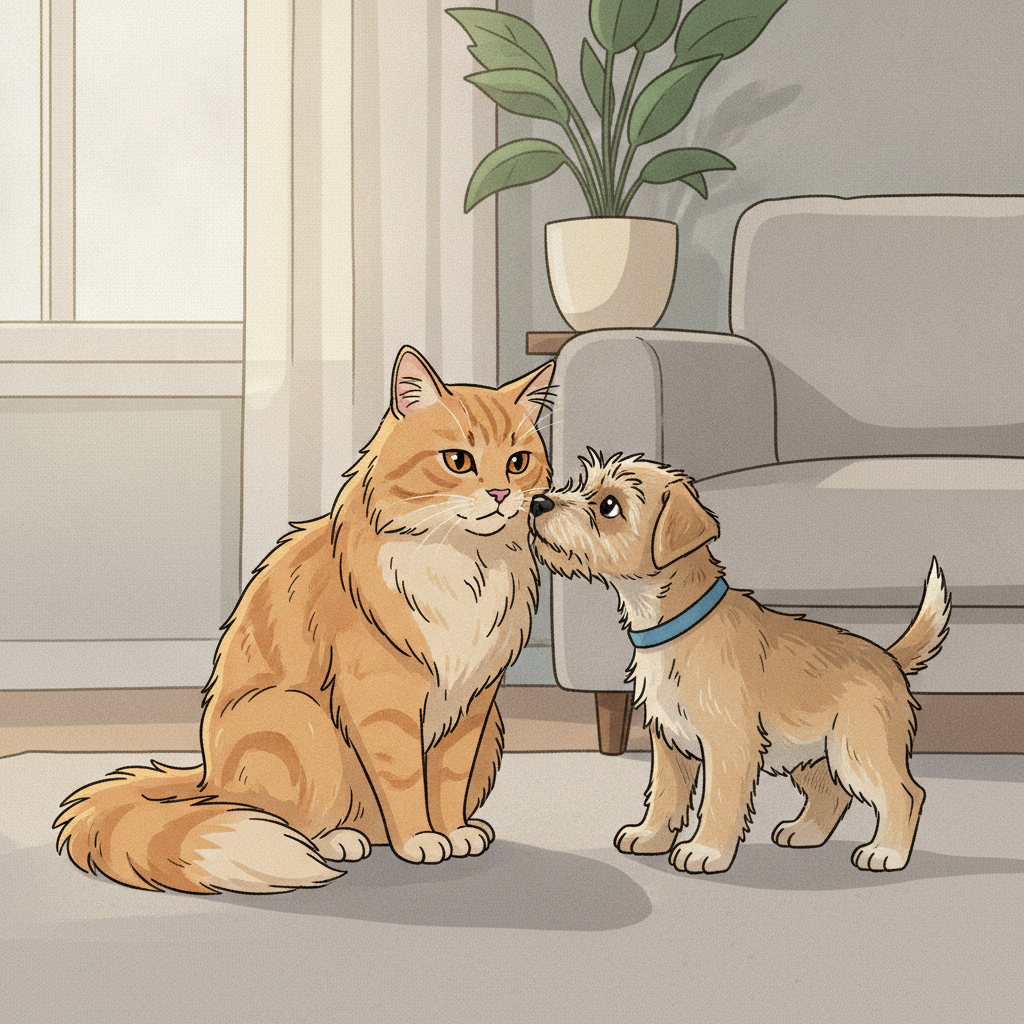
A new puppy comes home, and within a few weeks the resident cat is scratching, maybe with a bald patch or two. The conclusion writes itself: the cat is allergic to the dog. It is a reasonable guess, and cats can be allergic to dogs, so it is not even a wrong guess on its face. But it is usually a wrong first guess. Of all the things that make a cat itch, an allergy to canine dander sits near the bottom of the list. The more useful question is not “is my cat allergic to the dog,” it is “what actually changed when the dog arrived,” because the honest answer is often something the dog brought with it rather than the dog itself. This article walks the problem the way a vet does: from the most likely cause to the least.
Why timing fools us
The brain loves a clean story, and “we got a dog, the cat started itching, therefore the dog” is a clean story. The trouble is that getting a dog changes a lot of variables at once. There is a new animal, yes, but also new traffic in and out of the house, possibly new fleas, a new schedule, new stress, and a calendar that has simply moved forward into a new allergy season. Any of those can be the real driver. So before pinning it on dog dander, it is worth ruling out the suspects that are both more common and easier to fix.
The likelier culprits, roughly in order
Fleas. This is the big one, and it is often the dog’s fault without the dog being the allergen. A new pet is a classic way for fleas to enter a household, and flea-bite hypersensitivity is one of the most common causes of feline itch. A single bite can set off an outsized reaction. Rigorous flea control on every pet in the home is step one, full stop.
A seasonal or environmental allergy that simply flared. Many cats have environmental allergies (to pollen, mold, dust, mites) that wax and wane with the seasons and tend to worsen with age. If the puppy arrived in spring, the timing may be pure coincidence with pollen season.
Food sensitivity. Food allergy produces the same itchy, over-groomed, sometimes patchy picture and has nothing to do with the dog. It is diagnosed only by an elimination diet, not by blood or skin tests.
Skin infection or parasites. Mites, lice, ringworm, and bacterial or yeast infections all mimic allergy. Some are secondary to the scratching itself, which is why an itchy cat can spiral.
And, finally, the dog. A cat truly allergic to canine dander is possible but uncommon. It belongs at the end of the workup, after the above are excluded, not at the beginning.
When someone brings me an itchy cat and a brand-new puppy, I’m far more interested in whether that puppy brought fleas than in whether the cat is allergic to the dog. Nine times out of ten the fix is something other than the dog, which is a relief, because nobody wants to rehome a pet over an itch we can actually treat.
What an allergic cat actually looks like
Allergy in cats is mostly a skin story, and it can be subtle because cats hide it. They may do their scratching when you are not watching, or simply over-groom until you notice the result rather than the act. Watch for:
- Intense scratching and over-grooming, often focused on reachable areas like the belly, flanks, and neck.
- Hair loss and broken hair from that sandpaper tongue and inflamed follicles.
- Redness and skin lesions, sometimes moist, raw, and painful where self-trauma has opened the skin.
- Recurrent ear infections, since the same inflamed skin lines the ear canal.
- Small bumps (papules or pustules) early on, and darkened, thickened skin (hyperpigmentation) later, often from secondary yeast overgrowth.
- Less commonly, sneezing and congestion, and a known link between allergic skin disease and feline asthma.
Because all of these overlap with infections, parasites, and food reactions, the symptom list tells you a cat is uncomfortable, not what is causing it.
How vets actually pin it down
If the workup gets to environmental allergy testing, there are two tools, and they answer different needs:
- Serum allergy testing uses a blood sample sent to a lab. It is easy on the cat and can be run even while the cat is on steroids or antihistamines, but results vary by lab and can throw false positives or negatives.
- Intradermal skin testing injects tiny amounts of various allergens into the skin and reads the reactions. It targets the affected organ directly and tests a wider panel, but it requires sedation and a two-to-four-week washout off steroids and antihistamines, which is hard on a severely itchy cat.
There is genuine debate about which performs better in cats, so vets choose based on the individual. Crucially, neither test diagnoses food allergy reliably; the gut behaves differently, and an ingredient elimination trial remains the gold standard there.
Managing it, including when the dog really is the trigger
The good news, and the part worth leading with for any worried owner, is that even a real dog allergy almost never means giving up a pet. Management works:
- Cut the allergen load. If the dog is confirmed as a trigger, regular dog baths remove dander before it sheds into the environment. Add HEPA filtration, frequent vacuuming and washing of bedding, and wiping pets down after time outdoors.
- Immunotherapy. Once testing identifies the specific triggers, allergy immunotherapy, given as under-the-skin injections or an under-the-tongue liquid, gradually desensitizes the cat. It is not instant (figure on three-plus months) but controls symptoms in more than half of treated cats.
- Medication for flares. For an active flare, vets may reach for steroids like prednisolone or immunosuppressants like cyclosporine. Some use oclacitinib (Apoquel), though it is not labeled for cats and its efficacy in them is unproven. Antihistamines may reduce how often flares occur but do little once one is underway.
The bottom line
Cats can be allergic to dogs, but a freshly itchy cat next to a freshly arrived dog is far more often a story about fleas, seasons, food, or infection than about the dog itself. Resist the tidy conclusion, work the problem from most likely to least with your vet or a veterinary dermatologist, and treat the cause you actually find. And if the dog does turn out to be the culprit, take heart: a bath schedule, a clean-air routine, and the right therapy almost always let your two pets keep sharing a home.
References
- Bajwa, Jangi. “Atopic dermatitis in cats.” The Canadian Veterinary Journal, vol. 59, no. 3 (2018): 311-313.
- International Society of Feline Medicine / AAFP: Feline Atopic Skin Syndrome
- Jensen-Jarolim, Erika, et al. “Pollen Allergies in Humans and their Dogs, Cats and Horses.” Clinical and Translational Allergy, vol. 5, no. 15 (2015).
- Moriello, Karen A., et al. “Prevalence of positive aeroallergen reactions in cats with small-airway disease.” Veterinary Dermatology, vol. 18, no. 2 (2007): 94-100.
Common questions
My cat started scratching right after we got a puppy. Isn't that proof?
Not on its own. Timing feels like proof but is not. Fleas brought in by the new dog, a seasonal allergy that happened to flare, food sensitivity, or a skin infection can all produce the same itch. A vet works through those before landing on the dog.
How do vets test what a cat is allergic to?
Two main tests. Serum allergy testing uses a blood sample and can be done while a cat is on some medications. Intradermal testing injects tiny amounts of allergens into the skin and is more precise but needs sedation and a medication washout. Neither reliably diagnoses food allergy, which requires an elimination diet.
If the dog really is the trigger, do I have to rehome it?
Almost never. Allergies are usually managed, not cured by separation. Regular dog baths to cut dander, HEPA filtration, frequent cleaning, and, when needed, immunotherapy or medication from your vet typically let cat and dog keep living together.
Not a substitute for your vet. Our guidance is educational. For urgent symptoms, contact a vet or emergency clinic right away. Editorial standards
Dr. Park is a board-certified emergency and critical care specialist. She reviews our health and safety content for clinical accuracy and contributes guides on recognising urgent conditions. Her focus is helping owners act quickly and correctly when it matters most.
Meet our experts ↗Keep reading
 Health & WellnessRingworm Isn't a Worm. It's a Fungus That Can Jump to You.Dr. Priya Nair · 6 min
 Health & WellnessA Scab Is Not a Diagnosis. It's a Map.Dr. Mara Chen · 7 min
 Health & WellnessThat Scaly Patch on Your Cat Could Be Yours NextDr. Nina Kohl · 7 min
 Health & WellnessA Hot Spot Is the Smoke, Not the Fire. Here's How to Find What's Burning Your Cat.Dr. Amara Solis · 7 min
 Health & WellnessThe Benadryl Trap: Why the Go-To Cat Remedy Usually Fails, and What WorksDr. Mara Chen · 9 min
 Health & WellnessThe Twitchy Back Is Usually Nothing. The One Time It Isn't Has a Name.Dr. Lena Park · 8 min