


The Real Question Isn't 'Is the Litter-Robot Good?' It's 'Is Your Cat a Candidate?'
An automatic litter box doesn't succeed or fail at random. It fails predictably for certain cats and wins for certain households. Here's how to tell which one you have before spending $700.

I love my senior cat, Pumpkin, more than almost anything, but his litter setup is a saga. A normal box is too cramped for him, so he uses what is essentially a litter crate: a three-foot-long, 18-inch-high storage bin that swallows a whole 32-pound bag of litter and needs scooping at least twice a day, or he pees on the bed, sometimes with me still in it.
I tell you this because when I tested an automatic litter box, it did not work for Pumpkin, and the easy conclusion would be “automatic boxes are overhyped.” That conclusion is wrong, and the reason it is wrong is the whole point of this piece. These machines do not succeed or fail at random. They fail for a specific, predictable set of cats and win for a specific, predictable set of households. The useful question is never “is the Litter-Robot good?” It is “is your cat a candidate?” Answer that before you spend the money, and you will not be cleaning a couch at 4 p.m. like I was.
What an automatic litter box actually does
After your cat finishes, the box sifts, flushes, or collects the waste on its own, dropping it into a sealed drawer so your contact with it is minimal. Instead of scooping daily, sometimes several times a day in a multi-cat home, you empty a drawer every week or two and top off litter when the app tells you to. The better units also seal odor away and, increasingly, double as a quiet health monitor, which I’ll come back to, because it is the most underrated reason to own one.
The machine I tested, and the one you’d buy now
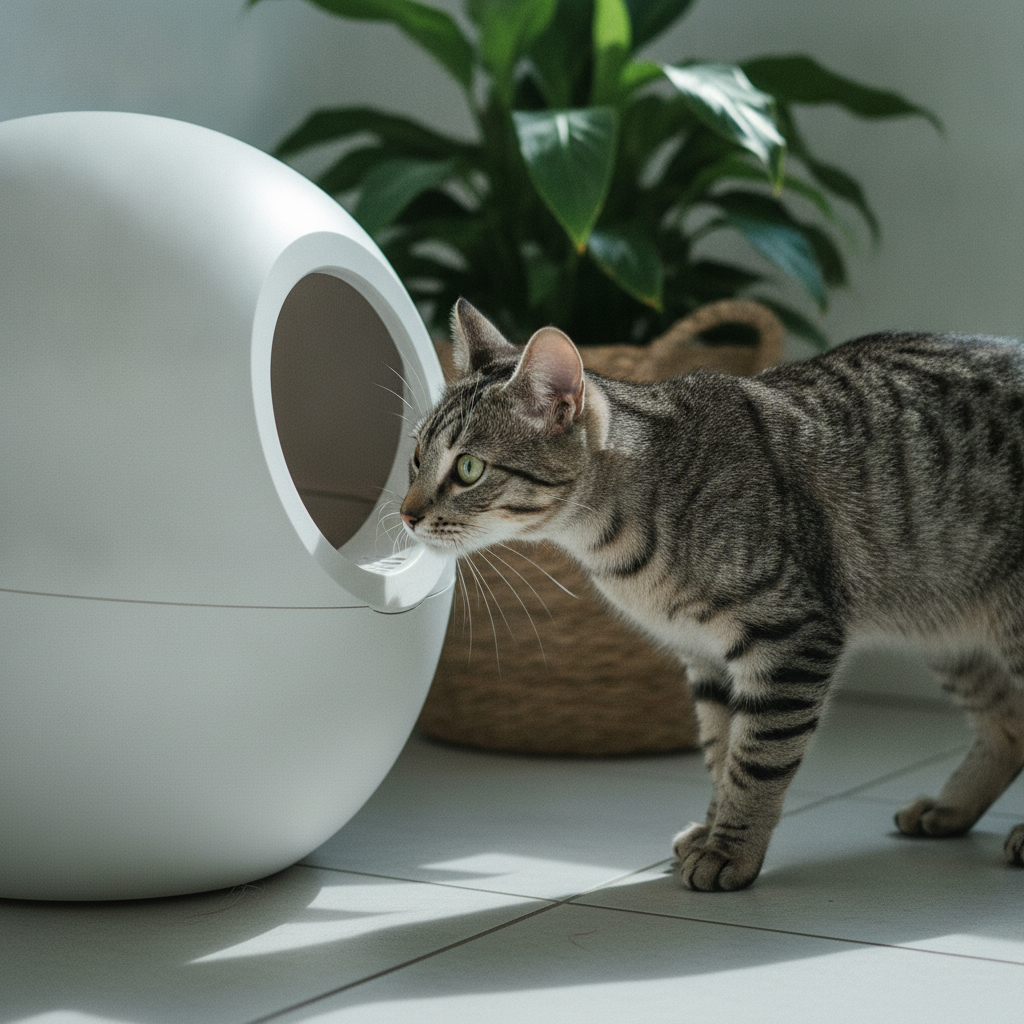
I tracked down the fanciest box I could find at the time: the Litter-Robot 3 Connect by Whisker, then about $550, the Mercedes-Benz of litter boxes, as every review will tell you. It is a sleek, WiFi-connected, egg-shaped chamber that rotates to sift, and it connects to an app that monitors litter and waste levels. It is light enough to move easily and simple to set up, with the usual caveat that any connected device can hit a pairing snag that sends you to customer service.
Worth knowing if you’re shopping today: the lineup has moved on. The current flagship is the Litter-Robot 4, around $699, and the upgrades are not cosmetic. It is rated for cats from 3 to 25 pounds, so it fits both kittens and large breeds; it clears up to four cats; and its standout feature is per-cat tracking. Using weight sensors, it logs how often each cat goes and what each one weighs, surfacing a seven-day history in the Whisker app. That matters because litter-box habits are one of the earliest windows into feline health, and a box that flags a sudden change in frequency or a slow weight drop is doing real veterinary surveillance between checkups. The footprint is about 22 by 27 by 29.5 inches with a roughly 15.8-inch square entry, so measure your nook before you commit.
The honest field test
I had always found automatic boxes ugly, expensive, and seemingly a nightmare to clean, and I genuinely could not picture spending that much on something my cat poops in. But the dream of never scooping again was loud.
I went in skeptical, partly because of a warning from feline behaviorist Dr. Nina Kohl.
“I’m cautious about automatic boxes,” Dr. Kohl told me. “Some cats adapt beautifully. Plenty of others are frightened of them, and the transition can be genuinely hard. Even on the big units, the spot where the cat actually goes is small, and that alone puts some cats off.”
She told me she has recommended one exactly once.
“One client’s cat demanded a spotless tray, a single visit’s evidence left behind and he took his business to the carpet. No human can stand guard with a scoop around the clock, so the self-cleaning unit fixed something no amount of diligence could.”
Of that whole conversation, I, being an all-or-nothing person, heard four words: “it solved a problem.” I set the box beside Pumpkin’s crate and let him acclimate for a few days before plugging it in, then watched him watch it run a cycle. He wasn’t scared, exactly, but he wasn’t curious either. I salted the chamber with his old litter, spritzed it with catnip, and finally stopped cleaning his old box to nudge him toward the new one.
For two and a half days he fouled his crate into one continuous urine clump dotted with turds, and I kept him out of my room to save the mattress. By the third afternoon I missed our naptime cuddles and watching him climb into an overflowing box ten times a day (he goes a lot) was breaking my heart, so I called it. Too late: I came home to Pumpkin on the couch next to a pee stain the size of a large pizza. Two hours, a bottle of vinegar, and the original litter went back in his old box.
Why it failed for him, and why that’s actually useful
Looking back, I never should have meddled. Pumpkin is 16. He has medical issues that sometimes require a cone, and a cone plus an egg-shaped chamber is a geometry problem with no good answer. He is the textbook profile of a cat these boxes are wrong for. That is not the machine failing; that is me ignoring the candidate question.
And the contrast proved the point. I gave the box to a friend with two cats, who not only use it reliably but play in it. She’s thrilled: zero smell, and she empties the drawer once every week or two. A company rep told me 96 percent of cats who try the Litter-Robot transition to it fully. I have no way to audit that figure, but my n-of-two, one disaster, one delight, tracks with the larger truth: it comes down to the cat.
The box didn’t win or lose on its own merits. It lost for a 16-year-old cone-wearing cat and won for two young, easygoing ones. The hardware was the same.
Is your cat a candidate? A real checklist
Before you buy, count how many of these describe your cat. The more that do, the more carefully you should think.
Lean toward caution if your cat:
- Is a senior, or has mobility or balance issues
- Periodically wears a cone or recovery suit
- Startles easily at mechanical noise and movement
- Is particular about litter depth or insists on a specific litter type (many automatic boxes only work with certain litters)
- Has GI issues that make for messy, frequent, or urgent visits
- Has a history of going outside the box when stressed
Lean toward yes if you:
- Work long hours or travel often
- Have a physical limitation that makes daily scooping hard
- Run a multi-cat household and want one fewer chore
- Have young, adaptable, noise-tolerant cats
- Want the per-cat health tracking the newer models offer
Dr. Kohl’s framing is the one to keep in mind: “When in doubt, size up. A cat needs roughly half again its own body length to pivot comfortably, and no gadgetry excuses cramming them into a phone booth. The machine has to serve the cat’s sense of space, not the other way around.”
If you’re a candidate, transition slowly
The mistake I made was speed. Do the opposite.
“Let the cat set the calendar,” Dr. Kohl says. “Pressure is the fastest way to sink the whole project. Park the new unit right beside the old box, and give it weeks if weeks are what it takes. Keep the litter familiar. Then catch them doing it right, every successful visit earns a treat, a scratch, whatever currency your cat trades in.”
Concretely: leave the unit unplugged for a few days so your cat meets it as furniture before it ever moves or hums, and keep the old box right beside it the whole time so there is always a familiar fallback. Pull the old box only once the new one is clearly winning, not a day before.
The case for the health angle
If I were buying today, the per-cat weight and frequency tracking would carry more weight in my decision than the no-scooping convenience, and that surprised me. Dr. Kohl is right that an app is not the same as eyes on the litter, and daily scooping is still the gold standard for noticing “outputs.” But for a multi-cat home where you can’t always tell who did what, a box that quietly logs each cat’s weight trend and bathroom frequency is catching exactly the early signals, of kidney disease, diabetes, urinary trouble, that owners most often miss. That is a genuine reason to consider one even if you don’t mind scooping.
The drawbacks, stated plainly
- Tech can fail. Sensors and motors break, and a box that doesn’t fully self-clean becomes more hassle than help.
- Noise frightens some cats. It’s the number-one reason for rejection, and some cats never get over it.
- Cleaning isn’t zero. You skip daily scooping but still monitor litter, troubleshoot, and do periodic deep cleans, which can be fiddlier than a basic pan, especially with a messy cat.
- The price is real. At $699 for the current model, this is a considered purchase, not an impulse buy.
One genuine safety net specific to the Litter-Robot: there’s a 90-day return window for a full refund. If you’ve read the candidate checklist and you’re still not sure, that trial period is the responsible way to find out.
The bottom line
An automatic litter box is a fantastic tool for the right cat and a $700 stressor for the wrong one, and the difference is knowable in advance. It suits busy owners, multi-cat homes, people for whom scooping is physically hard, and anyone who’d value automatic health tracking, paired with a young, easygoing, noise-tolerant cat. It’s a poor fit for seniors, cone-wearers, the noise-averse, and the litter-particular. Pumpkin was the second kind, and I learned it the expensive way. Run the checklist first, transition slowly if you proceed, and use the return window if your cat votes no, because no one talks a cat into a box it has decided against.
References
- Whisker. “Litter-Robot 4 Specifications and Capacity.”
- Forbes Personal Shopper. “Litter-Robot 3 vs. 4: The Big Differences, Based on Cat Testing.” 2025.
- Cornell Feline Health Center. “Feline Behavior Problems: House Soiling.”
- American Association of Feline Practitioners. “Litter Box Guidelines.”
Common questions
How much does the Litter-Robot cost in 2026?
The current flagship, the Litter-Robot 4, runs about $699. The older Litter-Robot 3 Connect, which is what I tested, sold for around $550. Both are at the premium end of the category.
Will my cat actually use an automatic litter box?
Most do, with a slow transition, but the cats who struggle are predictable: seniors, cats who wear a cone, cats spooked by noise, cats picky about litter depth or type, and cats who reject any used box. If yours fits several of those, weigh it carefully.
Can I use the Litter-Robot with multiple cats?
Yes. The Litter-Robot 4 is cleared for up to four cats and can even track each cat's weight individually through the app. The more cats use it, the more often you'll empty the waste drawer.
How often do I clean an automatic litter box?
The app pings you when the drawer is full or litter is low. Plan on wiping the whole unit down monthly and a deeper clean once a year, more if your cat has GI issues.
Nina Vasquez writes about life at home with pets and the relationships at the heart of it. Her work covers day-to-day living, people-and-pet stories, and the products that fit into a real household, with a warm, grounded take on everyday pet ownership.
Meet our experts ↗Keep reading
 Product Picks8 Litter Box Enclosures That Hide the Box Without a Cat BoycottSara Lim · 8 min
 Product PicksThe 9 Best Outdoor Cat Trees of 2026, Reviewed for CatiosSasha Ford · 15 min
 Product Picks6 Eco Cat Swaps That Don't Feel Like a SacrificeSara Lim · 5 min
 Product PicksThe Tofu Litter That Ended My Cat's Bathroom BoycottDr. Priya Nair · 4 min
 Product PicksThe Best Kitten Litters of 2026, and the Safety Rule That Comes FirstSara Lim · 19 min
 Product PicksMost Kittens Should Never Wear a Diaper. If Yours Truly Needs One, Read This.Dr. Mara Chen · 6 min