
Finding a cat to love is easy. Finding a cat tree you can stand to look at is the hard part. The market is a wall of bland beige carpet towers, and most of us eventually surrender to one, park it in the least visible corner, and apologize to our interiors. Which is why stumbling onto Cat Haus feels less like shopping and more like relief: someone finally built cat furniture with an actual point of view.
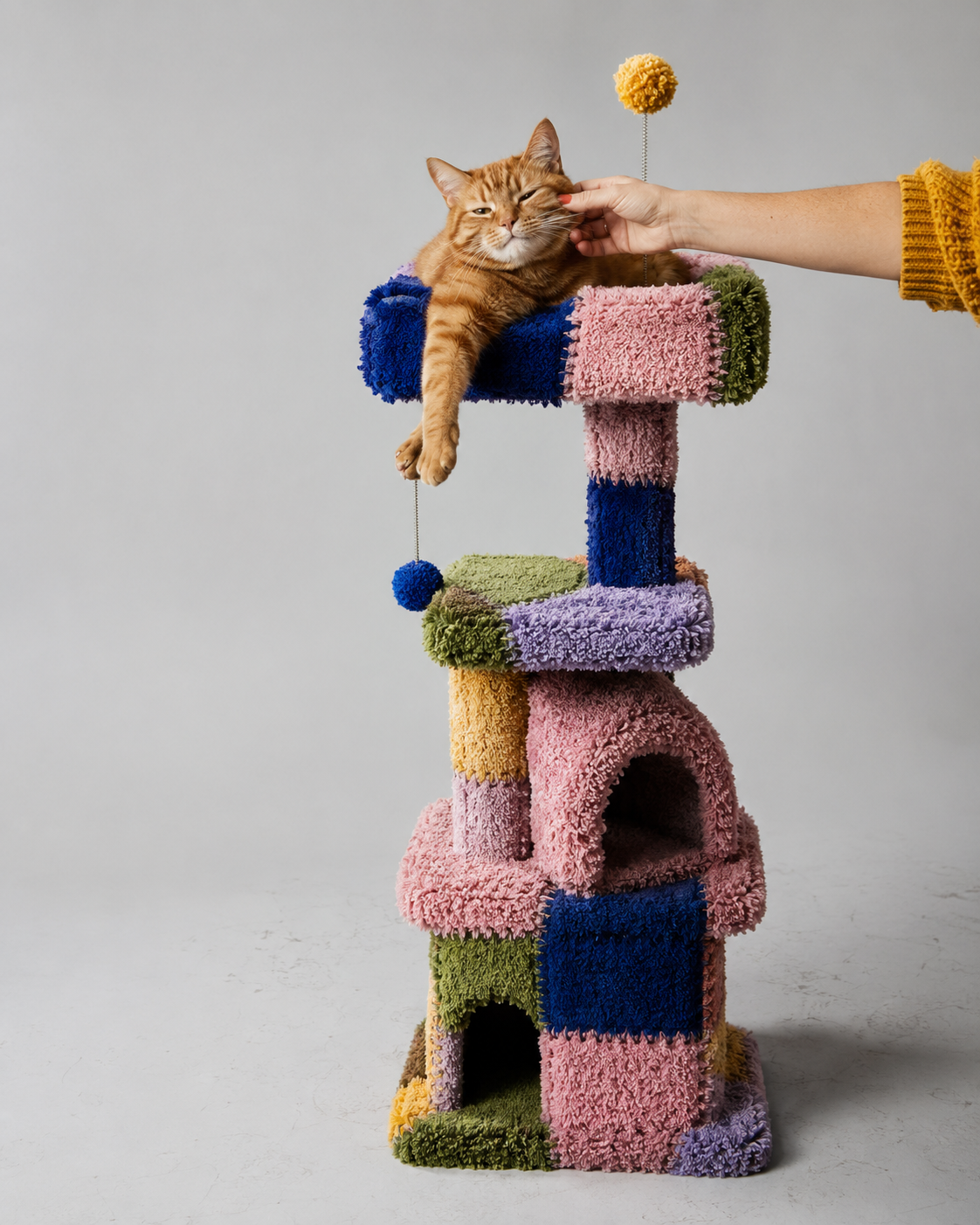
A Cat Haus condo looks like a piece of soft sculpture that a cat happens to live on. Multi-level towers wrapped in shaggy patchwork, clashing pinks and cobalts and mossy greens, pom-poms on springs, the whole thing closer to a brightly painted Miami bungalow than to anything in a pet aisle. If your search history contains the phrase “non-ugly cat furniture,” this is where that search was always headed.
Blame the cat
The origin story belongs, appropriately, to a cat. Founder Lora Lombardi credits her gray tabby, Tuesday, who helped launch the business without meaning to, by systematically making their mark on the human furniture in their former Portland home. The choice became obvious: keep sacrificing the sofa, or build the cat something better than the sofa.
Lombardi describes the mission in her own words: “Born from the general need for more attractive intentional objects, CAT HAUS brings style, design and sustainability to the wildly bland mass produced cat tree marketplace.”
Junkyard couture
The sustainability half of that mission is not garnish. The materials for the multi-level condos come from warehouse scraps, junkyard finds, and Craigslist freebies, entirely up-cycled, which means every tower is one of a kind by construction rather than by marketing. It is a neat inversion of the usual cat-furniture math: instead of new materials made to look disposable, disposable materials made into something you keep.
The cats, for their part, get exactly what a scratcher-tower-condo is supposed to provide, elevation, texture, and something that is unambiguously theirs, with the shag-carpet abundance cats have endorsed since the 1970s. The humans get the rarer thing: a cat tree that improves the room it stands in.
What’s new since this was written
Cat Haus is still very much alive. As of this year the brand sells through its own site, cathaus.world, where each piece is made in the USA, by hand, to order, by Lombardi herself, with the operation based back in Portland, Oregon. There is also a custom option, where you can commission a Haus built around your space and your cat.
The made-to-order model is worth knowing before you fall in love: these are not warehouse items, so expect a wait that matches the handmade reality. For a piece of furniture your cat will use daily for a decade, and one that doubles as the best conversation piece in the room, it is the good kind of wait.