


Your Cat Doesn't Know You're Pregnant. It Knows Your House Is Changing
The 'my cat knew before the test' stories are real, but they're not mind reading. Here's what your cat is actually tracking during pregnancy, and the one safety fact that matters more than whether it 'senses' anything.

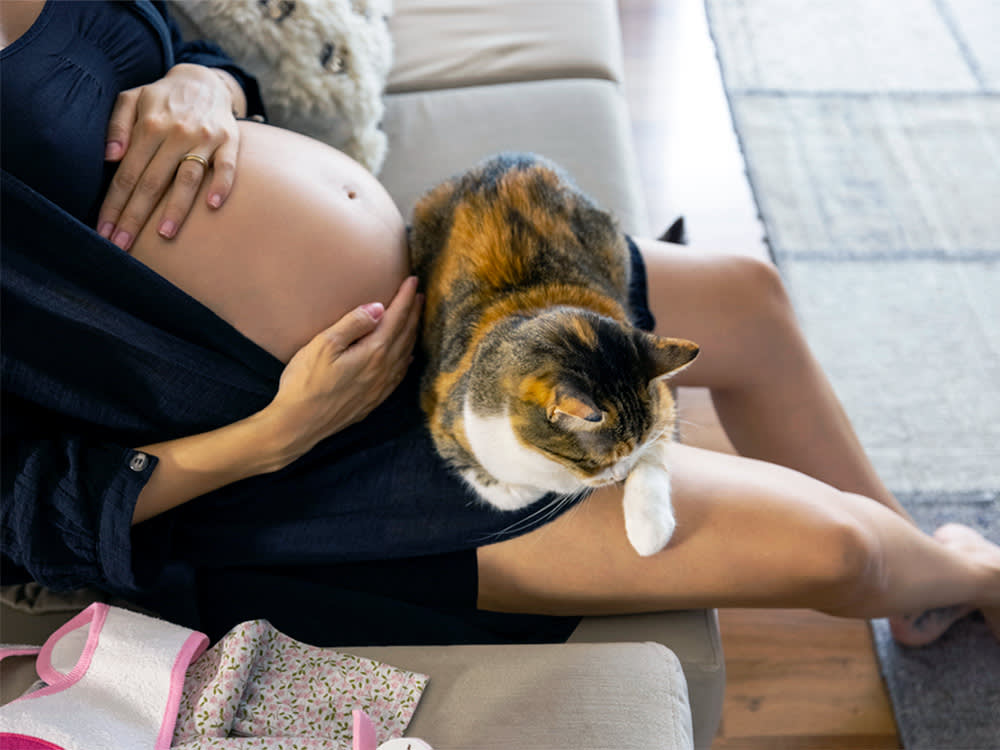
Almost every expecting cat owner hears the same line: the cat knew before the test did. And the stories are real, the lap-glued cat, the one suddenly sleeping against the belly, the one that got weird weeks before the announcement. But “the cat knew” is the wrong frame. Your cat can’t hold the concept of pregnancy in its head at all. What it can do, brilliantly, is notice that its entire world is quietly reorganizing, and react to that. Once you see it that way, two things get easier: you stop expecting feline ESP, and you focus on the one part of cohabiting-while-pregnant that actually deserves your attention.
What your cat is really reacting to
Strip out the magic and a cat in a pregnant household has plenty of genuine signals to work with, none of which require it to understand why.
The biggest one is the least romantic: the house is changing. Cats are creatures of habit to an almost comic degree, and pregnancy quietly rewrites the routine long before there’s a baby. Furniture moves. A spare room fills with boxes, then a crib. Your schedule shifts, your energy dips, your movement slows. A cat tracks all of that with no idea what it’s building toward.
Cats live by pattern, so the first thing they register isn’t your hormones, it’s the disruption to their environment. Rearranged rooms, new objects, a different daily rhythm, an owner who’s tired or nauseous. That’s the data they’re actually responding to, and it’s available long before any baby arrives.
Layered on top are real physical changes a cat is well equipped to notice. A cat’s sense of smell runs roughly 14 times more sensitive than ours, and pregnancy does shift your scent: hormone surges can increase sweating, and vaginal secretions change as pH rises to fight infection. There’s a temperature angle too, often overlooked, a pregnant body runs about 0.4 degrees Fahrenheit warmer on average, a change you won’t feel but a cat curled against you easily could. And the behavioral shifts of early pregnancy, nausea, mood swings, are exactly the kind of thing a cat reads off your face and your tone.
So a cat has scent, warmth, routine, and your own behavior to go on. What it doesn’t have is any concept of pregnancy. It’s reacting to a changing person and a changing home, not to a positive test.
Can a cat actually smell the pregnancy itself?
This is where the science is honest about its limits, and it’s worth being clear, because the “14 times stronger nose” stat gets stretched into proof it isn’t.
We know some trained dogs can flag certain medical conditions by scent, and a handful of studies suggest cats can pick up on some illnesses by smell too, though feline scent-detection is far less precise and far less studied than the canine version. The chemistry of early pregnancy is real and early: human chorionic gonadotropin (hCG), the hormone pregnancy tests look for, plus surging progesterone and estrogen, all begin rising as soon as six to 10 days after ovulation.
But “the hormones exist and the nose is sharp” is not the same as “the cat detects the pregnancy.”
“We can’t rule out that a cat smells some hormonal change, and we can’t confirm it,” Dr. Nair says. “What I’d push back on is the leap from ‘cats have an incredible nose’ to ‘cats know you’re pregnant.’ Those are different claims, and only the first one has evidence behind it.”
The cleaner read, and the one the newer research supports, is that cats are constantly gathering chemical information about the specific humans they live with, not running a pregnancy diagnostic. A 2025 study in PLOS One showed cats can tell their owner’s scent from a stranger’s by smell alone, and a 2023 study in Scientific Reports found cats react differently to human body odors tied to specific emotions, most strongly to the scent of fear. The picture that emerges isn’t a cat detecting pregnancy. It’s a cat that’s always reading you, and that picks up the side effects of pregnancy along with everything else.
The reaction is your cat’s personality, turned up
If there’s a single rule for how cats respond to a pregnancy, it’s this: whatever your cat already is, expect more of it. Big household change tends to amplify a cat’s existing temperament rather than create a new behavior.
“Every cat is its own small universe, and the pregnancy doesn’t override that, it exaggerates it,” Dr. Nair says. “A clingy cat gets clingier. A skittish cat hides more. A cool, independent cat may not react at all. None of those is the cat ‘knowing.’ It’s the cat being itself under stress.”
In practice that shows up as a few recognizable patterns. Anxious or sensitive cats may overgroom, eat less, start eliminating outside the litter box, or rub compulsively on you and the furniture. Protective cats follow you room to room, plant themselves in your lap, and go hypervigilant. Affectionate cats knead, purr, and lap-sit more. Attention-seekers ramp up demands for play and contact. Independent cats shrug and carry on. You might see one of these, several, or, honestly, nothing at all, and none of it is a verdict on the pregnancy.
The famous belly-kneading, the cat “making biscuits” right on the bump, falls in here too. It’s generally harmless to the baby. The one real medical caveat has nothing to do with kneading and everything to do with the litter box, which brings us to the part that actually matters.
The one thing that’s worth getting right: toxoplasmosis, demystified
Of everything in this topic, this is the part with real stakes, and it’s also the part that gets people needlessly scared into rehoming a perfectly safe cat. So here’s the practical version.
Toxoplasmosis is an infection caused by a parasite that can be present in cat feces, and a first-time infection during pregnancy can pose a risk to the baby. That’s the legitimate reason for caution. But the logistics work strongly in your favor, and most coverage skips the detail that makes the whole thing manageable: the parasite’s eggs (oocysts) shed in cat feces are not infectious the moment they land in the box. They need at least 24 hours, often one to several days, sitting in the litter to “sporulate” and become capable of infecting anyone.
That single fact is the entire game plan. If the box is scooped daily, the feces are gone before they can become infectious. So the standard, vet-backed advice is straightforward: have someone else handle the litter box for the duration of the pregnancy if you can. If you truly can’t, scoop daily, wear disposable gloves, and wash your hands thoroughly afterward. It’s also worth knowing the bigger exposure routes are often outside the litter box entirely, undercooked meat and unwashed garden produce or soil, so gloves for gardening and careful kitchen habits matter just as much.
What you almost certainly do not need to do is give up your cat. With daily scooping or a delegated box, the risk drops to negligible, and an indoor cat that doesn’t hunt is unlikely to be shedding the parasite in the first place. If you’re worried about a specific situation, your OB and your vet can talk through it, including whether testing makes sense.
Setting the household up before the baby
Since most of what looks like “sensing” is really your cat reacting to upheaval, the most useful thing you can do is make the upheaval gentle. Keep the cat’s world as predictable as you can while everything else changes. Introduce the nursery in stages instead of transforming a room overnight. Set up the crib early so it stops being a novelty. And get ahead of the new soundscape: play recordings of baby cries and coos at low volume, paired with treats or play, so by the time a real baby is crying at 3 a.m. your cat already files that sound under “good things happen now,” not “alarm.”
Do that, and the question shifts from the fun-but-unanswerable “did my cat know?” to the one that actually shapes the next year: is my cat set up to take a new family member in stride? That one you can control.
References
- Concha, A., et al. “Behavioral Responses of Domestic Cats to Human Odor.” PLOS One, 28 May 2025
- d’Ingeo, Serenella, et al. “Relationship Between Asymmetric Nostril Use and Human Emotional Odours in Cats.” Scientific Reports, 2023
- Centers for Disease Control and Prevention. “Toxoplasmosis: Epidemiology & Risk Factors.” CDC DPDx
- American Veterinary Medical Association. “Toxoplasmosis.”
Common questions
Can male cats sense pregnancy?
Sex and breed don't seem to matter. What predicts whether a cat reacts is temperament, history, and how bonded it is to you, not whether it's male or female.
How early can a cat react to pregnancy?
There's no reliable answer, because there's no proof cats detect pregnancy itself. The body's chemistry starts shifting as early as six to 10 days after ovulation, so an unusually sensitive cat could in theory notice scent or routine changes early, but most reactions track visible household changes, not a hidden test result.
Do cats get clingy when you're pregnant?
Some do, some get standoffish or territorial, and plenty don't change at all. Clinginess is the most-reported reaction but it's far from guaranteed. It's a personality story, not a pregnancy one.
Is it safe to keep my cat while pregnant?
Yes, for the vast majority of cat owners. The real concern is toxoplasmosis from cat feces, and it's manageable: hand off litter-box duty, or scoop daily with gloves and wash up, because the parasite needs at least 24 hours in the litter to become infectious.
Dr. Nair is a veterinarian focused on diet and feeding. She covers everyday nutrition, treats, and the many "can they eat this?" questions owners ask, grounding each answer in what is actually safe and sensible for dogs and cats.
Meet our experts ↗Keep reading
 LivingYour Cat Picks the Foot of the Bed on Purpose. Here's the LogicClaire Sutton · 6 min
 LivingShe Says 'Meow' Instead of 'Hello.' Meet Fashion's Most Committed Cat Lady.Claire Sutton · 4 min
 LivingThe Three Ways a Cat Lowers Your Anxiety (and the One Thing Research Can't Say)Dr. Priya Nair · 6 min
 TrainingCat Behavior Has a Photo Problem. Someone Finally Drew Their Way Out of It.Dr. Mara Chen · 7 min
 LivingThe Year a Cat Won an Oscar — and 6 More Feline Moments That Ruled 2025Sasha Ford · 5 min
 Living95% of Them Kept the Cat: What a Loneliness Study Proved About FosteringNina Vasquez · 5 min