


The Worst Thing You Can Do to a Botfly on Your Dog Is Squeeze It
The lump under your dog's skin is alarming, but the real danger is the instinct to pop it. Here is why squeezing a botfly larva can trigger a life-threatening reaction, and what to do instead.

The lump appears almost overnight. You are scratching your dog’s neck and your fingers catch on a firm swelling with a tiny hole in the center, and if you look long enough, something inside it moves. The natural human response is to grab it and squeeze. Do not do that. With a botfly, the squeeze is more dangerous than the worm.
A botfly larva (genus Cuterebra) is a parasite that ends up under a dog’s skin by accident. On its own, a single larva extracted properly is usually a minor veterinary visit. What turns it into an emergency is almost always the removal, specifically a ruptured larva. Understanding why is the difference between a quick fix and a frightening one.
Why squeezing is the real hazard
When a Cuterebra larva sits under the skin, its body is a sealed packet of foreign proteins your dog’s immune system has never catalogued. Pop that packet by squeezing, and all of those proteins flood the surrounding tissue at once. The immune system can respond with a violent hypersensitivity reaction, and in the worst cases that reaction escalates to full anaphylaxis within minutes, with swelling, a crash in blood pressure, and respiratory distress. Dogs have died this way, not from the parasite but from the attempt to remove it.
This is the piece most owners never hear, and it reframes the whole problem. The warble is not a pimple, and it should never be treated like one. The goal of removal is to get the larva out intact, which is precisely why veterinarians do it rather than leaving it to a squeeze in the backyard.
The larva is essentially a balloon full of allergens. Pop it and you can dump that allergen load into the bloodstream all at once. I have seen owners who meant well turn a fifteen-minute extraction into an anaphylaxis emergency. The single best thing you can do is keep your hands off it and call us.
A vet removes a botfly by gently enlarging the breathing pore, then easing the whole larva out with forceps so it never bursts. Afterward they flush the cavity with sterile saline, debride any dead tissue, and the wound heals open from the inside over the following weeks. Antibiotics go on board if there is any sign of secondary infection. None of that is something to improvise at home.
How to recognize a warble
A botfly site is distinctive once you know what you are looking at:
- A firm, swollen lump, usually on the head, neck, or trunk
- A single small hole in the center, the larva’s breathing pore
- Movement inside the opening if you watch closely
- Oozing discharge, sometimes streaked with pus or blood
- Redness, swelling, or obvious tenderness when touched
- Persistent licking or scratching at one specific spot
In more advanced cases a dog may go off food and turn lethargic. Those are signs to move quickly rather than wait.
When it is more than a skin lump: the migration warning
Most larvae stay politely in the skin. The dangerous exception is the one that wanders. If a Cuterebra larva migrates internally instead of forming a tidy warble, it can travel to places it has no business being, and the signs shift accordingly. Treat any of the following as a reason to see a vet the same day:
- Neurological signs: circling, stumbling or loss of coordination, seizures, or sudden blindness can point to larval migration into the brain or spinal cord, a rare condition called neurologic cuterebriasis.
- Respiratory signs: sudden sneezing fits, nasal discharge, gagging, or labored breathing can mean a larva has reached the nasal passages or throat.
- Eye changes: redness, discharge, or vision loss can signal a larva in or around the eye.
These outcomes are uncommon, but they are exactly why “wait and see” is the wrong default. A larva you can see in the skin is one a vet can remove cleanly. A larva that has moved is a much harder problem.
Where dogs pick them up, and which dogs are at highest risk
Botflies do not target dogs. The adult fly lays its eggs near the burrows and runways of rodents and rabbits, which are its intended hosts. A dog becomes collateral damage by brushing against that vegetation. The eggs, cued by the warmth and carbon dioxide of a passing animal, hatch on contact, and the tiny larvae crawl onto the skin and enter through a hair follicle, a small wound, or a mucous membrane like the nose or eye. From there the larva settles in and forms its warble.
That life cycle tells you who is most exposed. Risk climbs for dogs who:
- Spend time off-leash in fields, brush, or wooded areas
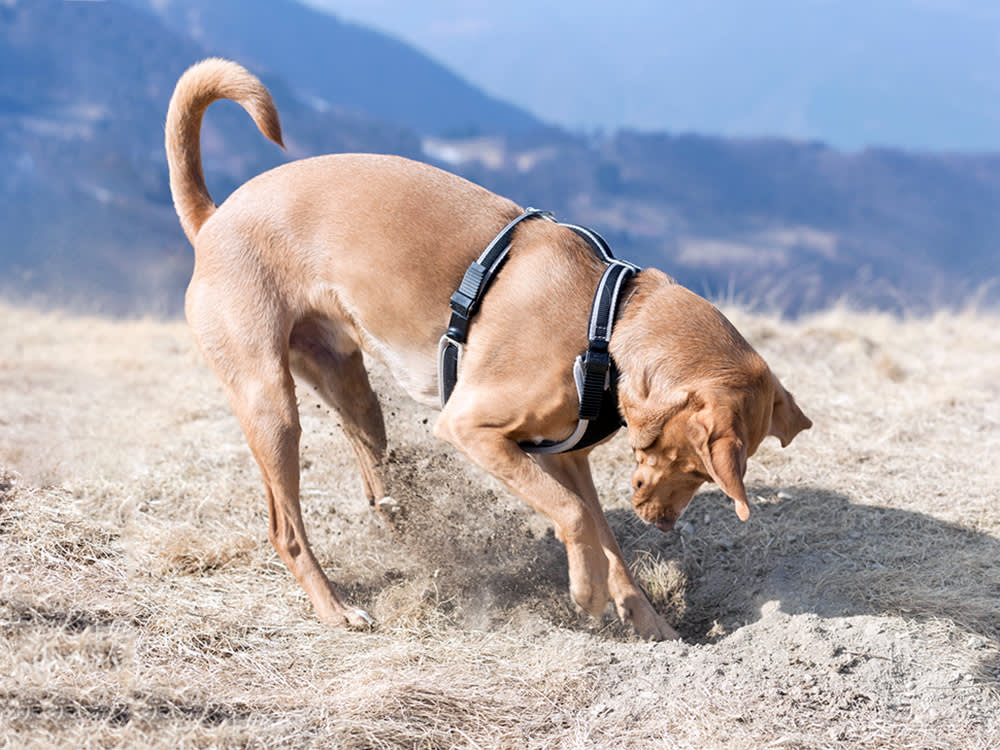
- Dig, nose into burrows, or hunt small animals
- Carry long, thick coats that trap crawling larvae against the skin
- Live in rural areas with heavy rodent populations
It is also seasonal. Cuterebra are warm-weather parasites, so the late summer and early fall, when larvae are active and dogs are spending the most time outdoors, are peak warble season. Infestations are not common overall, but they cluster in exactly these conditions.
Caring for the wound after the vet
Once the larva is out, the job becomes ordinary wound care:
- Keep the area clean and dry
- Give any prescribed antibiotics and pain medication on schedule
- Use an Elizabethan collar so your dog cannot lick or chew the site
- Watch for swelling, pus, or increasing pain, all signs of infection
- Return for a recheck if your vet asks for one
The open wound healing inward is normal and expected; it is not a sign that something went wrong.
How to keep botflies off your dog in the first place
Prevention is mostly about geography and grooming:
- Keep your dog out of tall grass, brush, and active rodent burrows during warm months
- Run your hands over your dog’s coat and skin after every outing, checking for new lumps
- Stay current on flea and tick preventatives, some of which also discourage botflies
- Keep your yard mowed and unwelcoming to nesting rodents
- Bathe regularly and use bath time as a chance to inspect the skin
The bottom line
A botfly looks revolting and feels like an emergency, but the parasite itself is usually a manageable problem. The genuine danger is the human impulse to pop it, which can turn a routine extraction into a life-threatening reaction. Leave the lump alone, get your dog to a vet for a clean, intact removal, and watch for the rare signs of internal migration. Do those three things and the worst part of a botfly will be how it looks, not what it does.
References
- Merck Veterinary Manual. “Cuterebra Infestation in Small Animals.” Integumentary System.
- PetMD. “Botflies in Dogs: What They Are and How To Treat Them.”
- Helkiö, K. M., et al. “Botfly Cephenemyia Ulrichii Larvae in the Nasal Cavity and Nasopharynx of a Dog with Respiratory Signs.” Journal of Small Animal Practice, vol. 64, no. 4, 2023, pp. 306-309.
- Park, Janice Y., et al. “Fatal Cerebral Cuterebrosis in a Dog.” Veterinary Parasitology: Regional Studies and Reports, vol. 26, 2021, p. 100636.
- Slansky, Frank. “Insect/Mammal Associations: Effects of Cuterebrid Bot Fly Parasites on Their Hosts.” Annual Review of Entomology, vol. 52, no. 1, 2007, pp. 17-36.
Common questions
What does a botfly look like on a dog?
It usually appears as a firm, swollen lump with a single small hole in the center, the larva's breathing pore. If you look closely you may see the larva shift inside the opening. It is most often found on the head, neck, or trunk.
Can humans catch botflies from dogs?
Not from the dog directly. People become accidental hosts the same way dogs do, by contacting Cuterebra eggs in the environment near rodent burrows. Your dog cannot pass its larva to you.
Are botflies harmful to dogs?
A single larva extracted cleanly is usually a minor problem. The danger comes from rupture during removal or from a larva that migrates internally to the eye, nose, or brain. Both are reasons to let a vet handle it.
What happens if you don't remove a botfly on a dog?
The larva keeps growing until it emerges on its own, but in the meantime the site can abscess, and in rare cases the larva migrates into the body. Veterinary removal is faster, safer, and far less likely to leave fragments behind.
Not a substitute for your vet. Our guidance is educational. For urgent symptoms, contact a vet or emergency clinic right away. Editorial standards
Dr. Mehta is a board-certified veterinary nutritionist who evaluates pet food formulations, ingredient quality, and the science behind dietary trends. He writes and reviews all nutrition content at The Pet Times, including our food rankings and feeding guides.
Meet our experts ↗Keep reading
 Health & WellnessThat Red Rash on Your Dog's Belly Is Trying to Point SomewhereDr. Nina Kohl · 6 min
 Health & WellnessMost Home Remedies for Dog Skin Do Nothing. Three Are Worth Keeping in the House.Dr. Nina Kohl · 11 min
 Health & WellnessYour Dog's Scooting Isn't Funny. It's a Message From the Other End.Dr. Mara Chen · 7 min
 Health & Wellness"Purebreds Get More Cancer" Is Too Simple. It's About Breed, Not PedigreeDr. Mara Chen · 5 min
 Health & WellnessThe 'Miracle' Antibiotic for the Mystery Dog Illness Isn't a Cure. It's a Last Resort.Dr. Lena Park · 6 min
 Health & WellnessThe Dog-Killing Liver Fluke Just Crossed Into California. The Map Is the Real StoryDr. Ravi Mehta · 5 min