


What Happens When a Furniture Designer Decides Your Dog's Gear Is Built Wrong
Jay Sae Jung Oh makes museum-grade furniture, but it took her heavy-pulling Frenchie to expose how disposable most pet products really are. Her brand Boo Oh is a case study in industrial-design thinking applied to the dog aisle.

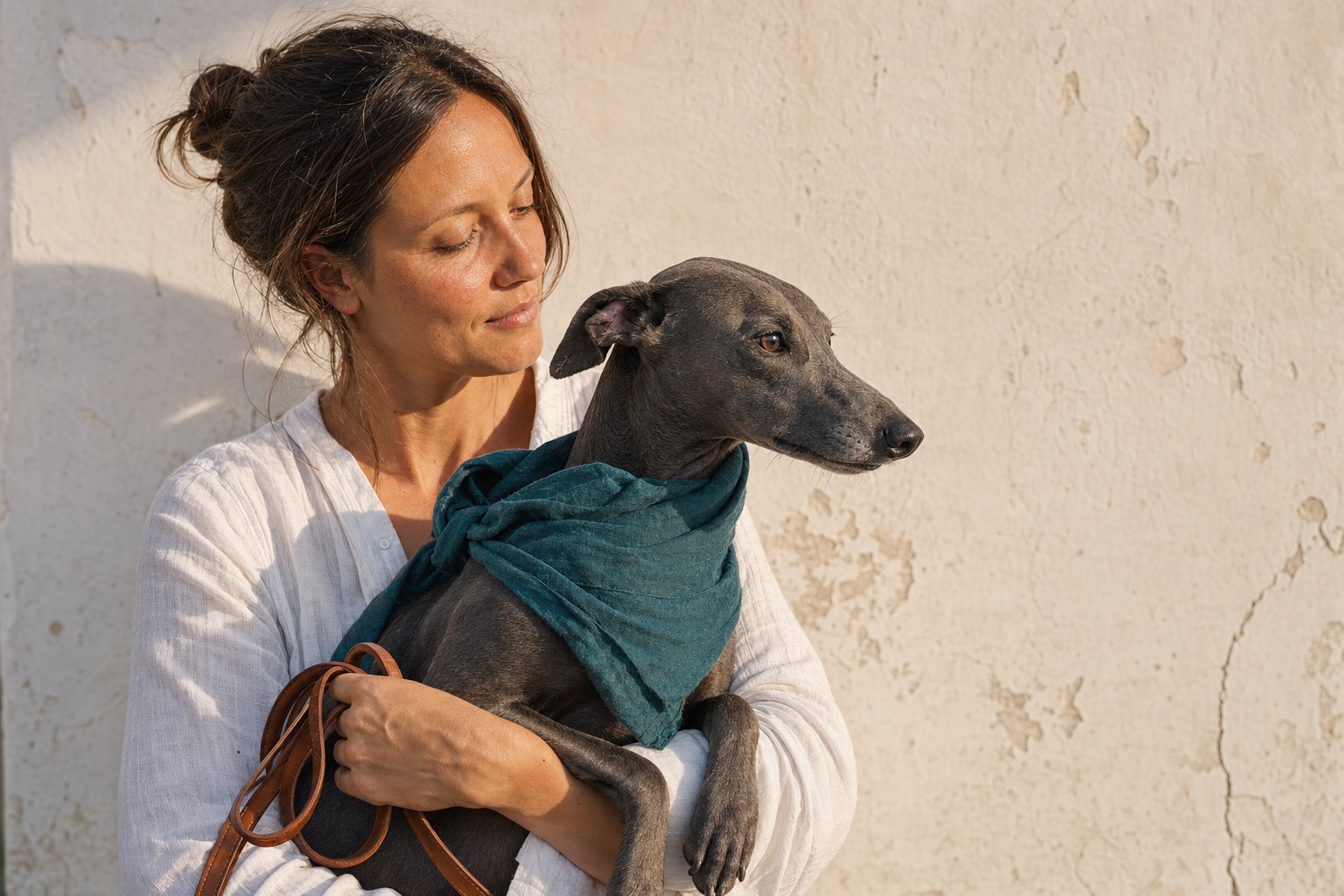
Most pet products are designed to a price, not to a problem. That single fact explains why the harness frays, why the bowl cracks, why the poop-bag holder swings into your thigh on every walk. Jay Sae Jung Oh noticed it the way only an industrial designer would, as a series of solvable failures, and then she did something most frustrated owners cannot: she redesigned all of it. Her brand, Boo Oh, named for the heavy-pulling French Bulldog who started it, is what the dog aisle looks like when someone refuses to accept that pet gear has to be cheap and disposable.
The designer behind the dog brand
Oh is not a pet-industry insider. The South Korean, Seattle-based industrial designer is best known for “sculptural castaways,” a bespoke furniture practice that rescues thrift-store debris, a chair with a snapped leg, a bicycle missing its wheels, and mummifies it in jute cord until it reads as functional art. That work earned her a feature in Architectural Digest and a Best in Show award at Design Miami. By any conventional measure, pet bowls are a strange detour for someone operating at that level. Plenty of people told her so. “A lot of people couldn’t understand why I was suddenly making pet products,” she says. “Like, why don’t you just go make furniture or household objects, utilize what you’ve built so far.”
The honest answer, she says, is not sentimental. “I am an animal lover, but that’s not it. That doesn’t make me just launch a brand. I just saw huge potential in this market and saw that there are a lot of things that I can fix.”
The dog who became the design brief
Boo supplied the problems. “She’s a super hyper Frenchie and she tears up everything so quickly,” Oh says. “Especially when I take her on a walk, the harnesses I put on her would break all the time because she is a really heavy puller.” For a designer, a dog who destroys things in an afternoon is not a nuisance so much as a stress test. “I found a lot of problem-solving opportunities,” she says. “It’s a habit. If there’s a problem I try to fix it to offer a better experience.”
Back in 2013, when she started, the market gave her plenty to fix. “There were really not that many options,” she says. “Most of the products were very price competitive, so the quality wasn’t really great. Sometimes Boo would just tear things up in a day or in a couple hours. I was kind of tired of having to keep replacing things over and over.” Even the small annoyances got the treatment. “Even the poop-bag holders, I just hated how it was always dangling, hitting my thigh when I was walking.”
Industrial-design thinking, applied to the dog aisle
What separates Boo Oh from the wall of look-alike accessories is not aesthetics, though the pieces are striking: sleek silicone bowls that are BPA-free and hypoallergenic, silk-blend and vegetable-tanned Italian leather collars and leashes in muted, neutral tones. It is the engineering discipline underneath. “That’s why we patent everything,” Oh says, treating each object as a problem with a defensible solution rather than a style to copy.
Her sourcing reflects the same mindset. “Because I’m an industrial designer, I have my own suppliers for each material,” she says. “None of our products are things that you can get from any supplier; they’re not things that you can easily find from like Alibaba or something. We know who the best supplier is for each category, and that’s something that can differentiate us from other brands.” In a category where most companies buy from the same catalogs and compete on price, controlling the supply chain by material is itself a design decision.
Durability as the real sustainability play
Ask Oh about sustainability and she does not reach for buzzwords; she reaches for longevity. The thread connecting her one-of-a-kind furniture to her mass-produced pet gear is a refusal to make things that get thrown away. “I didn’t want them to get thrown away easily, and I wanted people to use them for a long time,” she says. “It’s the same thinking basically, but the approach was very different.” Her furniture changes how a viewer sees the objects around them; her pet products quietly attack the replace-it-every-month cycle that defines the budget end of the market. A leash you keep for years is, in the most practical sense, the greener leash.
What it tells you about buying pet gear
You do not need to buy Boo Oh to take the useful lesson from it. Oh’s whole approach is a checklist for spotting genuinely well-made pet products versus expensive-looking ones:
- Material honesty. Vegetable-tanned leather, food-grade silicone, and solid hardware age well; coated synthetics and thin plastic do not. Ask what a product is actually made of, not just what color it comes in.
- Failure points. The places gear breaks are the clasps, the stitching, and the load-bearing seams on anything a strong dog pulls against. Premium is meaningless if those points are flimsy.
- Designed for the dog, not the shelf. A bowl that does not tip, a holder that does not swing, a harness that survives a heavy puller, these are solved problems, and the brands that solved them tend to say how.
- Built to last, not to repurchase. If you have replaced the same item three times, the cheaper option was never actually cheaper.
That, in the end, is the quiet argument Boo Oh makes from the dog aisle: most pet products are designed to be replaced, and they do not have to be. It took a furniture designer and one destructive little Frenchie to prove it.
References
- Architectural Digest. “This South Korean Designer Transforms Castoffs Into Sculptural Furniture.”
- Salon 94 Design. “Jay Sae Jung Oh.”
- Boo Oh. boo-oh.com.
Leila Torres leads our Living coverage, from home life and travel to the products and rescue stories that come with sharing a life with animals. She edits and writes across the section, with a soft spot for pieces about the bond between people and their pets.
Meet our experts ↗Keep reading
 LivingDoes Raising a Dog Together Prep You for a Kid? Yes and No, ExactlySara Lim · 5 min
 LivingCannes Hands Out a Golden Palm. It Also Hands Out a Dog Collar.Claire Sutton · 6 min
 LivingThe ADA Has No Breed List. Your Landlord's Insurance Does.Dr. Priya Nair · 6 min
 LivingThe Most Inclusive Room in NYC Comedy Also Lets You Bring Your DogJordan Ellis · 5 min
 LivingThe Best Thing You Can Do for Your Health Might Be Adopting a DogDr. Amara Solis · 8 min
 LivingThe Dog You Didn't Choose: How Titan Adopted Arabelle SicardiLeila Torres · 8 min