


How a Dog Grows a New Jaw: The Quiet Revolution in Canine Bone Repair
When cancer takes part of a dog's jaw, the old answer was amputation. A UC Davis team figured out how to make the bone grow back, and the technique has now rebuilt jaws in nearly 20 dogs.

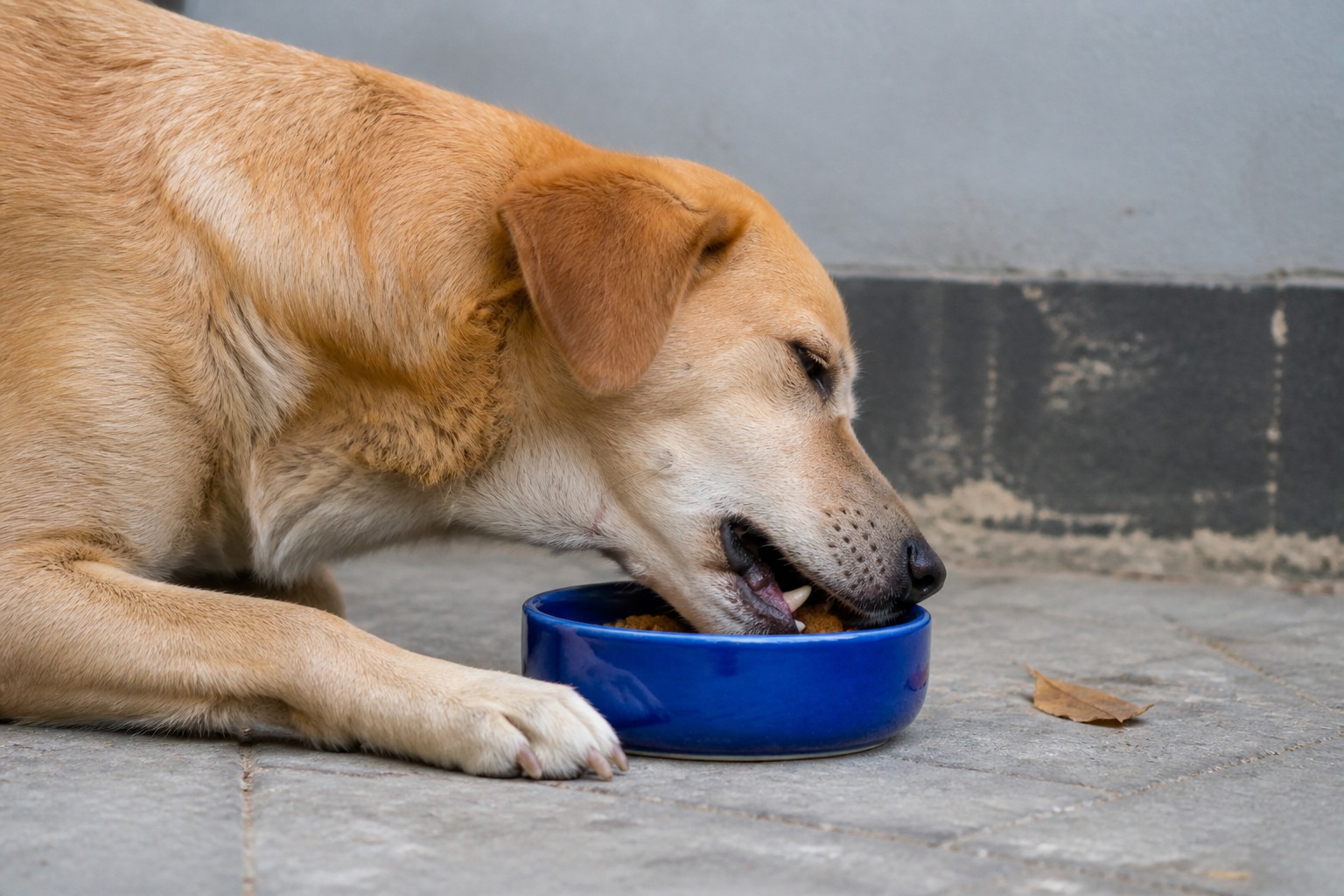
For most of veterinary history, a tumor in a dog’s jaw left two bad options on the table: cut the diseased bone out and accept a permanently altered mouth, or shave the growth down and do it again, and again, as it came back. Both treat the jaw as something you subtract from. The quiet revolution of the last decade is a third option that does the opposite. It adds bone back. A dog can now lose two and a half inches of its lower jaw to cancer and grow a replacement, made of its own living bone, over the course of a few months. The story of how that became routine is really the story of a protein, a sponge, and a stubborn idea that bone could be coaxed to rebuild itself on command.
The decision every owner with this diagnosis faces
Before the engineering, there is a diagnosis, and it is more common than most owners realize. Oral tumors are not rare in dogs, and squamous cell carcinoma is the second most common malignant one. The catch that makes it so destructive is its appetite for bone: this tumor readily invades the jaw itself, which is why so many treatments end in removing part of the jaw.
The standard of care, when the cancer has not spread, has long been a partial mandibulectomy, surgically removing the affected section of jawbone, sometimes paired with chemotherapy or radiation. Here is the encouraging part owners rarely hear up front. For oral squamous cell carcinoma caught before it travels, the numbers are genuinely good. Local recurrence after a clean-margin surgery runs under 10 percent, spread to the lungs is uncommon, and reported median survival after surgery ranges from roughly 19 to 43 months, with one-year survival as high as 88 to 100 percent in some case series. Dogs, it turns out, do remarkably well with partial jaws, and the change to their appearance is usually far less than people fear.
So the real question an owner weighs is not always “will surgery cure this.” Often it is “what kind of mouth does my dog live with afterward.” That is the gap the regeneration work set out to close.
What “growing a jaw back” actually requires
Removing a chunk of jaw and walking away leaves a problem. The remaining bone, no longer carrying its normal load, slowly resorbs. Teeth and remaining bone drift out of alignment, and in some dogs the teeth begin to ulcerate the roof of the mouth. A titanium plate can bridge the gap, but a plate spanning a large defect is itself the weak point; over time the pressure on it causes the surrounding bone to give way. The plate buys time, not a cure.
The breakthrough was figuring out how to make the gap fill with real bone. It rests on a discovery that predates the surgery by half a century. In 1948, Dr. Marshall Urist, a UCLA orthopedic surgeon, began chasing the idea that bone itself contains signals that can trigger new bone to form. By 1971 he had named the active ingredient: bone morphogenetic protein, or BMP. These proteins act like a homing beacon. Placed in the body, they pull a dog’s own stem cells toward them, and those cells convert into bone-forming cells that build new bone exactly where the protein sits. The new bone carries the same DNA as every other bone in the dog’s body. On a molecular level, it is not an implant at all. It is the dog.
Inside the operation
At the University of California, Davis, a team turned that biology into a repeatable procedure. The collaboration paired a biomedical engineer, Dr. Dan Huey, with veterinary surgeons Dr. Boaz Arzi and Dr. Frank Verstraete, who leads the school’s dentistry and oral surgery service. Their goal was to drag bone replacement out of the experimental literature and into a hospital schedule.
The operation has three parts working together, and none of them works alone:
- The plate. Surgeons first remove all of the diseased bone, then screw a custom titanium plate onto the healthy remaining jaw to hold its shape across the gap.
- The scaffold. Into the empty space goes a stiff, sponge-like scaffold. It gives the new bone a three-dimensional frame to grow into so the void does not simply fill with soft tissue.
- The signal. The scaffold is soaked in recombinant human BMP-2, a synthetic, lab-engineered version of Urist’s protein. The team uses the human form deliberately because it does not provoke an immune reaction in dogs, so there is no need to match it to an individual animal.
Then biology takes over. Within about two weeks, surgeons can feel new bone forming under the skin. By roughly three months, the gap holds new bone close to the density of the dog’s native jaw, typically over an eight-to-ten-week growth window. “What still amazes me about this is how little of it is the implant and how much of it is the dog’s own repair machinery,” says Dr. Priya Nair, who covers surgical innovation for The Pet Times. “The hardware is scaffolding in the most literal sense. You are not installing a jaw. You are giving the body a reason and a frame to build one.”
How far it has come
When the technique was first reported, it had been used on a handful of dogs over a two-year span, several of them dogs that had lost large sections of jaw to cancer. The early results held: those dogs healed with functional, well-formed jawbones. The proof of concept worked.
It did not stay small. The approach has since been refined to regrow nearly the entire arch of the lower jaw, a far more demanding reconstruction than filling a single gap. And the count has grown well past those first cases. UC Davis now reports that the procedure has rebuilt jawbones in close to 20 dogs, with the animals alive and eating normally on bone that did not exist before surgery. What began as an innovative one-off, in the words of the surgeons themselves “not an experimental study, just an innovative application of existing materials,” became a service other vets refer their patients to.
The frontier, and the honest caveats
The vets are candid about the limits, and that candor is the most useful thing for an owner to absorb. This is not a treatment for cancer that has already spread; it is offered when a tumor is local and removable, and it improves the quality of life that follows surgery rather than changing whether the cancer is curable. It is also, so far, a procedure for the jaw and not for weight-bearing bones. A jaw holds chewing forces; a leg holds up a running dog, and the technique has not yet been proven against those loads. Adapting it to limbs in dogs, and eventually to human arms and legs, is the long-range hope, not today’s reality.
There is a cost to weigh as well. The reconstruction has historically run several thousand dollars, and like all surgery it carries risk; the largest is failure of the plate across a wide span before new bone matures. For owners facing a jaw cancer diagnosis, the practical takeaway is this: ask whether your dog is a candidate for reconstruction, not only resection, and ask early, because the option that grows the jaw back is no longer science fiction. It is a Tuesday at a teaching hospital.
References
- UC Davis, “Dog Jawbones Regrown With Biomedicine Technique.”
- UC Davis School of Veterinary Medicine, “UC Davis Veterinarians Successfully Perform Nearly Complete Lower Jaw Reconstruction in a Dog.”
- UC Davis Veterinary Institute for Regenerative Cures, “Mandibular Reconstruction.”
- Veterinary Society of Surgical Oncology, “Oral SCC — Canine.”
- Veterinary Partner (VIN), “Oral Squamous Cell Carcinoma in Dogs and Cats.”
Not a substitute for your vet. Our guidance is educational. For urgent symptoms, contact a vet or emergency clinic right away. Editorial standards
Dr. Chen is a small-animal veterinarian who leads health and safety coverage at The Pet Times. She writes and reviews the bulk of our illness, condition, and safety content, translating clinical guidance into clear, practical advice owners can act on at home.
Meet our experts ↗Keep reading
 Health & WellnessYour Dog's Cancer Pill Was Built for Humans First. That's Exactly the Point.Dr. Ravi Mehta · 6 min
 Health & WellnessYou Found a Lump on Your Dog. Here's the One Thing You Can't Do About It.Dr. Nina Kohl · 8 min
 Health & WellnessYour Dog Has an Ear Infection and Money's Tight. Read This First.Dr. Priya Nair · 8 min
 Health & WellnessThe 'Miracle' Antibiotic for the Mystery Dog Illness Isn't a Cure. It's a Last Resort.Dr. Lena Park · 6 min
 Health & WellnessAcid Reflux in Dogs: Why Chasing Symptoms Fails, and What Actually WorksDr. Lena Park · 10 min
 Health & WellnessBlood From Your Dog's Rear: How to Read It in the First 60 SecondsDr. Priya Nair · 8 min