


Bloat in Dogs: The Deadly Emergency You Can Largely Prevent Before It Starts
Bloat kills fast, but the more useful fact is that a single preventive surgery can take an at-risk dog's lifetime death risk from this condition down to a fraction of a percent. Here is the prevention math, the warning signs, and the clock you are racing.

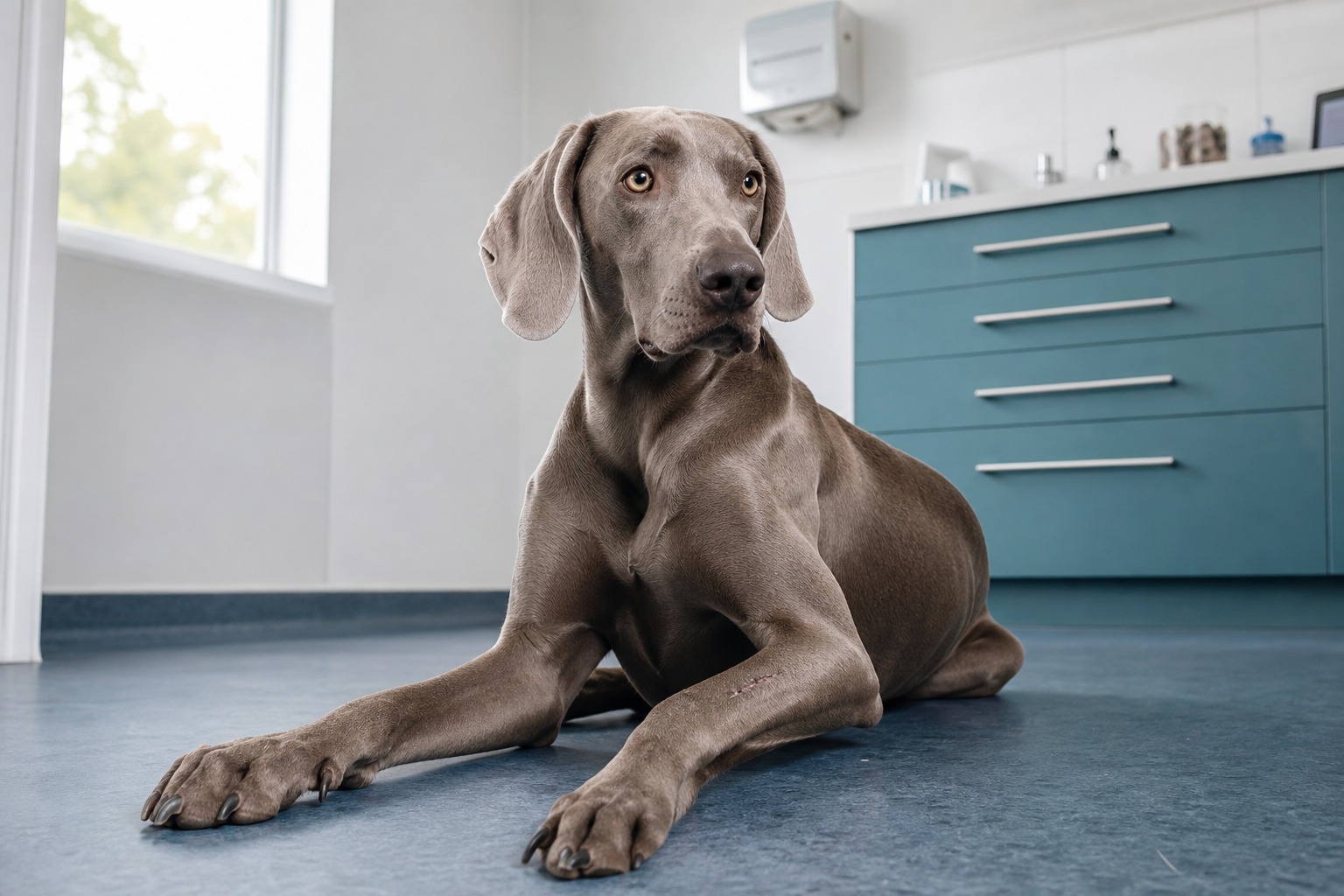
Most articles about bloat are written to help you react to it. This one is written to help you make sure you never have to. Because here is the fact that should reframe the entire condition for anyone with a deep-chested dog: bloat, the fastest-moving emergency a large breed can face, is also one of the most preventable. A single surgery, often done at the same time as a spay or neuter, can take a high-risk dog’s lifetime chance of dying from bloat from frightening to almost negligible. Knowing the warning signs matters, and we will cover every one of them. But the most powerful thing you can do about bloat happens long before any symptom appears.
First, the prevention math nobody quotes you
Bloat, formally gastric dilatation and volvulus (GDV), is the condition in which a dog’s stomach fills with gas and then twists on its own axis, sealing off both ends and choking off the blood supply to the back half of the body. Untreated, it is essentially always fatal. Even with emergency surgery, reported mortality runs anywhere from about 10 percent to as high as 33 to 45 percent depending on how sick the dog is on arrival, and one large ten-year review of nearly 500 cases found an overall mortality of 37 percent. Those are the numbers that make emergency staff move fast.
Now the other set of numbers, the ones that change what you do with this information. A preventive procedure called a prophylactic gastropexy tacks the stomach to the body wall so it physically cannot twist. In dogs who have already survived one bloat, gastropexy drops the chance of it happening again from roughly 80 percent to under 5 percent. Done preventively in a healthy at-risk dog, it cuts the lifetime risk of dying from GDV to around 0.3 percent. For a Great Dane, a breed in which an estimated 40 percent will bloat at some point, that is the difference between a coin-flip-grade lifetime threat and a rounding error. One analysis found Great Danes with a preventive gastropexy were about 30 times less likely to die of GDV than those without one.
The catch is timing. A gastropexy is a real abdominal surgery, so the smart move is to fold it into a procedure your dog is already having. For a high-risk breed, that usually means asking your vet to perform it at the same time as the spay or neuter, when your dog is already under anesthesia and the recovery is essentially the same. If your dog is already grown and unaltered, a laparoscopic (keyhole) gastropexy can be done on its own with a short recovery. This is the single most important conversation in this entire article, and it is one most owners of at-risk breeds are never prompted to have.
Is your dog actually at risk? A clear-eyed look
Prevention only makes sense if you know where your dog sits on the risk curve, and the risk is far from evenly spread. Decades of research have not pinned down exactly what triggers the twist, but they have produced a consistent profile of which dogs it strikes.
The single biggest factor is body shape. Large and giant breeds with deep, narrow chests are the classic victims: Great Danes lead the list by a wide margin, followed by German Shepherds, Doberman Pinschers, Weimaraners, Boxers, Standard Poodles, Irish Setters, and other barrel-chested dogs. A small, round dog is at very low risk; a tall dog with a chest like a wine barrel is the textbook case.
The other contributors stack on top of breed:
- Age. Risk climbs steadily as a dog gets older. It can strike young dogs and even puppies, but middle-aged and senior dogs are by far the most common patients.
- Family history. Having a first-degree relative who has bloated meaningfully raises a dog’s own odds, which points to a genetic component and is one reason responsible giant-breed breeders track it.
- Temperament. Anxious, fearful, or high-strung dogs appear to bloat more often than calm ones, an under-appreciated risk factor worth mentioning to your vet.
- Feeding setup. Eating fast, gulping air, eating a single large daily meal, and (counterintuitively) eating from a raised bowl have all been linked to higher risk in large breeds.
- Being underweight. A very lean body condition appears to predispose dogs to bloat, so “skinny” is not automatically “healthy” here.
- A foreign body in the stomach and sharp drops in temperature have each been associated with higher incidence in at least one study.
These factors are not perfectly consistent across studies, which is exactly why no single habit change fully protects a dog and why the structural fix, the gastropexy, matters so much for the highest-risk animals.
The day-to-day habits that lower the odds
For a high-risk dog who has not had a gastropexy, and for every large-breed dog in general, a handful of daily habits shave the risk further. None of them is a guarantee, and none replaces the surgery for a giant breed, but together they are worth doing:
- Split the day’s food into two or three smaller meals instead of one large one.
- Slow the eating down. A slow-feeder bowl or a food-dispensing puzzle turns a 90-second gulp into a several-minute meal and cuts the air your dog swallows.
- Keep the bowl on the floor unless your vet specifically recommends otherwise for another condition.
- Build in a calm-down window around meals. Avoid hard exercise for roughly an hour before and after eating, and discourage big gulps of water right after a meal.
- Keep weight in a healthy range, neither overweight nor too lean.
The warning signs, and why minutes matter
If prevention is the first half of this article, recognition is the second, because even a gastropexied dog can dilate (it just cannot twist), and a non-gastropexied at-risk dog can go from normal to critical in under an hour. If you know your dog’s baseline, the signs are not subtle. Treat any combination of these as a drop-everything emergency:
- Sudden restlessness and pacing. As the stomach swells, the dog cannot get comfortable and will stand up, lie down, and circle repeatedly.
- Unproductive retching. This is the most recognizable sign. The dog heaves and tries to vomit over and over but brings up nothing, or only a little foamy saliva, because the exit is sealed off. Some owners describe the sound as almost a roar.
- A swollen, hard belly. The abdomen, usually behind the ribs, may visibly distend and feel taut as a drum. In very deep-chested dogs like Great Danes it may not show at all, so do not let a normal-looking belly reassure you if the other signs are present.
- Drooling and obvious nausea, from the stretched stomach and a twisted esophagus.
- Looking at, licking, or biting at the flank.
- Labored breathing or heavy panting, as the ballooning stomach presses on the diaphragm.
- Pale gums and weakness, then collapse, as blood stops returning to the heart and the dog slides toward shock. By this stage you are well into the danger zone.
There is no home remedy for bloat and nothing to gain by waiting. If you suspect it, get in the car. Call the emergency clinic while someone else drives so the team can prepare; with a confirmed or suspected GDV, they will take your dog straight back ahead of the waiting room.
What happens at the emergency clinic
Knowing the sequence ahead of time makes a terrifying night slightly less so. When a bloated dog arrives, several things happen almost at once.
The team places IV catheters, runs in fluids, and starts pain control to fight shock, often before bloat is even confirmed, because relieving the pressure quickly can be lifesaving. They confirm the diagnosis with an abdominal X-ray, which shows GDV clearly, and draw blood to flag any systemic problems before anesthesia. To decompress the stomach, they release the trapped gas either by passing a wide tube down the throat or, when that is not possible, by inserting a large needle through the body wall directly into the stomach. This single step takes enormous pressure off the major blood vessels and is one of the biggest factors in survival.
Once GDV is confirmed, the vet has a frank conversation with the family about prognosis, cost, and what surgery involves, because this is a major operation. Roughly 80 to 85 percent of dogs who make it to surgery survive and go home. In surgery, the stomach is emptied and untwisted, the surgeon checks that the stomach wall and spleen still have a healthy blood supply (dead tissue worsens the prognosis sharply and may need to be removed), and then, crucially, performs a gastropexy then and there to prevent a recurrence. Dogs typically stay hospitalized for one to three days and go home on activity restriction for ten to fourteen days.
The bottom line
Bloat earns its reputation as one of the scariest emergencies in veterinary medicine: it is fast, it is brutal, and it disproportionately strikes the gentle giant breeds people love. But the takeaway is not just “watch for a hard belly.” It is that for a high-risk dog, you can move the odds enormously in your favor before anything goes wrong. Feed smaller, slower meals; keep your dog at a healthy weight; learn the warning signs cold; and, if you share your life with a Great Dane, a Shepherd, a Doberman, or any deep-chested giant, ask your vet about a preventive gastropexy at spay or neuter. It is the rare emergency you can largely cross off your list in advance.
References
- AKC Canine Health Foundation, “Understanding the Mortality Rate of GDV (Bloat) in U.S. Dogs.”
- VCA Animal Hospitals, “Bloat — Gastric Dilatation and Volvulus in Dogs.”
- Cornell University Riney Canine Health Center, “Gastric Dilatation Volvulus (GDV) or ‘Bloat.’”
- Ward, M.P., et al., “Benefits of Prophylactic Gastropexy for Dogs at Risk of Gastric Dilatation–Volvulus,” Preventive Veterinary Medicine.
- Glickman, L.T., et al. “Non-dietary risk factors for gastric dilatation-volvulus in large and giant breed dogs.” Journal of the American Veterinary Medical Association vol. 217, 10 (2000): 1492-9. doi:10.2460/javma.2000.217.1492.
- de Battisti, A., et al. “Gastric foreign body as a risk factor for gastric dilatation and volvulus in dogs.” Journal of the American Veterinary Medical Association vol. 241, 9 (2012): 1190-3. doi:10.2460/javma.241.9.1190.
Not a substitute for your vet. Our guidance is educational. For urgent symptoms, contact a vet or emergency clinic right away. Editorial standards
Dr. Kohl is a board-certified veterinary dentist with a particular interest in preventive oral care. She reviews all dental health content at The Pet Times and contributes practical guides on home dental routines, professional cleaning, and oral disease prevention.
Meet our experts ↗Keep reading
 Health & Wellness'Too Old to Treat' Is a Guess About a Statistic, Not Your DogDr. Ravi Mehta · 6 min
 Health & WellnessYour Dog's Poop Is a Daily Health Report. Here's How to Read ItDr. Lena Park · 8 min
 Health & WellnessMichigan's 'Mystery Dog Illness' Was Parvo All Along. The Test Was the Liar.Dr. Lena Park · 7 min
 Health & WellnessStop Watching Your Puppy Breathe. Start Counting.Dr. Lena Park · 8 min
 Health & WellnessA Warm, Dry Nose Tells You Nothing. Here's How to Actually Know Your Dog Has a Fever.Dr. Priya Nair · 6 min
 Health & WellnessPut Down the Neosporin. Your Dog Is Just Going to Eat It.Dr. Ravi Mehta · 7 min