


BARK Air Keeps Adding Routes. The More Interesting Story Is Who's Following
The dog-first airline now reaches a dozen cities and offers shared charters, but the headline isn't the map. It's that an entire category of dog-friendly air travel is forming in its wake.

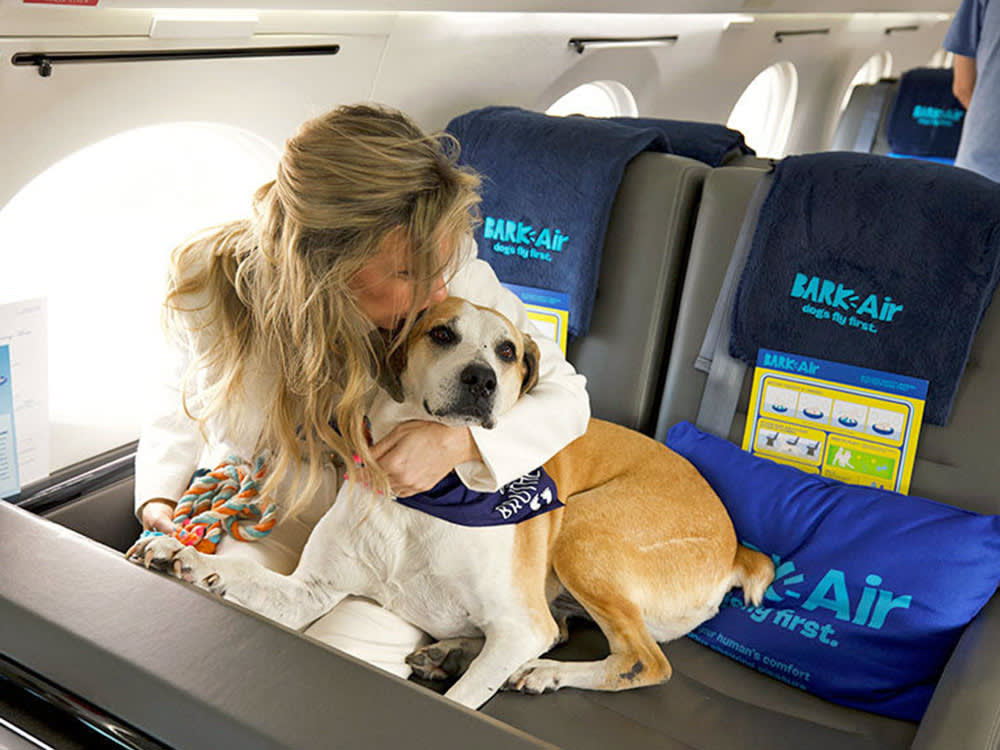
When BARK Air launched in April 2024 as the first airline built entirely around the comfort of traveling dogs, the easy take was that it was a stunt for the rich, and the easy follow-up story was “look, more routes now.” Both miss the more interesting development. In the two years since a dog first padded down its aisle, BARK Air has not just expanded its own map; it has seeded an entire category. Today there is a tier of premium dog-first flying and a budget tier forming underneath it, plus a country changing its laws so big dogs can sit in the cabin at all. That shift, not the route list, is what will actually change how most of us travel with our dogs.
Still, the route list is the obvious place to start, so let us clear it.
Where BARK Air flies now
From a launch network of just New York to Los Angeles and London, BARK Air has stretched to roughly a dozen cities. The regular schedule now centers on New York with service to and from Los Angeles, San Francisco, London, Paris, Lisbon, and Madrid, with Honolulu and Seattle added on the domestic side and Berlin and Milan filling out the European menu.
Two caveats survive the expansion. First, the network is hub-and-spoke around New York: for most destinations, and every international one, you depart from there. Second, the fares remain firmly in splurge territory. Pricing shifts by route and season, but a one-way ticket generally runs from about $6,000 to $8,000, with the longest hauls climbing into five figures. Each ticket covers one dog and one human.
The detail most coverage skips: BARK Air doesn’t fly the plane
Here is the operational fact that reframes the whole company. BARK Air is a public charter operator, not a direct air carrier. It does not own or operate any aircraft. Every flight is operated by a licensed U.S. air carrier, with BARK Air designing the experience on top. That structure is why it could scale routes so quickly, it is buying and branding charter capacity rather than running a fleet, and it is also worth knowing as a customer, because the people minding your dog at altitude work within that arrangement.
That same model produced the genuinely useful addition: shared charters. When someone books a BARK Air charter with seats to spare, those seats open to other travelers heading the same way. It is the same premium, vet-tech-on-board experience, crowdsourced so the cost is split. It will never be cheap, but it is the first version of BARK Air that is not strictly a private-jet proposition.
What you actually get for the money
Whatever you make of the price, the in-flight product is built for the dog, not the human’s bragging rights. Before travel, a concierge gathers your dog’s personality and preferences. At the gate, there is no crate and no TSA gauntlet for your pet, check-in runs around 45 minutes. Onboard, dogs are offered calming treats, calming jackets, and noise-canceling headphones, plus a beverage at takeoff and landing to ease ear pressure, since they cannot chew gum. Flight attendants and vet techs ride along to monitor each passenger. The entire premise, as the company has put it, is treating dogs as VIP guests rather than cargo, and on that narrow promise, it delivers.
The part that matters for the rest of us
You are probably not spending $11,000 to fly your dog to Berlin. The reason BARK Air still matters to you is the category forming in its slipstream.
On the budget end, RetrievAir launched in-cabin, pet-first service across a set of U.S. cities, New York, Los Angeles, Dallas, Denver, Fort Lauderdale, Tampa, Salt Lake City, Chicago, and Monterey among them, with fares from roughly $350 to $750 a seat. The model is different and far more attainable: dogs up to 40 pounds can ride in your lap, and if you fly as a pair of adults, the pet often flies free in the legroom space. It is not luxury, but it is a real flight you can actually book.
And the regulatory ground is moving too. In 2025, Italy became the first country in Europe to let medium and large dogs fly in the cabin beside their owners, dogs over 10 kilograms, in certified carriers secured to a purchased seat, with each airline filing an operational plan before it can carry them. ITA Airways moved early, allowing dogs up to 10 kilograms plus a 2-kilogram carrier on domestic Italian flights. A premium charter brand cannot change what a flag carrier is allowed to do; a law can.
The significance of BARK Air was never going to be the fare. It was the proof that demand exists for treating dogs as passengers instead of luggage. Once that is on the table, you get a budget competitor and you get lawmakers paying attention. That is how a category is born, an expensive flagship that makes the cheaper, broader version inevitable.
So yes, BARK Air added Lisbon and Madrid and a shared-charter option, and that is nice for the people who can afford it. The better news, if you are the rest of us, is everything it set in motion underneath.
References
Nina Vasquez writes about life at home with pets and the relationships at the heart of it. Her work covers day-to-day living, people-and-pet stories, and the products that fit into a real household, with a warm, grounded take on everyday pet ownership.
Meet our experts ↗Keep reading
 LivingThe CDC's Dog-Import Rules Punish the Rescues Doing Rabies Prevention RightMarcus Webb · 11 min
 LivingInside the 'Soho House for Dogs,' Where a Dog Park Costs $1,400 a YearSasha Ford · 6 min
 LivingThe Best Way to See Boston Is on the End of a LeashJordan Ellis · 4 min
 LivingYour Dog's Canoe Problem Isn't the Water. It's the Boredom.Marcus Webb · 6 min
 LivingThe Dreamy Part of Working From Anywhere With a Dog Is a Lie. Here's the Real Job.Marcus Webb · 6 min
 LivingDallas Just Lost Its Most Famous Dog Bar. The City Will Be Fine.Marcus Webb · 7 min