


An Avalanche Dog's Real Job Starts Before Anyone Is Buried
We picture avalanche dogs as last-minute lifesavers digging victims from the snow. Their bigger contribution is quieter: making an entire mountain take the danger seriously.

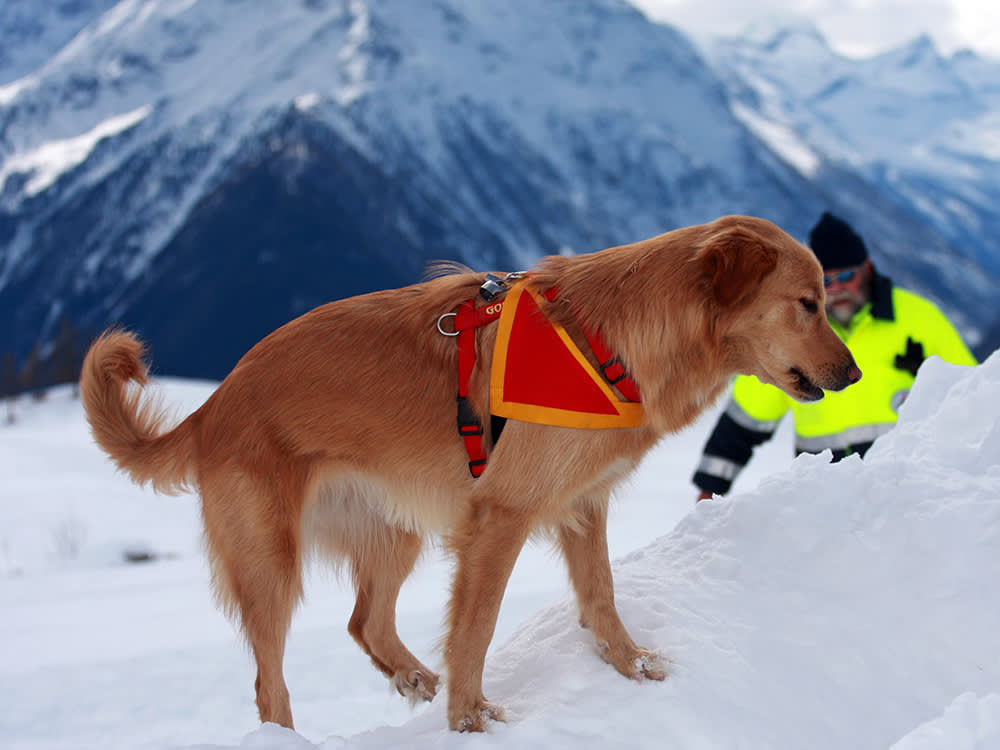
The image we carry of an avalanche rescue dog is dramatic and a little misleading: a heroic retriever bounding across the debris, nose down, hauling a survivor back from the brink in the nick of time. That happens. But it is the rarest part of the job, and fixating on it misses how these dogs actually save lives, most of which has nothing to do with digging anyone out at all.
To understand why, you have to start with a brutal clock. Then you can see why an avalanche dog’s most valuable shifts are often the days nothing happens, when its presence at the top of a lift line quietly makes hundreds of skiers think harder about the mountain they are about to drop into. This is the story of how these dogs are built and trained, and a more honest account of what they are really for.
The clock that defines everything
Avalanches do not just threaten skiers and snowboarders; snowmobilers and ice climbers die in them too. Across the United States, an average of about 27 people are killed in avalanches each year, according to the Colorado Avalanche Information Center, which keeps the country’s authoritative records. Colorado alone holds more than a million acres of avalanche terrain and a notoriously unstable snowpack.
Here is the statistic that governs the entire rescue effort. A person fully buried in an avalanche has roughly a 90 percent chance of survival if they are dug out within 15 minutes. By 30 minutes, that survival rate has already fallen to around 50 percent. The decline is steep and unforgiving: most deaths come from asphyxiation, not trauma, and the snow sets around a buried person like concrete.
That clock is the uncomfortable truth behind avalanche rescue. By the time anyone calls for help, drives a team to a trailhead, and flies a dog to the site, the highest-survival window has frequently closed. Which is exactly why the dogs’ value cannot be measured only in live finds, and why the rest of what they do matters so much.
What a deployment actually looks like
To see the live-rescue side at its best, picture a real training scenario. On a cold February morning, a Golden Retriever named Rocky and his handler, John Alfond, climb into a Flight for Life helicopter bound for Arapahoe Basin Ski Resort. Rocky, then in training with the Colorado Rapid Avalanche Deployment program, leans into Alfond during the fast, chaotic liftoff. The flight takes 12 minutes. Every one of them counts.
On the ground, ski patrol briefs the team: a man witnessed a slide sweep others away, and no one knows how many are buried. Alfond, a Vail ski patroller himself, first reads the scene for danger, wind direction, cornices, signs of a second slide, because a dead rescuer helps no one. Only once the snowpack is stable does he kneel, look Rocky in the eye, and ask, “Are you ready to work?” He unclips the leash. “Find it!”
Rocky bolts. He finds a partially buried man, alive, with head and leg injuries, and is rewarded with praise and a romp before being sent back out. Within minutes he locates two more, fully buried; Alfond determines both are deceased. Rocky is praised anyway, because his job is to “daylight” victims, to find and unbury them whether alive or not, and a dog cannot be allowed to learn that some finds disappoint his handler. Total time from stepping off the helicopter: 23 minutes.
The whole thing is a simulation; the “bodies” are ski-patrol volunteers, and the “injured man” hops off the sled to wrestle with Rocky. “He’s ready for certification,” Alfond says. The following month, Rocky certifies at Copper Mountain alongside a Labrador named Mookie and handler Caroline Stone, becoming the second and third members of Vail’s certified avalanche-dog team. “I was more stressed than Rocky was,” Alfond says. “When it comes to avy dogs, humans are the dumb end of the leash.”
How you build a dog that runs toward a disaster
A dog that will calmly board a helicopter and search a debris field is not found; it is bred and made, and the process is more deliberate than most people imagine.
Rocky’s path started before he was born. Alfond grew interested in avalanche dogs in 2009 as a rookie patroller, when Vail was testing the concept with a Golden Retriever named Henry. By his third year, the program was ready to expand, and Alfond went looking for a breeder. He chose Hunters Trace Kennel in Wyoming, where owner Marsha Greenwell had already placed four dogs into ski-patrol programs.
Greenwell’s selection criteria reveal what the work actually demands. “There are specific traits I look for in a puppy for avalanche rescue,” she says, “but the most important factor is the dog’s genetics.” She breeds dogs with pedigrees showing good health and sound joints, plus hunting or field-competition backgrounds, because those dogs tend to be intelligent, bold without being reckless, and built to keep searching long after a less driven dog would quit. From a litter she watches for pups who track scent easily, work hard, stay confident and playful, and, crucially, know when to rest.
The trait she prizes most is eye contact. “They get a lot of their instruction from us by what we’re saying to them with our eyes,” she says. “It’s how they learn to trust in scary situations, like getting into a helicopter.” She narrowed Rocky’s litter to one candidate, the male with gold yarn around his neck, by eight weeks. “She was right,” says Alfond. “Rocky is smart, has a great temperament and a strong work drive, and loves to search.”
Training then layers a game on top of that genetic foundation. Alfond built the search from the most important command in the discipline, “Find it!”, starting with Rocky simply running to him across open ground, then to him hidden behind a rock, then to him concealed downwind and located by scent alone. Snow drills followed: watching a person crawl into a snow cave, then finding someone buried completely out of sight. A stint at the prestigious WBR International Dog School in Utah, which draws instructors from Wasatch Backcountry Rescue, the Canadian Avalanche Rescue Dog Association, the Swiss Alpine Club, and the International Commission for Alpine Rescue, polished the work. Total time from puppy to CRAD certification: two years. To the dog, all of it is the best game in the world. That is the point; a dog who loves searching searches harder.
The honest reframe: presence over rescue
Now back to that brutal clock, because it is where the real value lives. The hard fact within avalanche safety is that companion rescue, victims dug out by the people they were skiing with, using transceivers and probes in the first critical minutes, saves far more lives than dog teams do, simply because the companions are already there when the window is open. A dog flown in afterward is often working past the highest-survival mark.
That does not make the dogs less important. It changes what they are important for. Their first contribution is recovery: bringing closure to families by locating victims who would otherwise stay lost under acres of snow, a genuinely meaningful job even when it is not a rescue. Their second, and arguably larger, contribution is cultural. A certified avalanche dog stationed at a resort is a visible, four-legged reminder that the mountain is dangerous. People who see the dog ask about it, learn what it does, and absorb the message: check the forecast, carry a beacon, know the terrain. The dog becomes a daily, friendly piece of safety messaging that a sign never could be.
That is the sense in which avalanche dogs make the slopes safer for everyone, not only the rare buried skier they daylight, but the thousands who never get caught because the culture around them tightened up. The most lives an avalanche dog saves may be the ones that were never in danger, because its presence helped keep them that way.
References
- Colorado Avalanche Information Center, “Statistics and Reporting” (annual U.S. avalanche fatalities)
- Brugger H et al., “Survival probability of avalanche victims over time” (the 15- and 30-minute survival curve), Resuscitation
- Colorado Rapid Avalanche Deployment (C-RAD), avalanche rescue dog program and certification standards
- Wasatch Backcountry Rescue International Dog School, training program overview
Claire Sutton writes about life with pets, from the first days home to the small daily routines that make a household work. Her reporting spans people-and-pet relationships, training basics, and the practical side of bringing a new animal into the family.
Meet our experts ↗Keep reading
 TrainingYou Can't Force a Dog Friendship. But 6 Things Stack the DeckDr. Ravi Mehta · 5 min
 Health & WellnessThe Eclipse Won't Freak Your Dog Out. You Might.Dr. Priya Nair · 5 min
 LivingMalamute or Husky? One of Them Will Redecorate Your House FasterDr. Nina Kohl · 8 min
 TrainingMore Dogs Isn't More Chaos, If You Know What Actually Starts the FightsDr. Mara Chen · 7 min
 LivingThe Dog Who Calms Olympians Needed Help Himself. How Beacon Pulled ThroughDr. Mara Chen · 4 min
 LivingThe Science Says Joy Is Agency. Give Your Dog More ChoicesJordan Ellis · 5 min