


He Had No Connection to Ukraine. He Booked the Flight Anyway.
A Sunshine Coast vet watched refugees carrying their pets across the border, asked who was helping the animals, and realized the answer was nobody. Then he drove into Irpin.
The thing that moved Dr. Lachlan Campbell was not the destruction. It was a detail in the footage that most people scrolled past.
What caught his attention, by his own account, was the animals: refugees fleeing with pets in their arms, and nobody he could see organized to help them.
He is a veterinarian on the Sunshine Coast in Queensland, Australia. He has been in practice for 13 years. He lives with his wife Richelle, who is also a vet, their two kids, Penny and William, and three dogs, Euka, Pip, and Edna. He had no connection to Ukraine whatsoever. Within a couple of days of asking that question, he had booked a flight to Poland.
He had exactly the veterinary training the situation called for, and once he sat with the problem it stopped feeling optional. Richelle, he has said, understood before he finished explaining. She knew it was something he had to do, and she backed him on it.
The plan was the border. The plan lasted about a week.
He promised Richelle he would stay on the Polish side. He meant it at the time.
At the border he worked with Polish welfare organizations, examining and treating animals coming across: the Lower Silesian Animal Protection Inspectorate and the Ada Clinic. The caseload was what you would expect from a war and also somehow worse than you would expect.
Some had been burned in explosions. One, he recalls, could not walk until he took a bullet out of her spine. Others came in crawling with parasites, starved to the bone, and badly dehydrated. One young dog had been shut in a pen for four weeks after his carers fled ahead of the advancing Russian army, and had his back legs chewed off by other dogs.
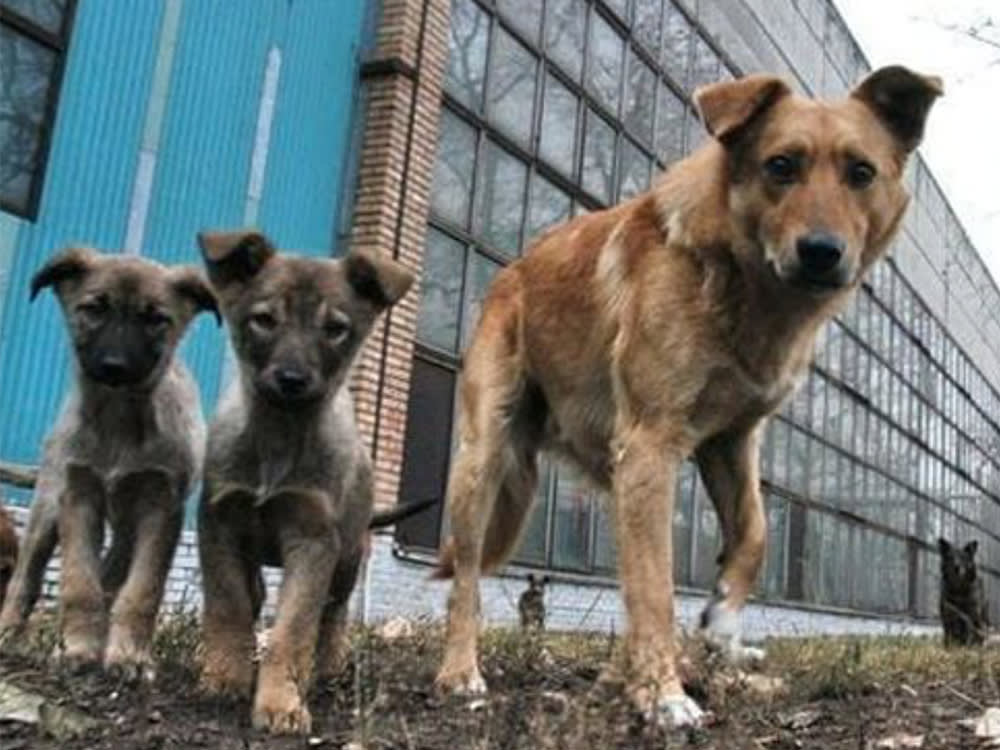
Most of the animals, though, were not war-wounded at all. They were strays who needed food, care, and somewhere to go.
Standing at the border handing out care to whatever crossed it started to feel like the wrong end of the problem. He decided, before long, that he would do more good on the far side of it, working where the animals were actually coming from.
What it is like to work inside a war
Campbell is careful not to dramatize this, and the flatness of his description makes it land harder.
He runs through the parts he never expected to live: the checkpoints manned by soldiers, the blacked-out nights when a single light could invite a bomb, the explosions somewhere off in the dark, the sirens, the climbs down into bunkers. None of it, he notes, was anything he had ever pictured for himself.
The logistics were their own war. Bridges were blown. Checkpoints slowed every journey to a crawl. A severe diesel shortage meant every kilometer had to be planned in advance. Driving at night was worse than useless: you could not clear checkpoints, and the odds of being attacked went up sharply.
Inside the country he ran a pop-up veterinary clinic in a university building in Lviv that was housing 800 refugees and their animals: dogs, cats, some reptiles and birds. People lined up and waited for a consultation.
Then he got military approval to enter Irpin, the city north of Kyiv that Russian forces had only just been pushed out of. The Ukrainian army briefed him before he went in: unexploded ordnance was everywhere, some of it visibly half-buried in the ground, and the Russians had mined the area. The day after he left, the area was closed again because of Russian saboteurs.
The searching is the part that stayed with him: over fences, through backyards, into gutted apartments, looking for anything still alive and aware the whole time that what he found might be a body.
The dog in the pen
Ask him for a highlight and he does not give you a statistic.
He describes finding a dog abandoned in her pen after artillery partially destroyed her owner’s house. She had survived three to four weeks with no food and no water. Frightened, dehydrated, malnourished. And, he says, lovely and friendly.
He also mentions the teddy bears he handed to kids while the sirens sounded, and the way their faces changed.
The rest of the work is less cinematic and probably matters more. Building a surgical theater inside a shelter. Teaching Ukrainian vets to run an ultrasound probe, a skill that stays behind after he leaves. Getting food and medicine to shelters buckling under the animals coming off the front line, which quietly helps hundreds he will never meet.
Why the animals get left
Campbell refuses to blame anyone for this, and it is the most humane note he strikes.
War touches everything, he says, and pets are family the world over. But people watching relatives die, or running from a bombed house, or simply trying to survive, are forced to put themselves and their human families first, and he does not fault them for a second. In that triage, animals slip to the bottom of the list. That slippage is precisely the space he flew into.
That is not a criticism of refugees. It is a description of a gap, and the gap is what he filled.
The money he did not ask for
He intended to fund the entire trip himself. When friends and family found out what he was doing, they asked how they could help, so he started a GoFundMe.
It raised more than $80,000 in the first weeks. By June 2022 it had reached nearly $96,000 from just over 950 donations.
He describes those hundreds of donors as an honor and a weight at once: he feels accountable for spending every dollar carefully, and for putting it straight into the animals the war has hurt rather than anywhere else.
Not being attached to any single rescue organization turned out to be an advantage. He could assess what was actually needed on the ground and move money and supplies there quickly, instead of routing it through an organizational plan written somewhere else.
What he built to outlast the trip
This is the part that separates a rescue trip from a rescue effort.
From Australia, Campbell began working with the British charity NOWZAD on redeveloping a shelter in Borodyanka, upgrading its facilities so it can perform surgery and hospitalize animals rather than just house them. He is separately supporting several Ukrainian charities with veterinary advice, supplies, food, and preventatives.
He also bought a van. It lives in Ukraine, it is shared among charities, and it moves animals, food, and supplies. It is there, as he puts it, to stay for good.
He intends to keep backing the effort for as long as it takes, and expects to be back in Ukraine before long to carry the work forward.
If you want to help, do this instead of that
Campbell is blunt that flying over is usually not the answer. Volunteer slots at charities in Ukraine, Poland, and Romania are hard to get and mostly filled by European vets. What is genuinely needed is duller and more useful.
- Support the organizations already embedded there. He names three he has worked with and trusts: the Lower Silesian Animal Protection Inspectorate, the Ada Clinic, and NOWZAD.
- Send supplies, not sentiment. Veterinary medications and consumables are the bottleneck.
- Parasite preventatives above all. Fleas, mites, worms, and ticks are a serious problem, and ticks carrying Babesia canis, a blood parasite that destroys red blood cells and can kill a dog, spike going into summer. Preventatives are needed in bulk.
- Clinics, wholesalers, and distributors can move real volume. Campbell has offered to act as the supply-chain link for anyone in the veterinary trade who wants to contribute.
The part worth stealing
There is a version of this story that is just admiration, and admiration is useless. The usable part is the shape of what he did: he found the specific gap nobody was covering, he went to it, he built supply lines instead of headlines, and then he made sure something stayed behind that works when he is not there. A trained ultrasonographer, an upgraded surgical suite, a van.
That is a template, and it does not require a plane ticket.
References
- Porter, Tracey. “Meet Dr Lachlan Campbell — the war doctor.” Vet Practice Magazine, June 2022.
- Veterinary Help to Ukraine’s Animals, GoFundMe.
- NOWZAD, UK animal welfare charity operating in Ukraine.
James Okafor covers rescue, adoption, and the causes shaping animal welfare. His work follows the people and organisations working to give more pets a home, and the issues owners and advocates care about most.
Meet our experts ↗Keep reading
 LivingAn Oklahoma Lab Didn't Just Lose Its Animals. It Lost Its LicenseNina Vasquez · 4 min
 LivingOne Fake Email Nearly Shut Down This Animal ShelterMarcus Webb · 5 min
 LivingThe Easter Bunny Is a 10-Year Commitment. Make Yours Chocolate.Nina Vasquez · 5 min
 LivingShe Was Convicted of Torturing Animals. The Law Still Called Them Hers.James Okafor · 6 min
 LivingCan't Afford to Feed Your Pet Right Now? There's a Safety Net You Can't SeeClaire Sutton · 5 min
 LivingThe 'Street Vet' Was Named CNN's Hero of the Year, Then Gave the Prize AwayMarcus Webb · 4 min